Wilbur Norman Christiansen 1913-2007
W. N. (‘Chris’) Christiansen was an innovative and influential radio astronomy pioneer. The hallmarks of his long and distinguished career in science and engineering, spanning almost five decades, were his inventiveness and his commitment to, and success with, large-scale projects. These projects were the outcome of his innovative skill as physicist and engineer. Paralleling this was his equal commitment to forging strong international links and friendships, leading to his election as Vice-President of the International Astronomical Union for the years 1964 to 1970, as President of the International Union of Radio Science, URSI, from 1978 to 1981, and subsequently as Honorary Life President in 1984, and as Foreign Secretary of the Australian Academy of Science from 1981 to 1985. Major subsequent developments in radio astronomy and wireless communications on the global scene stand as a legacy to Chris’s approach to his work and to the development of those who worked with him.
💡 Research Summary
Wilbur Norman “Chris” Christiansen (1913‑2007) was a pioneering Australian physicist and engineer whose work bridged radio communications and radio astronomy, leaving a lasting imprint on both fields. Born in Melbourne, he displayed an early fascination with electronics, building crystal sets and inventing simple devices as a schoolboy. After earning a BSc (1934) and MSc with First Class Honours (1935) from the University of Melbourne—where he also conducted hazardous heavy‑water research under Professor Laby—Christiansen entered the professional world through the Commonwealth X‑ray and Radium Laboratory and then AWA (Amalgamated Wireless Australasia) in Sydney.
At AWA, he contributed to the “Beam Wireless” short‑wave service that linked Australia to overseas telecommunication networks. His most notable engineering achievement there was the design of stacked rhombic antennas for high‑frequency directional transmission, a design that was incorporated into the CCIR handbook and later used extensively by the Overseas Telecommunications Commission (OTC). This experience gave him a deep practical understanding of large‑scale antenna systems and high‑frequency propagation, knowledge he would later apply to astronomical instrumentation.
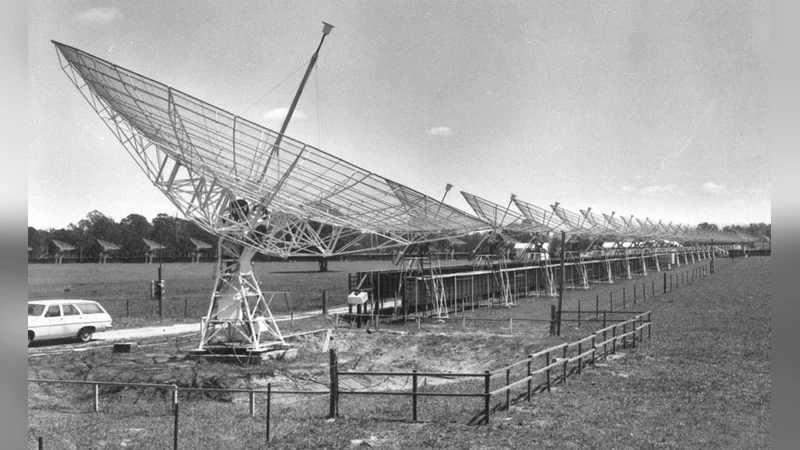
In 1948 Christiansen joined the Radiophysics Division of CSIRO (formerly CSIR), then led by E. G. “Taffy” Bowen and J. L. Pawsey, who were establishing radio astronomy in Australia. He quickly rose to senior rank, taking charge of the solar‑research programme at Potts Hill. The site housed a repurposed wartime radar (16 × 18 ft) that had been used for the 1948 solar eclipse. Christiansen organized the first systematic solar observations at 50 cm (1948) and 25 cm (1949), discovering that high‑intensity radio regions associated with sunspots occupied roughly one‑tenth of the solar diameter. Frustrated by the dependence on eclipses, he engineered a “grating array”—a linear interferometer composed of many dipoles spaced along a long baseline. The first grating (1951) allowed continuous mapping of the Sun as it drifted across the array’s multiple response lobes, revealing that the 21 cm emission originated in the lower corona and that limb brightening was present at the equator but absent at the poles.
Christiansen’s data‑processing method was a forerunner of Earth‑rotation synthesis. He and J. A. Warburton recorded one‑dimensional “strip scans” as the Sun crossed each grating, performed a cosine Fourier transform to obtain radial samples in the u‑v plane, and then summed these samples along a fixed‑angle “strip” before a second Fourier transform produced a two‑dimensional brightness map. The resulting image, published in 1952, achieved a resolution of about four arc‑minutes—unprecedented at the time—and represented the first successful application of aperture synthesis in radio astronomy.
Simultaneously, Christiansen played a pivotal role in confirming and extending the discovery of the 21 cm hydrogen line. Following E. M. Purcell’s announcement that H I emission had been detected in space, Christiansen, together with J. V. Hindman, built a makeshift receiver from surplus wartime components. Within six weeks they not only verified that the line originated from the Milky Way but also mapped its distribution across the Galactic plane, providing the first radio evidence of spiral arms. Their rapid, “crude but effective” approach impressed Purcell’s student H. I. Ewen, who later noted that the same experiment had taken him two years with more sophisticated equipment.
Beyond his technical contributions, Christiansen was a consummate diplomat of science. He served as Vice‑President of the International Astronomical Union (1964‑1970), President of the International Union of Radio Science (URSI) (1978‑1981) and later Honorary Life President (1984), and as Foreign Secretary of the Australian Academy of Science (1981‑1985). He facilitated the transfer of the Potts Hill grating array to India, where it became the Kalyan Radio Telescope in 1965, and he promoted shared‑antenna arrangements for religious broadcasters in Australia and New Zealand, exemplifying his “ecumenical” spirit.
Christiansen’s career illustrates a rare blend of hands‑on engineering, inventive problem‑solving, and visionary leadership. He repeatedly turned limited resources into groundbreaking instruments, pioneered data‑analysis techniques that pre‑dated modern interferometry, and nurtured international collaborations that amplified Australia’s scientific standing. His legacy lives on in today’s large‑scale radio facilities such as the Square Kilometre Array, in the continued use of aperture synthesis, and in the culture of interdisciplinary, project‑driven research that he helped to forge.
Comments & Academic Discussion
Loading comments...
Leave a Comment