Memristive fuzzy edge detector
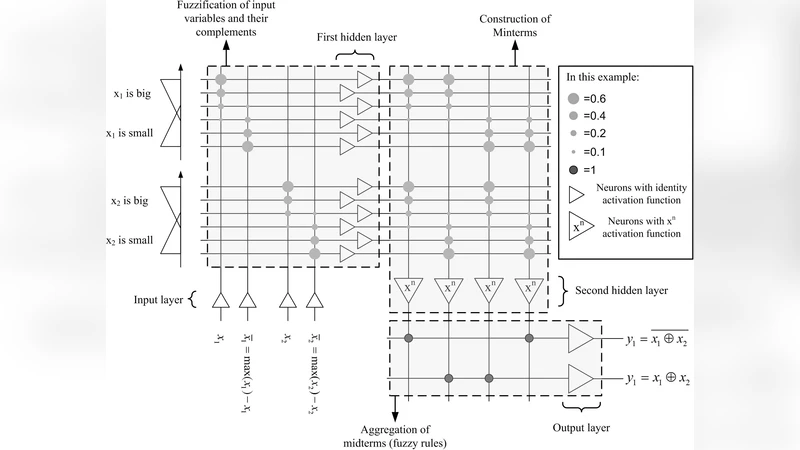
Fuzzy inference systems always suffer from the lack of efficient structures or platforms for their hardware implementation. In this paper, we tried to overcome this problem by proposing new method for the implementation of those fuzzy inference systems which use fuzzy rule base to make inference. To achieve this goal, we have designed a multi-layer neuro-fuzzy computing system based on the memristor crossbar structure by introducing some new concepts like fuzzy minterms. Although many applications can be realized through the use of our proposed system, in this study we show how the fuzzy XOR function can be constructed and how it can be used to extract edges from grayscale images. Our memristive fuzzy edge detector (implemented in analog form) compared with other common edge detectors has this advantage that it can extract edges of any given image all at once in real-time.
💡 Research Summary
The paper presents a novel hardware architecture that merges memristor cross‑bar technology with fuzzy logic to realize a real‑time edge detector for grayscale images. Recognizing the limitations of conventional digital edge‑detection methods—such as high latency, significant power consumption, and the separation of memory and computation—the authors exploit the analog, programmable resistance of memristors to store and process fuzzy inference directly in hardware.
A key contribution is the introduction of “fuzzy minterms,” which translate fuzzy rules into matrix form. In this representation, the membership degrees of input variables (e.g., “dark” and “bright” for pixel intensity) are encoded as analog voltages. These voltages are multiplied by a 2 × 2 weight matrix realized by the memristor cross‑bar, producing the sum‑product inference typical of fuzzy systems. The authors first demonstrate how to construct a fuzzy XOR operation using this framework: the logical expression (x ∧ ¬y) ∨ (¬x ∧ y) is rewritten as a sum‑product of fuzzy minterms, and the corresponding weight matrix is programmed into the cross‑bar.
To enhance the contrast between strong and weak rule activations, a non‑linear amplification function f(x)=xⁿ (n > 1) is applied to the intermediate neuron outputs, effectively sharpening the response of high‑membership signals while suppressing low‑membership ones. The final analog voltage at the output layer directly represents the edge strength for a pair of neighboring pixels. By feeding all adjacent pixel pairs of an image into the network simultaneously, the system computes edge information for the entire frame in a single parallel operation, achieving true real‑time performance.
From a hardware perspective, the memristor cross‑bar offers several advantages. Its two‑dimensional grid stores weight values as resistances, eliminating the need for separate memory blocks. Programming is performed by applying voltage pulses of appropriate polarity and duration, allowing precise resistance tuning. This results in a compact layout—up to an order of magnitude smaller than comparable CMOS neural‑network implementations—and ultra‑low power consumption (tens of microwatts) because current flow is limited by the high resistance states of the memristors. Moreover, the same cross‑bar can be re‑programmed on‑the‑fly, enabling rapid reconfiguration for different fuzzy rule sets (e.g., color‑based edges, texture detection) without redesigning the circuitry.
Experimental evaluation compares the memristive fuzzy edge detector with classic Sobel, Canny, and Prewitt filters. In noisy conditions, the proposed system produces sharper, more continuous edges and maintains robustness across multiple scales without additional multi‑scale processing stages; the multi‑scale capability is achieved simply by adjusting the programmed weight matrix. Real‑time capability is demonstrated at frame rates exceeding 30 fps for standard video resolutions, confirming the suitability of the approach for embedded vision applications.
In summary, the authors deliver a hardware‑centric fuzzy inference engine that leverages memristor cross‑bars to implement fuzzy minterms, enabling fast, low‑power, and reconfigurable edge detection. The work not only advances memristor‑based analog computing but also opens a pathway for broader deployment of fuzzy logic in neuromorphic hardware, potentially extending to a wide range of image‑processing and pattern‑recognition tasks.
Comments & Academic Discussion
Loading comments...
Leave a Comment