Reduction in X does not agree with Intersection and Union Types (Extended abstract)
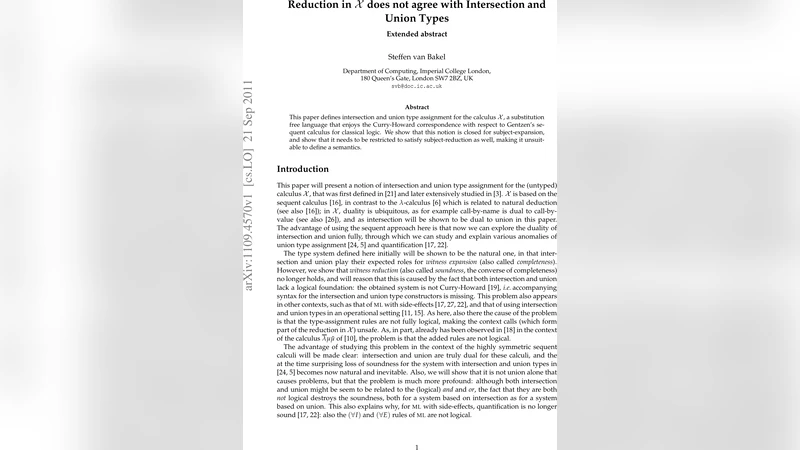
This paper defines intersection and union type assignment for the calculus X, a substitution free language that enjoys the Curry-Howard correspondence with respect to Gentzen’s sequent calculus for classical logic. We show that this notion is closed for subject-expansion, and show that it needs to be restricted to satisfy subject-reduction as well, making it unsuitable to define a semantics.
💡 Research Summary
The paper investigates the addition of intersection (∩) and union (∪) types to the calculus X, a substitution‑free language that directly mirrors Gentzen’s sequent calculus for classical logic. X distinguishes two kinds of connectors—sockets (inputs) and plugs (outputs)—and its reduction rules are expressed through logical cuts, activation, and propagation, reflecting the duality of call‑by‑name and call‑by‑value.
First, the authors extend the simple implicative type system of X with the constructors ∩ and ∪, together with the constants ⊤ (top) and ⊥ (bottom). Types are generated by the grammar
A ::= ϕ | ⊤ | ⊥ | (A→A) | (A∩A) | (A∪A).
A preorder ≤ is introduced as the smallest relation satisfying the usual idempotent, commutative and associative laws for ∩ and ∪, together with ⊤ being the greatest element and ⊥ the least. Equality of types is taken modulo the induced equivalence ∼.
The typing judgments have the form P ··· Γ ⊢ Δ, where Γ and Δ are contexts assigning types to free sockets and plugs of the net P. The original X rules (cap, imp, exp, cut) are retained, and new rules for ∩‑introduction, ∩‑elimination, ∪‑introduction, ∪‑elimination, and the handling of ⊤/⊥ are added. Notably, no subtyping rule for arrow types is included; the system deliberately avoids the usual contravariant/subtype interaction between → and ∩/∪.
The main metatheoretic results are:
-
Subject‑expansion holds. If a net P is typable and reduces to Q (P → Q), then Q is typable with the same contexts. This shows that the extended system is closed under the forward direction of reduction, even with intersection and union.
-
Subject‑reduction fails in general. When a reduction step involves an activated cut that propagates through a net containing ∩ or ∪ types, the typing contexts can become “unsafe”: the type assigned to a socket or plug may no longer be derivable after the step. The failure is traced to the lack of a logical foundation for the ∩ and ∪ constructors; there are no Curry‑Howard‑corresponding inference rules that would guarantee preservation of types across cut‑elimination.
To remedy the failure, the authors propose two kinds of restrictions:
-
Restricting activation – e.g., allowing only the (a†) rule (call‑by‑value style) for certain cuts, or only the (†a) rule (call‑by‑name style). This yields two distinct reduction strategies (CBV and CBN) that each preserve typing, but at the cost of losing confluence and expressive power.
-
Typing only normal forms – by adjusting the typing rules so that only nets in normal form receive types. This eliminates the problematic reductions but makes the system unsuitable as a semantics for the whole language.
The paper also surveys related work on intersection and union types in other classical sequent‑based calculi (λµ, λµ˜µ) and in ML with side‑effects, noting that the same unsoundness appears whenever the type constructors are not grounded in a logical system.
In conclusion, the authors argue that simply grafting ∩ and ∪ onto X without a proper logical justification leads to an unsound type system: subject‑reduction cannot be guaranteed unless the system is severely restricted. This highlights a broader lesson for type‑theoretic research—intersection and union types must be accompanied by a Curry‑Howard‑compatible logical framework if they are to support robust semantics, subject‑reduction, and practical static analysis. Future work is suggested to develop such logical foundations, perhaps by enriching the sequent calculus with dedicated inference rules for ∩ and ∪ or by exploring alternative type‑orderings that respect arrow types.
Comments & Academic Discussion
Loading comments...
Leave a Comment