Characterization of accessibility for affine connection control systems at some points with nonzero velocity
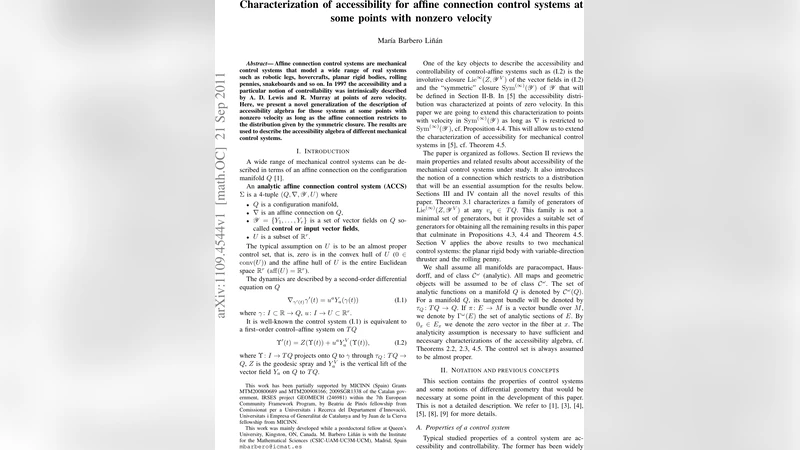
Affine connection control systems are mechanical control systems that model a wide range of real systems such as robotic legs, hovercrafts, planar rigid bodies, rolling pennies, snakeboards and so on. In 1997 the accessibility and a particular notion of controllability was intrinsically described by A. D. Lewis and R. Murray at points of zero velocity. Here, we present a novel generalization of the description of accessibility algebra for those systems at some points with nonzero velocity as long as the affine connection restricts to the distribution given by the symmetric closure. The results are used to describe the accessibility algebra of different mechanical control systems.
💡 Research Summary
The paper addresses a fundamental gap in the theory of affine connection control systems (ACCS): while the accessibility algebra for such systems has been fully characterized at points of zero velocity (the so‑called “rest” configuration) by Lewis and Murray (1997), no intrinsic description existed for points where the system possesses a non‑zero velocity. The authors fill this gap by extending the intrinsic characterization of the accessibility distribution to a class of non‑zero velocity points, under the natural geometric condition that the affine connection ∇ restricts to the distribution generated by the symmetric closure of the control vector fields.
The work begins with a concise review of ACCS. An ACCS Σ is a quadruple (Q,∇,Y,U) where Q is an analytic configuration manifold, ∇ an affine connection, Y={Y₁,…,Yᵣ} a set of analytic control vector fields, and U⊂ℝʳ an almost‑proper control set (zero belongs to the convex hull and the affine hull of U is the whole ℝʳ). The second‑order dynamics ∇{γ′}γ′ = Σₐ uᵃ Yₐ(γ) are equivalently written as a first‑order system on the tangent bundle TQ: Υ′ = Z(Υ) + Σₐ uᵃ Yᵥₐ(Υ), where Z is the geodesic spray associated with ∇ and Yᵥₐ denotes the vertical lift of Yₐ. Reachability sets R(v_q,T) and their interior are defined in the usual way, leading to the standard definition of accessibility: Σ is accessible from v_q iff the Lie algebra generated by Z and the vertical lifts Yᵥₐ spans the whole tangent space T{v_q}TQ.
The classical result (Theorem 2.3) for zero‑velocity points states that Lie∞(Z,Yᵥ)_{0_q} = Lie∞(Sym∞(Y))_q ⊕ Sym∞(Y)_q, where Sym∞(Y) is the smallest distribution containing Y and closed under the symmetric product h_XY = ∇_X Y + ∇_Y X. Consequently, accessibility at 0_q is equivalent to Sym∞(Y)_q = T_qQ.
The novelty of the present paper lies in extending this decomposition to points v_q with non‑zero velocity. The key geometric hypothesis is that the affine connection ∇ “restricts” to the distribution D = Sym∞(Y); that is, ∇_X Y ∈ Γ(D) for every X∈Γ(TQ) and Y∈Γ(D). Under this hypothesis D becomes geodesically invariant, which is equivalent to the closure of D under the symmetric product. Proposition 2.4 shows that the curvature endomorphism R(u,v) preserves D, reinforcing the invariance property.
Section III introduces a systematic set of “primitive brackets” that generate the full Lie algebra Lie∞(Z,Yᵥ) at any v_q∈TQ. Theorem 3.1 proves that every element of Lie∞(Z,Yᵥ)_{v_q} can be expressed as a linear combination of four families:
- The spray Z itself.
- The vertical lift A_{v_q} = (Sym∞(Y))ᵥ_{v_q}.
- The family B_{v_q} = { ad_Z^ℓ (Sym∞(Y))ᵥ_{v_q} | ℓ ∈ ℕ∪{0} }, i.e., repeated Lie brackets of Z with the vertical lifts of Sym∞(Y).
- The Lie closure C_{v_q} = Lie∞({ ad_Z^ℓ (Sym∞(Y))ᵥ | ℓ ∈ ℕ })_{v_q}, which is the smallest involutive distribution containing B but not A.
The proof proceeds by induction on the length of Lie brackets, using the Jacobi identity and the algebraic properties of the symmetric product. Crucially, brackets of the form
Comments & Academic Discussion
Loading comments...
Leave a Comment