Nonlinear Robust Tracking Control of a Quadrotor UAV on SE(3)
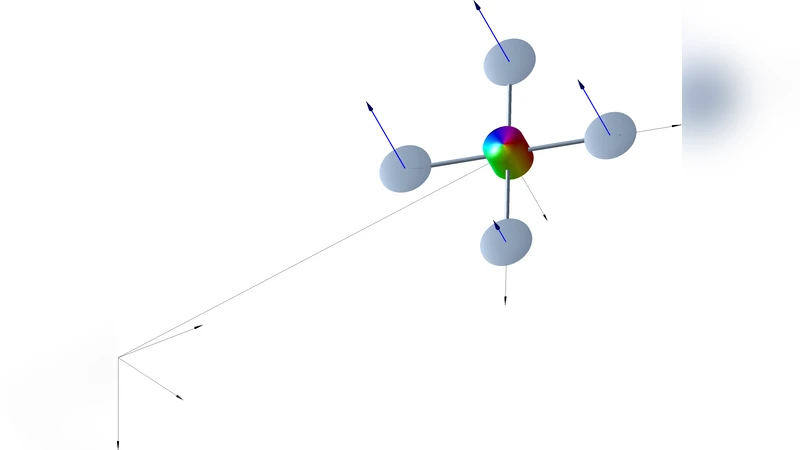
This paper provides nonlinear tracking control systems for a quadrotor unmanned aerial vehicle (UAV) that are robust to bounded uncertainties. A mathematical model of a quadrotor UAV is defined on the special Euclidean group, and nonlinear output-tracking controllers are developed to follow (1) an attitude command, and (2) a position command for the vehicle center of mass. The controlled system has the desirable properties that the tracking errors are uniformly ultimately bounded, and the size of the ultimate bound can be arbitrarily reduced by control system parameters. Numerical examples illustrating complex maneuvers are provided.
💡 Research Summary
The paper presents a rigorous nonlinear robust tracking control framework for quadrotor unmanned aerial vehicles (UAVs) formulated on the special Euclidean group SE(3). By modeling both translational and rotational dynamics on this manifold, the authors avoid the singularities inherent in Euler‑angle representations and the double‑cover ambiguity of quaternion‑based methods. The quadrotor dynamics are expressed as
\dot x = v, m\dot v = mg e₃ – f R e₃ + Δₓ,
\dot R = R ĤΩ, J\dot Ω + Ω×JΩ = M + Δ_R,
where x∈ℝ³, v∈ℝ³, R∈SO(3), Ω∈ℝ³, f is total thrust, M is the body‑fixed moment, and Δₓ, Δ_R are unknown but bounded disturbances (‖Δₓ‖≤δₓ, ‖Δ_R‖≤δ_R).
Two flight modes are defined: (i) an attitude‑controlled mode that tracks a desired attitude trajectory R_d(t) and its angular velocity Ω_d(t); (ii) a position‑controlled mode that tracks a desired position trajectory x_d(t) together with its velocity and acceleration. Because a quadrotor has only four independent inputs, it cannot simultaneously achieve asymptotic tracking of all six degrees of freedom; the hybrid architecture switches between the two modes while preserving almost‑global stability.
Attitude‑controlled mode.
The authors introduce an attitude error function Ψ(R,R_d)=½ tr(I–R_dᵀR) and associated error vectors
e_R = ½ (R_dᵀR – RᵀR_d)∨, e_Ω = Ω – RᵀR_d Ω_d.
Ψ is locally positive‑definite and its critical points consist of the desired attitude and its antipodal rotations (180° away). The control moment is designed as
M = –k_R e_R – k_Ω e_Ω + Ω×JΩ – J(ĤΩ RᵀR_d Ω_d – RᵀR_d \dot Ω_d) + μ_R,
with a robust compensation term
μ_R = –δ_R² e_A / (δ_R‖e_A‖+ε_R), e_A = e_Ω + c₂ J⁻¹ e_R.
The term μ_R is a sliding‑type element that counteracts the unknown torque disturbance Δ_R. By constructing a Lyapunov candidate that includes kinetic energy, the error function Ψ, and cross terms, the authors derive matrix inequalities (involving k_R, k_Ω, c₂, ε_R, and the inertia eigenvalues) that guarantee uniform ultimate boundedness (UUB) of (e_R, e_Ω). The bound can be made arbitrarily small by reducing ε_R, and exponential convergence is obtained if ε_R decays exponentially. The initial condition requirement Ψ(R(0),R_d(0))<ψ₂<2 corresponds to an initial attitude error of less than 180°, thus the result holds almost globally.
Position‑controlled mode.
A desired position x_d(t) and its derivatives are given. Position and velocity errors are defined as e_x = x – x_d, e_v = v – \dot x_d. A “computed attitude” R_c(t) is constructed so that its third body axis aligns with a desired thrust direction
b_{3c} = –
Comments & Academic Discussion
Loading comments...
Leave a Comment