Periodic sequences with stable $k$-error linear complexity
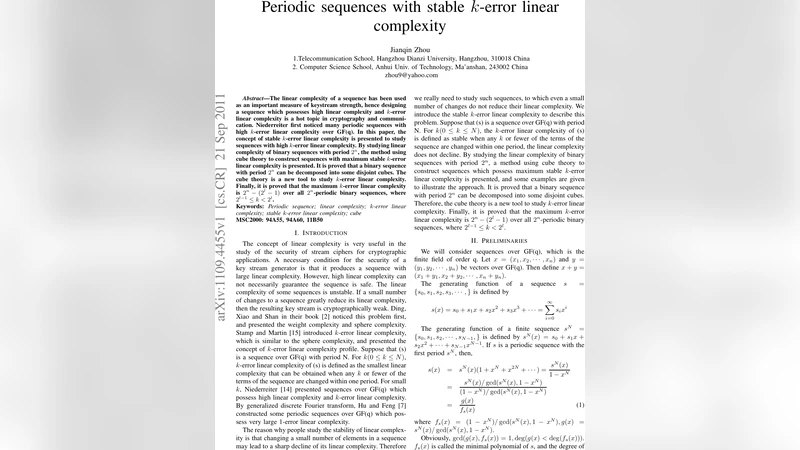
The linear complexity of a sequence has been used as an important measure of keystream strength, hence designing a sequence which possesses high linear complexity and $k$-error linear complexity is a hot topic in cryptography and communication. Niederreiter first noticed many periodic sequences with high $k$-error linear complexity over GF(q). In this paper, the concept of stable $k$-error linear complexity is presented to study sequences with high $k$-error linear complexity. By studying linear complexity of binary sequences with period $2^n$, the method using cube theory to construct sequences with maximum stable $k$-error linear complexity is presented. It is proved that a binary sequence with period $2^n$ can be decomposed into some disjoint cubes. The cube theory is a new tool to study $k$-error linear complexity. Finally, it is proved that the maximum $k$-error linear complexity is $2^n-(2^l-1)$ over all $2^n$-periodic binary sequences, where $2^{l-1}\le k<2^{l}$.
💡 Research Summary
The paper addresses a fundamental problem in stream‑cipher design: constructing periodic sequences that not only have high linear complexity but also retain that complexity when a limited number of symbols are altered. While high linear complexity (the length of the shortest linear feedback shift register that generates the sequence) is a classic measure of keystream strength, it can be fragile—changing a few bits may dramatically lower the complexity, making the keystream vulnerable. To capture this robustness, the authors introduce the notion of stable k‑error linear complexity: a sequence’s linear complexity remains unchanged for any modification of at most k symbols within one period.
The authors focus on binary sequences with period N = 2ⁿ. They first recall standard definitions: the generating function, the minimal polynomial fₛ(x) = (1−xᴺ)/gcd(sᴺ(x), 1−xᴺ), and the linear complexity L(s) = deg fₛ(x). For N = 2ⁿ, the factor (1−x) appears with multiplicity equal to the number of times the Hamming weight of a period is even; consequently, L(s) = N if the period’s Hamming weight is odd, otherwise L(s) = N − ν where ν is the exponent of (1−x) dividing sᴺ(x).
A key technical contribution is the cube theory. The authors define a cube E_{ij} as a binary sequence of period 2ⁿ that contains exactly two non‑zero positions i and j, with the distance j−i = 2ʳ·(2a+1) for some integers r ≥ 0, a ≥ 0. Lemma 2.3 shows that L(E_{ij}) = 2ⁿ − 2ʳ. Thus each cube contributes a well‑controlled amount to the overall linear complexity. By superposing several disjoint cubes (i.e., cubes whose non‑zero positions do not overlap), any binary sequence of period 2ⁿ can be expressed as a sum of such elementary components. Lemma 2.2 establishes that the linear complexity of a sum is the maximum of the individual complexities unless two components share the same complexity, in which case the sum’s complexity drops strictly.
Using these building blocks, the paper derives exact formulas for the maximum stable k‑error linear complexity for small k. For k = 1, Theorem 2.1 proves that the maximum is 2ⁿ − 1, achieved by a sequence with exactly two adjacent ones. For k = 2, a detailed analysis of four‑non‑zero‑position sequences (two cubes) yields a maximum of 2ⁿ − 3 (Theorem 2.3). Lemma 2.4 and Lemma 2.5 enumerate all possible relative distances among the four positions and show how each configuration influences the resulting complexity.
The central result, Theorem 2.3 (also referred to as Theorem 2.3 in the paper), generalizes to arbitrary k. Let l be the unique integer such that 2^{l‑1} ≤ k < 2^{l}. The authors prove that the maximum stable k‑error linear complexity over all 2ⁿ‑periodic binary sequences equals
L_max(k) = 2ⁿ − (2^{l} − 1).
The proof proceeds by constructing a sequence composed of 2^{l‑1} disjoint cubes, each of order r = l‑1, arranged so that any set of at most k altered bits cannot eliminate all cubes of a given order. Consequently, the linear complexity can drop by at most (2^{l} − 1). Conversely, they show that any sequence achieving a higher stable k‑error linear complexity would contradict the combinatorial limits imposed by the cube decomposition.
Section 3 extends the construction to larger numbers of cubes, e.g., eight non‑zero positions (four cubes) yielding a complexity of 2ⁿ − 7 (Lemma 3.1). The authors illustrate how to systematically increase the number of cubes while controlling the distances, thereby achieving the theoretical upper bound for any prescribed k.
The paper concludes by emphasizing that cube theory provides a transparent algebraic framework linking the factorization of the generating polynomial with the combinatorial arrangement of non‑zero symbols. This framework not only yields tight bounds on stable k‑error linear complexity but also offers a constructive method for designing keystreams that are provably resistant to limited‑error attacks. The results fill a gap between high linear complexity and practical robustness, offering a valuable tool for cryptographers designing stream ciphers and for analysts assessing the security of existing sequences.
Comments & Academic Discussion
Loading comments...
Leave a Comment