Idempotent splittings, colimit completion, and weak aspects of the theory of monads
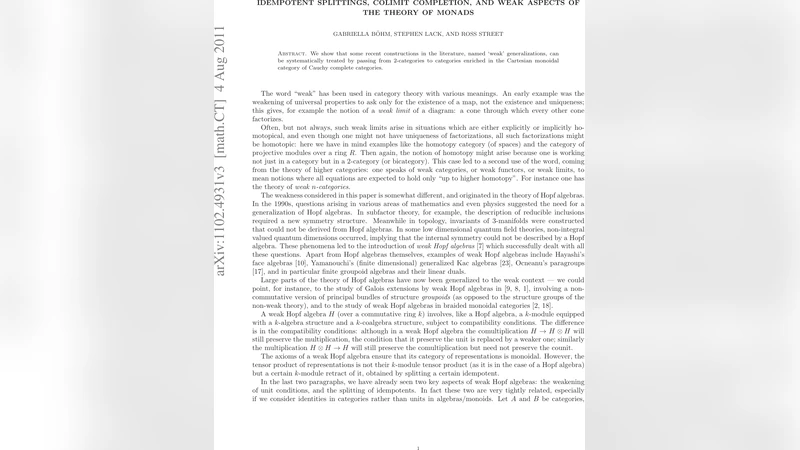
We show that some recent constructions in the literature, named `weak’ generalizations, can be systematically treated by passing from 2-categories to categories enriched in the Cartesian monoidal category of Cauchy complete categories.
💡 Research Summary
The paper develops a unified categorical framework for a variety of “weak” constructions that have appeared in recent algebraic and topological literature, especially in the theory of weak Hopf algebras and related quantum structures. The central idea is to replace ordinary 2‑categories by their Cauchy completions—categories obtained by freely splitting all idempotent 2‑cells. This process is captured by a monad Q on Cat and its 2‑dimensional extension Q∗ on 2‑Cat.
The authors begin by introducing semicategories (directed graphs with associative composition but no identities) and semifunctors (graph homomorphisms preserving composition but not identities). They show that a semifunctor A → B is exactly a functor A → QB, where QB = R U B is the Cauchy completion of B obtained by freely splitting idempotents. Thus the Kleisli category of the monad Q on Cat can be regarded as the category of “generalized functors” that ignore identities.
Extending to the 2‑categorical setting, Q∗ sends a 2‑category K to a new 2‑category Q∗K with the same objects and hom‑categories Q(K(A,A)). Because Q preserves finite products, Q∗K retains the necessary monoidal structure on each hom‑category, which allows the authors to define weak versions of many familiar concepts simply by applying Q∗ first and then using the ordinary definition.
A key illustration is the notion of a weak monoid (called a demimonoid). Given a monoidal category (B,⊗,I), the Cauchy completion QB inherits a monoidal structure with tensor (b,ρ)⊗′(b′,ρ′) = (b⊗b′, ρ⊗ρ′) and unit (I, q I). A demimonoid in B is precisely a monoid in QB. Concretely it consists of a multiplication μ:b⊗b→b and a map η:I→b such that η is compatible with the idempotent ρ (the “splitting” of the unit) and μ respects ρ on both sides. These axioms reproduce the weakened unit conditions that appear in weak Hopf algebras, where the tensor product of representations is a retract of the ordinary tensor product.
Similarly, a monad (A,t) in a 2‑category K becomes a demimonad (or weak monad) in Q∗K, i.e. a monoid in the hom‑category Q(K(A,A)). Ordinary monads embed as special cases via the inclusion K → Q∗K. The paper shows that many constructions involving monads—adjunctions, Eilenberg‑Moore categories, and distributive laws—have natural weak analogues obtained by working in Q∗K. In particular, the Eilenberg‑Moore 2‑category EMw(K) of weak monads is identified as the free completion of K (with split idempotent 2‑cells) under bicategorical Eilenberg‑Moore objects. This is stated as Corollary 5.3.
The authors then apply the framework to weak Hopf algebra theory. A weak Hopf algebra H can be seen as a weak bimonad (a demimonad equipped with extra structure ensuring that its Eilenberg‑Moore category of modules is monoidal). The induced monoidal structure on the module category is precisely the “weak” tensor product obtained by splitting an idempotent, matching the construction of weak smash products in the literature.
Beyond monads, the paper treats weak limits. By first applying Q∗ to a 2‑category, ordinary limits (e.g., Eilenberg‑Moore objects, weighted limits) become weak limits in the original setting. The authors discuss weak versions of colimits, powers, and Cauchy completions of hom‑categories, showing that many familiar universal properties survive up to the splitting of idempotents.
Finally, the paper sketches a “weak formal theory of monads,” extending the classical formal theory (which builds a 2‑category of monads, adjunctions, and distributive laws) to the weak context by replacing each 2‑category with its Cauchy‑completed version. This yields a systematic method for constructing weak versions of any 2‑categorical construction that originally required strict identities.
In summary, the work demonstrates that the seemingly disparate “weak” notions arising in Hopf algebra, quantum topology, and higher category theory can all be understood as ordinary categorical concepts applied after freely splitting idempotents. By formalizing this process through the Cauchy completion monad Q and its 2‑dimensional extension, the authors provide a powerful, unifying language that clarifies existing constructions and opens the door to new weak analogues in many areas of mathematics.
Comments & Academic Discussion
Loading comments...
Leave a Comment