Spectral triples and the geometry of fractals
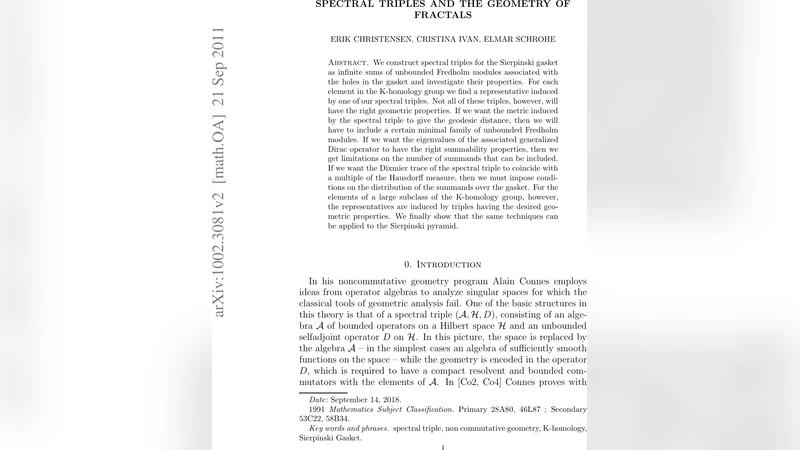
For each K-homolgy element of the Sierpinski gasket we construct a spectral triple which will generate that element. We show that there must be certain limits on the choice of the K-homology element if the geometric properties of the gasket shall be recoverable from that spectral triple. For a big subgroup of the K-homology group we show that our spectral triples will recover the metric, the dimension and the Hausdorff measure on the gaket.
💡 Research Summary
The paper investigates the interplay between K‑homology and non‑commutative geometry on the classic fractal known as the Sierpinski gasket. Its central achievement is the explicit construction, for every K‑homology class of the gasket’s C(^*)‑algebra (C(\text{Gasket})), of a spectral triple ((\mathcal A,\mathcal H_x,D_x)) that realizes that class. The authors begin by recalling that the gasket is a self‑similar compact metric space with Hausdorff dimension (d_H=\log 3/\log 2) and a natural Hausdorff measure (\mu_H). The K‑homology group (K^1(C(\text{Gasket}))) is described in terms of winding numbers around the triangular cells, and each class is represented by a Fredholm module.
To associate a spectral triple to a given class (
Comments & Academic Discussion
Loading comments...
Leave a Comment