Host Galaxy Properties of the Swift BAT Ultra Hard X-ray Selected AGN
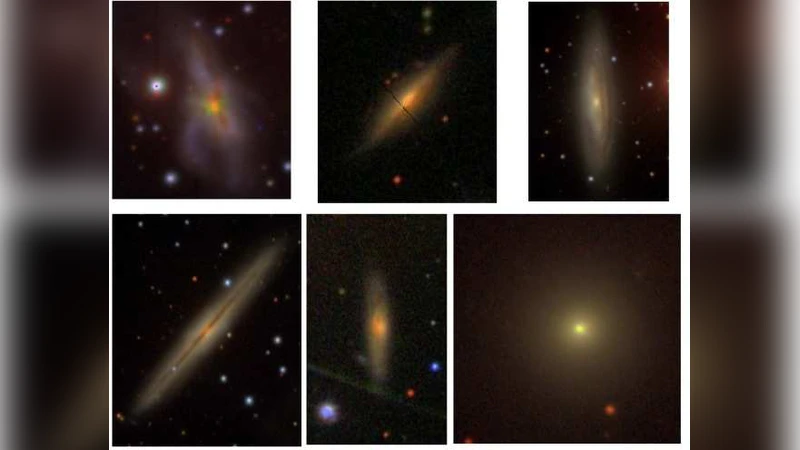
We have assembled the largest sample of ultra hard X-ray selected (14-195 keV) AGN with host galaxy optical data to date, with 185 nearby (z<0.05), moderate luminosity AGN from the Swift BAT sample. The BAT AGN host galaxies have intermediate optical colors (u-r and g-r) that are bluer than a comparison sample of inactive galaxies and optically selected AGN from the Sloan Digital Sky Survey (SDSS) which are chosen to have the same stellar mass. Based on morphological classifications from the RC3 and the Galaxy Zoo, the bluer colors of BAT AGN are mainly due to a higher fraction of mergers and massive spirals than in the comparison samples. BAT AGN in massive galaxies (log M_*>10.5) have a 5 to 10 times higher rate of spiral morphologies than in SDSS AGN or inactive galaxies. We also see enhanced far-IR emission in BAT AGN suggestive of higher levels of star formation compared to the comparison samples. BAT AGN are preferentially found in the most massive host galaxies with high concentration indexes indicative of large bulge-to-disk ratios and large supermassive black holes. The narrow-line BAT AGN have similar intrinsic luminosities as the SDSS NL Seyferts based on measurements of [O III]. There is also a correlation between the stellar mass and X-ray emission. The BAT AGN in mergers have bluer colors and greater ultra hard X-ray emission compared to the BAT sample as whole. In agreement with the Unified Model of AGN, and the relatively unbiased nature of the BAT sources, the host galaxy colors and morphologies are independent of measures of obscuration such as X-ray column density or Seyfert type. The high fraction of massive spiral galaxies and galaxy mergers in BAT AGN suggest that host galaxy morphology is related to the activation and fueling of local AGN.
💡 Research Summary
This paper presents the most extensive study to date of host‑galaxy properties for ultra‑hard X‑ray selected active galactic nuclei (AGN) drawn from the Swift Burst Alert Telescope (BAT) survey. The authors assemble a sample of 185 nearby (z < 0.05) Seyfert galaxies detected in the 14–195 keV band, a regime that is largely immune to absorption up to column densities of N_H ≈ 10²⁴ cm⁻². By focusing on a low‑redshift, mass‑matched set of objects, the study aims to provide an unbiased view of the environments that fuel local AGN activity.
Sample construction and comparison sets
The BAT AGN are restricted to northern declinations (Dec > ‑25°) and split evenly between narrow‑line (NL; Hα < 2000 km s⁻¹) and broad‑line Seyferts. To assess how their hosts differ from typical galaxies, two control samples are built from the Sloan Digital Sky Survey (SDSS) DR7: (1) a large inactive‑galaxy sample of 68 275 objects matched in redshift and stellar mass, and (2) a narrow‑line Seyfert sample of 128 SDSS AGN selected to have the same
Comments & Academic Discussion
Loading comments...
Leave a Comment