Voting in a Stochastic Environment: The Case of Two Groups
Social dynamics determined by voting in a stochastic environment is analyzed for a society composed of two cohesive groups of similar size. Within the model of random walks determined by voting, explicit formulas are derived for the capital increments of the groups against the parameters of the environment and “claim thresholds” of the groups. The “unanimous acceptance” and “unanimous rejection” group rules are considered as the voting procedures. Claim thresholds are evaluated that are most beneficial to the participants of the groups and to the society as a whole.
💡 Research Summary
The paper investigates how voting outcomes in a stochastic environment affect the expected capital (or utility) of two cohesive groups of comparable size. Proposals are generated randomly by an external “environment” and each proposal’s impact on an individual’s capital is modeled as an independent draw from a normal distribution N(µ, σ²). A group votes not on individual gains but on the average gain of its members; a group supports a proposal only if this average exceeds a preset claim threshold tᵢ (which may be positive, zero, or negative).
Two voting procedures are examined:
- Unanimous acceptance (both groups must support a proposal for it to be adopted). This corresponds to a “both‑sides‑agree” rule.
- Unanimous rejection (a proposal is adopted if at least one group supports it). This is essentially a “any‑support‑wins” rule.
The authors derive closed‑form expressions for the expected one‑step capital increment M(˜dᵢ) of a member of group i under each rule. The formulas involve the standard normal cumulative distribution function F(·) and density f(·) evaluated at (µ‑tᵢ)/(σ/√gᵢ), where gᵢ is the size of group i. Specifically:
- Under unanimous rejection:
M(˜dᵢ) = µ F_{3‑i} + (µ Fᵢ + σᵢ fᵢ) F_{3‑i}. - Under unanimous acceptance:
M(˜dᵢ) = (µ Fᵢ + σᵢ fᵢ) F_{3‑i}.
Here σᵢ = σ/√gᵢ, Fᵢ = F((µ‑tᵢ)/σᵢ), and fᵢ = f((µ‑tᵢ)/σᵢ).
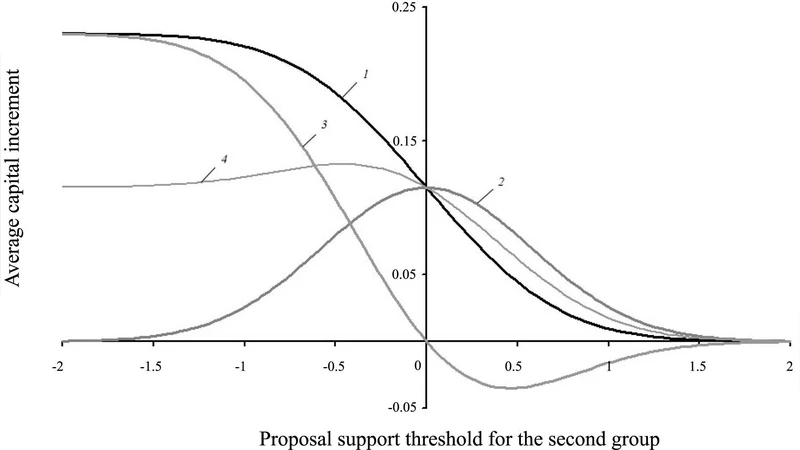
From these results the authors obtain the expected difference between the groups, M(˜d₁‑˜d₂) = σ₁ f₁ F₂ – σ₂ f₂ F₁, which is symmetric with respect to the sign of t₂ when µ = 0. This symmetry implies that a positive claim threshold of a given magnitude reduces a group’s expected gain just as much as a negative threshold of the same magnitude.
The core of the paper focuses on optimal claim thresholds.
Proposition 1 (unanimous acceptance): To maximize the advantage of Group 2 over Group 1 (i.e., maximize M(˜d₂‑˜d₁)), Group 2 should set its claim threshold to
t₂⁺ = µ + σ₁ f₁ F₁.
This threshold coincides with the expected average capital increment of Group 1, suggesting a simple algorithm: compute the average gain that Group 1 would obtain from the proposals it supports, then adopt that value as t₂.
Proposition 2 (societal optimum): To maximize the total expected capital of the whole society (g₁ M(˜d₁) + g₂ M(˜d₂)), the optimal threshold for Group 2 is
t₂⁰ = – (g₁/g₂)
Comments & Academic Discussion
Loading comments...
Leave a Comment