Clustering of Mobile Ad Hoc Networks: An Adaptive Broadcast Period Approach
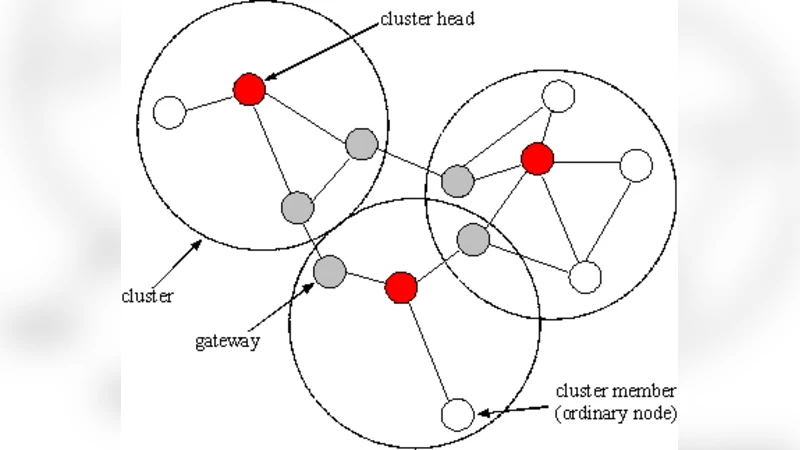
Organization, scalability and routing have been identified as key problems hindering viability and commercial success of mobile ad hoc networks. Clustering of mobile nodes among separate domains has been proposed as an efficient approach to address those issues. In this work, we introduce an efficient distributed clustering algorithm that uses both location and energy metrics for cluster formation. Our proposed solution mainly addresses cluster stability, manageability and energy efficiency issues. Also, unlike existing active clustering methods, our algorithm relieves the network from the unnecessary burden of control messages broadcasting, especially for relatively static network topologies. This is achieved through adapting broadcast period according to mobile nodes mobility pattern. The efficiency, scalability and competence of our algorithm against alternative approaches have been demonstrated through simulation results.
💡 Research Summary
The paper addresses two fundamental inefficiencies of existing active clustering schemes for mobile ad‑hoc networks (MANETs): excessive control‑message overhead and frequent cluster‑head (CH) changes. It proposes the Adaptive Broadcast Period (ABP) algorithm, a distributed clustering method that integrates node location (expressed as neighbor degree) and residual battery level into a single “cluster‑head competence” (CHC) metric. CHC is computed as CHC = c₁·d + c₂·b − p, where d is the number of one‑hop neighbors, b is the battery percentage, c₁ and c₂ are weighting factors that sum to one, and p is a hand‑over penalty. The penalty is set to zero for current CHs and to a positive integer for ordinary nodes, thereby discouraging marginally better candidates from triggering unnecessary CH re‑elections.
ABP’s clustering procedure completes within two “Hello” cycles. In the first cycle each node counts received Hello packets to estimate its degree d. In the second cycle it broadcasts a Hello packet containing its CHC value. Nodes select the sender with the highest CHC as their CH; ties are broken by the smallest node ID. This two‑step process retains the speed of the Lowest‑ID (LID) approach while adding battery awareness and stability through the penalty term.
Cluster size is regulated through a 4‑bit “Option” field in the Hello packet. Each CH records the number of member nodes it currently dominates. If this count reaches a predefined threshold T, the CH refuses further membership requests, preventing overload and ensuring a balanced load across clusters.
The most distinctive contribution is the dynamic adaptation of the Hello broadcast period (BP). The algorithm assumes that many MANET deployments exhibit periods of low mobility (e.g., conference rooms, classrooms). When mobility is detected to be low, BP is increased, reducing the frequency of control messages and saving bandwidth and energy. Conversely, when mobility rises, BP is shortened to quickly capture topology changes. The paper does not detail the exact mobility metric or the decision thresholds, leaving the implementation of BP adaptation open to interpretation.
Simulation results are presented to compare ABP with three representative active clustering algorithms: LID, Highest‑Degree (HD), and Vote‑based Clustering (VC). The authors claim that ABP achieves: (1) fewer CH re‑elections, leading to more stable cluster structures; (2) lower overall energy consumption because CHs are selected with higher residual battery and because control traffic is reduced in static scenarios; and (3) a significant reduction in control‑message overhead due to the adaptive BP mechanism.
Critical analysis reveals several open issues. First, the penalty p and the cluster‑size limit T are treated as static constants; the paper provides no systematic method for tuning these parameters according to network scale or application requirements. Second, the mobility detection and BP‑adjustment logic are described only conceptually; without a concrete algorithm, the effectiveness of the adaptive broadcast period cannot be fully assessed, especially in environments with rapidly fluctuating mobility patterns. Third, the simulation setup (node count, mobility model, traffic patterns, transmission range, etc.) is not detailed, making it difficult to gauge the generality of the reported gains. Finally, security considerations (e.g., malicious nodes falsifying CHC values) are not addressed.
In summary, ABP introduces a coherent framework that combines location and energy metrics, incorporates a penalty to curb unnecessary CH hand‑overs, enforces cluster‑size limits, and dynamically scales control‑message frequency based on perceived mobility. These ideas collectively aim to improve scalability, stability, and energy efficiency of MANET clustering. While the concept is promising, further work is needed to formalize parameter selection, define robust mobility‑estimation techniques, and validate performance across diverse network conditions. With such refinements, ABP could become a valuable tool for large‑scale, energy‑constrained ad‑hoc deployments.
Comments & Academic Discussion
Loading comments...
Leave a Comment