An observability for parabolic equations from a measurable set in time
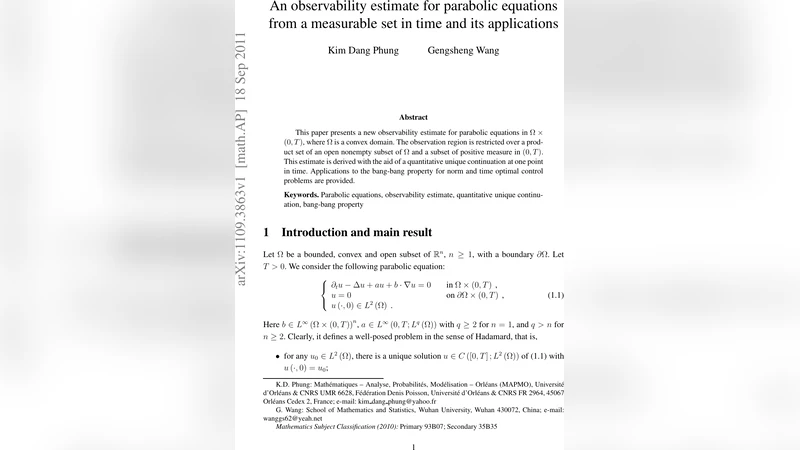
This paper presents a new observability estimate for parabolic equations in $\Omega\times(0,T)$, where $\Omega$ is a convex domain. The observation region is restricted over a product set of an open nonempty subset of $\Omega$ and a subset of positive measure in $(0,T)$. This estimate is derived with the aid of a quantitative unique continuation at one point in time. Applications to the bang-bang property for norm and time optimal control problems are provided.
💡 Research Summary
The paper investigates observability for linear parabolic equations with space‑time dependent lower‑order terms on a bounded convex domain Ω⊂ℝⁿ (n≥1). The equation under study is
∂ₜu – Δu + a(x,t)u + b(x,t)·∇u = 0 in Ω×(0,T),
with homogeneous Dirichlet boundary condition and initial data u(·,0)∈L²(Ω). The coefficients satisfy a∈L^∞(0,T;L^q(Ω)) (q≥2 for n=1, q>n for n≥2) and b∈L^∞(Ω×(0,T))ⁿ. Classical energy estimates guarantee well‑posedness and give the stability bound
‖u(·,t)‖{L²(Ω)} ≤ e^{C₀t(‖a‖²+‖b‖²)}‖u₀‖{L²(Ω)}.
The main contribution is an observability inequality that requires observation only on a product set D = ω×E, where ω⊂Ω is any non‑empty open subset and E⊂(0,T) is a measurable set of positive Lebesgue measure. Theorem 1.1 states
‖u(·,T)‖{L²(Ω)} ≤ C(Ω,n,q,ω,E,T,a,b) ∬{ω×E}|u(x,t)| dx dt.
The constant C depends solely on geometric data, the norms of a and b, and the measure of E, but not on the particular solution.
The proof proceeds through a novel two‑step strategy. First, a quantitative unique continuation estimate at a single time (a Hölder‑type inequality) is established:
‖u(·,T)‖{L²(Ω)} ≤ C ‖u(·,0)‖{L²(Ω)}^{α} ‖u(·,T)‖_{L²(ω)}^{1–α}, α∈(0,1).
This is sometimes called “Hölder continuous dependence from one point in time”. Second, the authors convert this pointwise estimate into an observability estimate over a measurable time set. The key technical tools are:
-
Density point construction (Proposition 2.1): For a density point ℓ of E, a decreasing sequence {ℓₘ} is built such that the gaps ℓₘ–ℓₘ₊₁ are controlled by the measure of E intersected with the corresponding intervals.
-
Local quantitative estimates (Proposition 2.2): Two inequalities are proved. The first (2.1.3) is a quantitative unique continuation estimate that links the L² norm at a later time L to the L² norm on a small ball B_r at the same time, with an explicit exponent α(r,T,‖b‖). The second (2.1.4) is an L¹–L² interpolation inequality that allows one to bound the L² norm at time t₂ by a combination of the L¹ norm on B_r at t₂ and the L² norm at an earlier time t₁, with a small parameter ε.
-
Carleman‑type weight functions: The heat kernel G_λ(x,t) = (L−t+λ)^{−n/2} exp(−|x−x₀|²/(4(L−t+λ))) satisfies (∂ₜ+Δ)G_λ=0. Using G_λ, the authors define a frequency function N_{λ,φ}(t) = ∫|∇φ|²G_λ / ∫|φ|²G_λ and derive a differential inequality (Lemma 2.3).
-
Log‑convexity and logarithmic convexity (Lemma 2.4): By integrating the differential inequality for N_{λ,u} and employing a logarithmic convexity argument, a log‑Boltzmann type estimate is obtained for N_{λ,u}(L). This yields an explicit bound involving the logarithm of the ratio of the initial and final L² norms, the coefficient norms, and the parameter λ.
With these tools, the authors perform an ε‑splitting argument on each interval (ℓₘ₊₁,ℓₘ] and sum over m. The exponential weights e^{−ηz^{m}} (where η depends on the geometry of ω and the coefficient norms) guarantee convergence of the series and lead to the final estimate (1.5).
The paper then applies the observability inequality to two optimal control problems:
-
Norm‑optimal control: Minimize the L²‑norm of the state at time T subject to a bounded control acting on ω. Using (1.5), the authors prove that any optimal control must be of bang‑bang type, i.e., it attains the extreme admissible values almost everywhere on the control horizon.
-
Time‑optimal control: Minimize the time needed to steer the system to a prescribed target set. Again, the observability estimate implies that the optimal control switches instantly from the maximal to the minimal admissible value, yielding a bang‑bang structure.
Both results highlight that full‑time observation is unnecessary; observing on a set of positive measure in time suffices to guarantee the strong structural property of optimal controls.
In summary, the paper establishes a new bridge between pointwise quantitative unique continuation and observability from sparse temporal measurements. It provides explicit constants, works for general space‑time dependent lower‑order terms, and demonstrates concrete implications for control theory, notably the bang‑bang property for norm‑ and time‑optimal controls. The methodology opens avenues for further extensions to non‑convex domains, nonlinear equations, and numerical implementations where measurement resources are limited.
Comments & Academic Discussion
Loading comments...
Leave a Comment