A Hierarchical NeuroBayes-based Algorithm for Full Reconstruction of B Mesons at B Factories
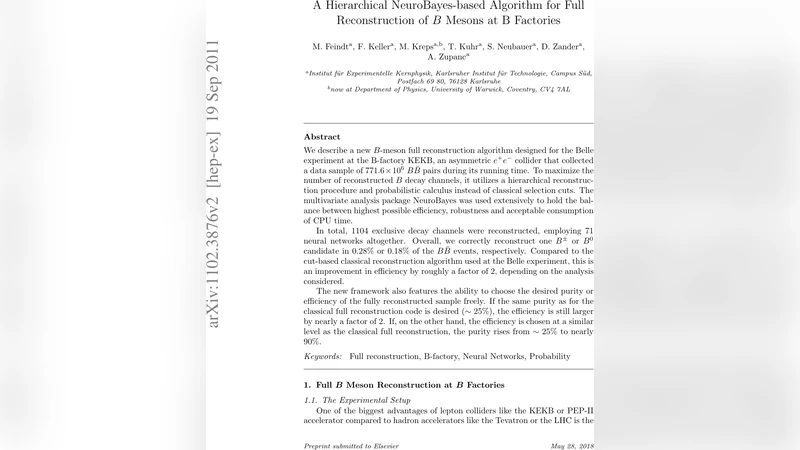
We describe a new B-meson full reconstruction algorithm designed for the Belle experiment at the B-factory KEKB, an asymmetric e+e- collider that collected a data sample of 771.6 x 10^6 BBbar pairs during its running time. To maximize the number of reconstructed B decay channels, it utilizes a hierarchical reconstruction procedure and probabilistic calculus instead of classical selection cuts. The multivariate analysis package NeuroBayes was used extensively to hold the balance between highest possible efficiency, robustness and acceptable consumption of CPU time. In total, 1104 exclusive decay channels were reconstructed, employing 71 neural networks altogether. Overall, we correctly reconstruct one B+/- or B0 candidate in 0.28% or 0.18% of the BBbar events, respectively. Compared to the cut-based classical reconstruction algorithm used at the Belle experiment, this is an improvement in efficiency by roughly a factor of 2, depending on the analysis considered. The new framework also features the ability to choose the desired purity or efficiency of the fully reconstructed sample freely. If the same purity as for the classical full reconstruction code is desired ~25%, the efficiency is still larger by nearly a factor of 2. If, on the other hand, the efficiency is chosen at a similar level as the classical full reconstruction, the purity rises from ~25% to nearly 90%.
💡 Research Summary
This paper presents a new full‑reconstruction algorithm for B‑mesons that was developed for the Belle experiment at the KEKB asymmetric e⁺e⁻ collider. The data set consists of 771.6 × 10⁶ BB̄ pairs collected during the entire KEKB run. The authors aim to maximise the number of reconstructed B‑decay channels while keeping the CPU consumption reasonable. To achieve this they replace the traditional cut‑based selection with a hierarchical reconstruction scheme combined with probabilistic inference using the multivariate analysis package NeuroBayes.
The reconstruction is organised into four stages. In the first stage, charged tracks and electromagnetic clusters are assigned particle‑type hypotheses (π, K, e, μ, γ). Separate NeuroBayes networks are trained for each hypothesis using a set of detector observables (time‑of‑flight, CDC dE/dx, ACC Cherenkov light, calorimeter shower shape, etc.). The network output is calibrated to represent a Bayesian probability for the candidate to be signal.
In the second stage, combinations of the first‑stage candidates are used to build intermediate particles such as D⁰, D⁺, Dₛ⁺ and J/ψ. For each decay mode a product of the daughter‑particle probabilities (NB_out,prod) is formed and a dedicated network evaluates the overall signal probability of the composite candidate. Soft pre‑selection cuts are applied based on a common “background‑per‑additional‑signal” criterion, which balances CPU load across many decay channels.
The third stage reconstructs higher‑level resonances (D* and D*_s) by adding soft π⁰ or photons to the D‑mesons, again using probability‑based selection.
Finally, in the fourth stage all reconstructed D, D* and J/ψ candidates are combined with the remaining tracks and clusters to form B⁺ and B⁰ candidates (the “B‑tag”). The accumulated probabilities from the previous stages are combined using Bayes’ theorem and a likelihood‑ratio correction (eq. 20) that accounts for differences between the training sample’s signal‑to‑background ratio and that of real data.
Training samples are generated with a full GEANT‑based detector simulation, including both Υ(4S) → BB̄ events and continuum e⁺e⁻ → qq̄ (q = u,d,s,c) processes. The algorithm reconstructs a total of 1 104 exclusive B‑decay channels, employing 71 neural networks. The overall reconstruction efficiencies are 0.28 % for B⁺ and 0.18 % for B⁰, corresponding to roughly a factor‑two improvement over the previous cut‑based full‑reconstruction code.
A key feature of the new framework is the ability to trade purity against efficiency at will. If the same purity (~25 %) as the classical algorithm is required, the efficiency is still almost doubled. Conversely, if the efficiency is kept at the level of the classical method, the purity rises dramatically to about 90 %. This flexibility is especially valuable for analyses involving invisible particles (e.g. B⁺ → τ⁺ν, B⁺ → K⁺νν̄, B⁰ → νν̄) where the knowledge of the B‑tag four‑momentum allows the reconstruction of missing‑energy kinematics.
The software framework automatically manages the hundreds of decay channels and the large number of neural networks, reducing human error and simplifying the addition of new channels. The hierarchical, probability‑driven approach is scalable to future high‑luminosity B‑factories such as Belle II, where the sheer number of possible decay modes and the need for high‑efficiency tagging will be even more critical.
In summary, by integrating NeuroBayes‑based multivariate classification into a four‑stage hierarchical reconstruction, the authors achieve a substantial gain in B‑meson full‑reconstruction efficiency while retaining control over purity and computational cost. This advancement opens the door to more precise measurements of rare B decays and provides a powerful tool for ongoing and future flavor‑physics experiments.
Comments & Academic Discussion
Loading comments...
Leave a Comment