A note on compactly generated co-t-structures
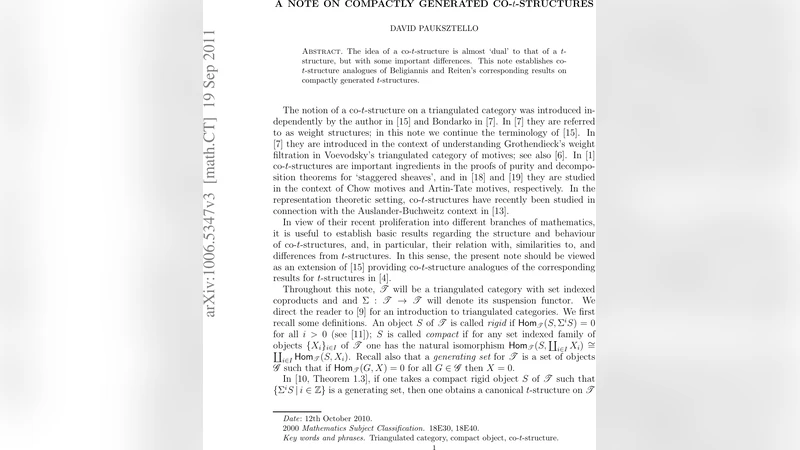
The idea of a co-t-structure is almost “dual” to that of a t-structure, but with some important differences. This note establishes co-t-structure analogues of Beligiannis and Reiten’s corresponding results on compactly generated t-structures.
💡 Research Summary
The paper develops a systematic theory of co‑t‑structures, focusing on the case where they are compactly generated, and establishes results that are exact analogues of the classical theorems of Beligiannis and Reiten for compactly generated t‑structures. After recalling the definition of a co‑t‑structure as a pair (U,V) of full subcategories satisfying ΣU⊂U and Σ⁻¹V⊂V, the author introduces a set C of compact objects in a triangulated category 𝒯 and constructs the smallest co‑aisle 𝔘_C containing C (closed under coproducts, extensions, and the suspension Σ) and its right orthogonal co‑coaisle 𝔙_C. The central technical step is Lemma 3.4, which shows that for every X∈𝒯 there exists a distinguished triangle U→X→V→ΣU with U∈𝔘_C and V∈𝔙_C; this guarantees that (𝔘_C,𝔙_C) is indeed a co‑t‑structure. The proof adapts the compact‑generation arguments used for t‑structures, but it must handle the reversed suspension conditions and the orthogonality in the opposite direction.
The paper then defines the co‑heart H = 𝔘_C ∩ Σ⁻¹𝔙_C and proves that H is an abelian category. Moreover, every object of H can be expressed as a finite direct sum and suspension of objects from C, showing that H is itself compactly generated. This mirrors the well‑known fact that the heart of a t‑structure is abelian, but the co‑heart exhibits a dual behavior: it is generated by compact objects rather than being a quotient of them.
A major contribution is the maximality theorem: among all co‑t‑structures whose co‑aisle contains C, the pair (𝔘_C,𝔙_C) is the largest (i.e., its co‑aisle contains any other such co‑aisle) and its co‑coaisle is the smallest. Consequently, the compactly generated co‑t‑structure associated to C is uniquely determined by C. This result provides a canonical choice of co‑t‑structure in situations where multiple candidates could exist, and it parallels the uniqueness of the smallest t‑structure generated by a set of compact objects.
The author illustrates the theory with several examples. In stable homotopy theory, taking C to be a set of Bousfield classes yields a co‑t‑structure that encodes the dual of Bousfield localization. In the derived category D(R) of a ring R, choosing C as the set of compact projective (or injective) modules produces a co‑t‑structure distinct from the standard t‑structure, and its co‑heart recovers a module category that is naturally abelian. These examples demonstrate that compactly generated co‑t‑structures can capture phenomena not visible through t‑structures alone.
Finally, the paper discusses future directions, suggesting connections with silting and cosilting theory, the study of co‑t‑structures in higher‑dimensional triangulated categories, and potential applications to the classification of localizing subcategories. By providing a clear dual framework and proving compact‑generation analogues, the work significantly expands the toolbox available for homological algebra and triangulated category theory.
Comments & Academic Discussion
Loading comments...
Leave a Comment