A categorical proof of the Parshin reciprocity laws on algebraic surfaces
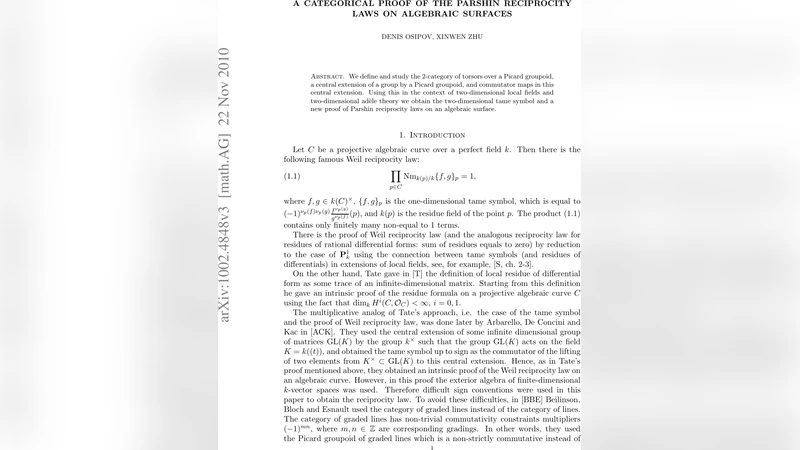
We define and study the 2-category of torsors over a Picard groupoid, a central extension of a group by a Picard groupoid, and commutator maps in this central extension. Using it in the context of two-dimensional local fields and two-dimensional adelic theory we obtain the two-dimensional tame symbol and a new proof of Parshin reciprocity laws on an algebraic surface.
💡 Research Summary
The paper presents a novel categorical framework for proving Parshin’s reciprocity laws on algebraic surfaces. It begins by constructing the 2‑category of torsors over a Picard groupoid, which is a symmetric monoidal 1‑groupoid whose objects and morphisms are themselves abelian groups. A “2‑torsor” is defined as a free and transitive action of a Picard groupoid on a category, and the authors verify that such torsors form a well‑behaved 2‑category equipped with a monoidal product, inverses, and coherent associativity constraints.
Using this machinery, the authors introduce the notion of a central extension of an ordinary group (G) by a Picard groupoid (\mathcal{P}). Unlike classical central extensions classified by (H^2(G,\mathbb{C}^\times)), these extensions have a commutator map that takes values in the objects and morphisms of (\mathcal{P}). The commutator is defined as a 2‑morphism in the 2‑category of torsors, and its basic properties (bilinearity, antisymmetry, and the Jacobi identity up to coherent 2‑isomorphisms) are proved.
The second part of the work applies the categorical construction to two‑dimensional local fields. For a smooth algebraic surface (X) over a perfect field, each pair consisting of a closed point (x) and an irreducible curve (C) passing through (x) gives rise to a two‑dimensional complete local field (K_{x,C}). The authors assemble these fields into the adelic ring (\mathbb{A}_X) and consider its multiplicative group (\mathbb{A}_X^\times).
Within the central extension framework, a three‑variable tame symbol ({f,g,h}{x,C}) is defined for (f,g,h\in K{x,C}^\times) as the value of the commutator map evaluated on the corresponding torsors. The symbol satisfies the expected properties: it is alternating in its arguments, multiplicative in each variable, and compatible with change of local parameters. Crucially, the construction avoids the intricate explicit formulas traditionally used for the two‑dimensional tame symbol; instead, the symbol emerges naturally from the categorical commutator.
The main theorem proves the global reciprocity law: for any triple ((f,g,h)\in \mathbb{A}_X^\times) the product of the local symbols over all pairs ((x,C)) equals the identity in the Picard groupoid, \
Comments & Academic Discussion
Loading comments...
Leave a Comment