Optimization, Randomized Approximability, and Boolean Constraint Satisfaction Problems
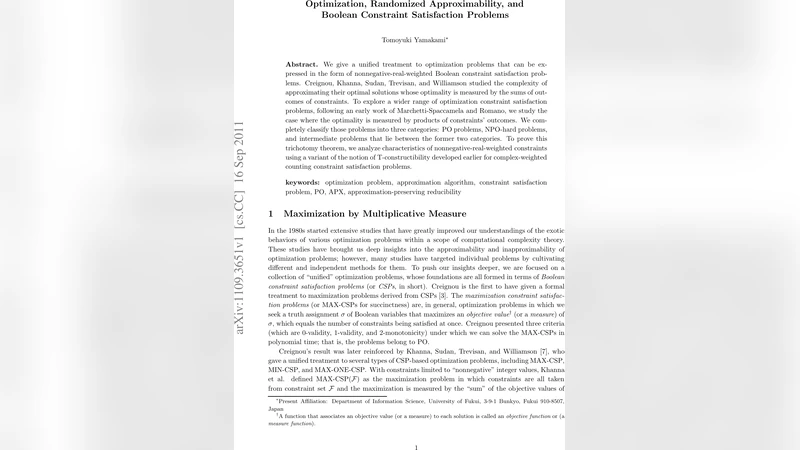
We give a unified treatment to optimization problems that can be expressed in the form of nonnegative-real-weighted Boolean constraint satisfaction problems. Creignou, Khanna, Sudan, Trevisan, and Williamson studied the complexity of approximating their optimal solutions whose optimality is measured by the sums of outcomes of constraints. To explore a wider range of optimization constraint satisfaction problems, following an early work of Marchetti-Spaccamela and Romano, we study the case where the optimality is measured by products of constraints’ outcomes. We completely classify those problems into three categories: PO problems, NPO-hard problems, and intermediate problems that lie between the former two categories. To prove this trichotomy theorem, we analyze characteristics of nonnegative-real-weighted constraints using a variant of the notion of T-constructibility developed earlier for complex-weighted counting constraint satisfaction problems.
💡 Research Summary
The paper extends the well‑studied framework of Boolean constraint satisfaction problems (CSPs) from additive objective functions to multiplicative ones. In the classic setting, a MAX‑CSP instance consists of a set of weighted Boolean constraints and the quality of an assignment is measured by the sum of the satisfied constraint weights. This additive measure has been thoroughly analyzed: depending on the constraint set F, the problem either belongs to PO (polynomial‑time solvable), is APX‑complete, or is harder.
Motivated by earlier work of Marchetti‑Spaccamela and Romano on “product‑based” optimization, the authors define a new class of problems, MAX‑PROD‑CSP(F). An instance is a collection H of constraints drawn from a finite set F, each constraint h being a non‑negative real‑valued function on a tuple of Boolean variables. For an assignment σ, the objective value is the product Q(σ)=∏_{h∈H} h(σ(…)). The goal is to find σ maximizing Q(σ). Unary constraints are assumed to be freely available (the “U” set), which mirrors standard CSP conventions.
The central contribution is a trichotomy theorem (Theorem 1.1) that classifies MAX‑PROD‑CSP(F) into exactly three complexity categories, based solely on the algebraic nature of F:
-
PO cases – If F is a subset of either AF (affine‑like constraints) or ED (constraints built from equality EQ, disequality XOR, and products of unary constraints), then MAX‑PROD‑CSP(F) can be solved exactly in polynomial time. The proof exploits the fact that, after a logarithmic transformation or by exploiting structural properties of affine relations, the product objective reduces to a tractable form.
-
Intermediate (APT‑reducible) cases – If F ⊆ IMopt (implication‑like constraints, i.e., unary constraints together with binary constraints of the form (1,1,λ,1) for 0 ≤ λ < 1), the problem is not known to be in PO but is also not NPO‑hard. Instead, it is shown to be approximation‑preserving Turing‑reducible (APT‑reducible) from the well‑studied MAX‑PROD‑BIS problem (maximum‑product independent set on bipartite graphs). Consequently, these problems lie in APX (or a related approximation class) but are believed to be strictly harder than PO.
-
NPO‑hard cases – If F is not contained in any of the three families above, MAX‑PROD‑CSP(F) is APT‑reducible from MAX‑PROD‑IS (maximum‑product independent set on general graphs), which is known to be NPO‑complete. Hence these instances are as hard as the hardest optimization problems in NPO.
To achieve this classification, the authors introduce T‑max‑constructibility, a variant of the T‑constructibility notion originally developed for complex‑weighted counting CSPs. While classic T‑constructibility allows a target constraint to be expressed as a combination (sum, product, scaling) of base constraints, T‑max‑constructibility adds a crucial “non‑vanishing” condition: during the construction the intermediate products must stay strictly positive, preventing the whole objective from collapsing to zero. This refinement is essential for multiplicative objectives because a single zero factor annihilates the entire product, a phenomenon absent in additive settings.
Using T‑max‑constructibility, the authors prove that any constraint set F either can be reduced to one of the tractable families (AF or ED) or can be shown to simulate the hard core constraints of IMopt or the general binary constraints that encode independent‑set hardness. The reductions are carried out via explicit gadget constructions that preserve the product value up to a constant factor, ensuring that approximation ratios are maintained under APT‑reductions.
The paper also maps several natural combinatorial optimization problems into the MAX‑PROD‑CSP framework, illustrating the breadth of the classification:
- MAX‑PROD‑CUT – the product‑based analogue of MAX‑CUT, obtained by assigning weight 2 to vertices on the cut side and weight 1 otherwise. This problem falls into the PO category because it can be expressed using affine‑like constraints.
- MAX‑PROD‑SAT / MAX‑PROD‑ONE‑CSP – product versions of classic SAT‑type maximization problems; depending on the clause types they land in PO, intermediate, or NPO‑hard categories.
- MAX‑PROD‑IS and MAX‑PROD‑BIS – maximum‑product independent set on general and bipartite graphs, respectively. The former is NPO‑hard, the latter is intermediate (APT‑reducible from IMopt).
- MAX‑PROD‑FLOW – a product‑based flow maximization where each edge contributes a factor ρ(u,v) if the flow direction condition σ(u) ≥ σ(v) holds, and each vertex contributes its inflow weight when σ(v)=1. This problem belongs to PO because its constraints are built from equality and unary constraints (i.e., it lies in AF/ED).
A side result (Lemma 2.2) shows that every MAX‑PROD‑CSP(F) is APT‑reducible to an exponential‑approximation class (exp‑APX), guaranteeing that some (possibly weak) approximation algorithm always exists. This mirrors known results for additive CSPs but requires careful handling of zero‑valued constraints.
In summary, the paper delivers a complete trichotomy for Boolean CSPs with multiplicative objectives, introduces a novel constructive tool (T‑max‑constructibility) tailored to product measures, and demonstrates the practical relevance of the theory through a suite of canonical optimization problems. The work not only clarifies the computational landscape of product‑based CSPs but also opens avenues for future research on multiplicative optimization in areas such as probabilistic graphical models, product‑type cost networks, and multiplicative resource allocation problems.
Comments & Academic Discussion
Loading comments...
Leave a Comment