Some inverse problems in biophysics
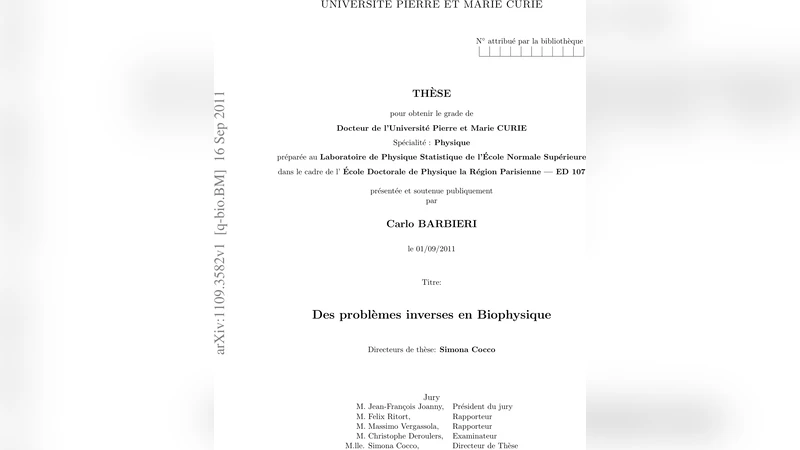
During the past few years the development of experimental techniques has allowed the quantitative analysis of biological systems ranging from neurobiology and molecular biology. This work focuses on the quantitative description of these systems by means of theoretical and numerical tools ranging from statistical physics to probability theory. This dissertation is divided in three parts, each of which has a different biological system as its focus. The first such system is Infotaxis, an olfactory search algorithm proposed by Vergassola et al. in 2007: we give a continuous formulation and we characterize its performances. Secondly we will focus on single-molecule experiments, especially unzipping of DNA molecules, whose experimental traces depend strongly on the DNA sequence: we develop a detailed model of the dynamics for this kind of experiments and then we propose several inference algorithm aiming at the characterization of the genetic sequence. The last section is devoted to the description of an algorithm that allows the inference of interactions between neurons given the recording of neural activity from multi-electrode experiments; we propose an integrated software that will allow the analysis of these data.
💡 Research Summary
This dissertation tackles three distinct inverse problems that have become central in quantitative biophysics thanks to recent advances in experimental techniques. The first part focuses on Infotaxis, an information‑theoretic olfactory search algorithm originally introduced by Vergassola et al. (2007). The author extends the original discrete lattice formulation to a continuous spatial domain. By deriving a set of stochastic differential equations for the posterior probability density, the work provides a rigorous mathematical foundation for the continuous version of Infotaxis. Detailed analyses of the prior choice, early‑search spiral trajectories, small‑distance expansions, and waiting‑time calculations reveal how the algorithm balances information gain against travel cost. Numerical integration confirms that the continuous formulation yields smoother trajectories and higher success rates in complex environments compared with its discrete counterpart.
The second part addresses single‑molecule DNA unzipping experiments, where the mechanical separation of double‑stranded DNA produces force‑extension traces that are highly sensitive to the underlying base‑pair sequence. The thesis builds a comprehensive physical model: single‑stranded DNA is represented as a modified freely‑jointed chain, double‑stranded DNA as an extensible worm‑like chain, and the experimental apparatus (magnetic tweezers or optical tweezers) is treated either as a fixed‑force or fixed‑distance ensemble. Over‑damped Langevin dynamics describe the motion of the unzipping fork, while scaling arguments for homogeneous and heterogeneous Rouse polymers provide insight into the polymeric response. The model reproduces experimental force–distance curves and serves as the forward engine for inverse inference.
Three Bayesian inference algorithms are then proposed to reconstruct the DNA sequence from noisy unzipping data. The “infinite bandwidth” method evaluates the full posterior over all possible sequences, which is computationally prohibitive but serves as a benchmark. The “perfect averages” algorithm introduces a prior and optimizes the step size, achieving linear‑time scaling with sequence length while retaining high accuracy. A third “dynamical” approach couples Ornstein‑Uhlenbeck processes to the measured signal, enabling real‑time sequence estimation. Comparative studies demonstrate that the perfect‑averages method offers the best trade‑off between precision, computational cost, and robustness; error bars and entropy measures are also derived to quantify uncertainty.
The third part concerns the inference of synaptic couplings in neuronal networks from multi‑electrode recordings. Using a leaky integrate‑and‑fire model for each neuron, the author formulates the likelihood of observed spike trains given a connectivity matrix. Limitations of earlier implementations (e.g., poor convergence, restrictive priors) are addressed by introducing a fully Bayesian MCMC sampler and by providing a comprehensive software package that automates data preprocessing, parameter initialization, posterior sampling, and visualization. Tests on simulated data and on in‑vivo mouse cortical recordings show that the method can recover connectivity with high fidelity even in the presence of substantial measurement noise.
Overall, the dissertation demonstrates how probabilistic modeling, grounded in statistical physics, can be systematically applied to diverse biophysical inverse problems. Each chapter combines rigorous theoretical derivations, efficient numerical algorithms, and validation against real experimental data, thereby advancing both methodological foundations and practical tools for the quantitative analysis of biological systems. The work also outlines future directions, including scaling continuous Infotaxis to high‑dimensional odor fields, refining DNA unzipping models for real‑time sequencing, and extending neuronal inference to incorporate plasticity and non‑linear dynamics.
Comments & Academic Discussion
Loading comments...
Leave a Comment