Sufficient conditions for the genericity of feedback stabilisability of switching systems via Lie-algebraic solvability
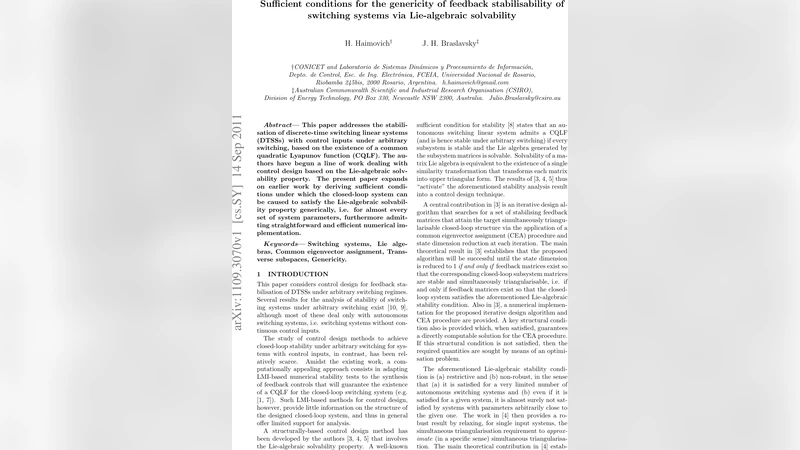
This paper addresses the stabilisation of discrete-time switching linear systems (DTSSs) with control inputs under arbitrary switching, based on the existence of a common quadratic Lyapunov function (CQLF). The authors have begun a line of work dealing with control design based on the Lie-algebraic solvability property. The present paper expands on earlier work by deriving sufficient conditions under which the closed-loop system can be caused to satisfy the Lie-algebraic solvability property generically, i.e. for almost every set of system parameters, furthermore admitting straightforward and efficient numerical implementation.
💡 Research Summary
**
The paper tackles the problem of designing state‑feedback controllers for discrete‑time switching linear systems (DTSS) that guarantee stability under arbitrary switching by ensuring the existence of a common quadratic Lyapunov function (CQLF). Building on earlier work that linked the solvability of the Lie algebra generated by the closed‑loop subsystem matrices to the existence of a CQLF, the authors focus on making this Lie‑algebraic condition “generic”, i.e., satisfied for almost all admissible system parameters.
The system under consideration is
(x_{k+1}=A_i x_k + B_i u_i,; i\in{1,\dots,N})
with full‑column‑rank input matrices (B_i) and each pair ((A_i,B_i)) controllable. A static state‑feedback law (u_i=K_i x_k) yields closed‑loop matrices (A_{cl,i}=A_i+B_iK_i). Lemma 1 (a restatement of a known result) asserts that if all (A_{cl,i}) are Schur stable and the Lie algebra generated by ({A_{cl,i}}) is solvable, then a CQLF exists and the switched system is exponentially stable under arbitrary switching.
The authors revisit the iterative algorithm introduced in their earlier papers (Algorithm 1). At each iteration (\ell) the algorithm seeks a common eigenvector (v_{\ell,1}) and associated stable eigenvalues (\lambda_{\ell,i}) for all internal subsystems. If such a vector exists, feedback matrices (F_{\ell,i}) are computed so that ((A_{\ell,i}+B_{\ell,i}F_{\ell,i})v_{\ell,1}=\lambda_{\ell,i}v_{\ell,1}). A unitary transformation then reduces the state dimension by one, and the process repeats until the dimension reaches one. The success of each iteration hinges on a structural condition expressed by the scalar
(p_\ell = n_\ell + \sum_{i=1}^N m_{\ell,i} - N n_\ell),
where (n_\ell) is the current state dimension and (m_{\ell,i}=\operatorname{rank}(B_{\ell,i})). Lemma 2 shows that if (p_\ell>0) then the kernel of a certain matrix (Q_\ell(\Lambda_\ell)) is non‑trivial for any choice of stable eigenvalues (\Lambda_\ell), guaranteeing the existence of a feedback‑assignable common eigenvector. Consequently, the Common Eigenvector Assignment (CEA) sub‑procedure can be executed without solving any optimization problem.
However, (p_\ell) may decrease as the algorithm proceeds, potentially violating the structural condition in later iterations. To prevent this, the paper introduces the concept of transversality of subspaces. Two subspaces are transverse if their intersection has minimal dimension (or equivalently, their sum has maximal dimension). Extending this to a collection of subspaces, the authors prove (Theorem 1 and Corollary 1) that if the common eigenvector at iteration (\ell) does not belong to the image of every input matrix, then (p_{\ell+1}\ge p_\ell); only when the eigenvector lies in all images does (p_{\ell+1}=p_\ell-1). Thus, maintaining transversality of the images ({\operatorname{img} B_{\ell,i}}) across iterations ensures that (p_\ell) never drops below one.
The central contribution of the current work is to derive sufficient genericity conditions that guarantee the transversality property for all iterations, based solely on the original system dimensions ((n, {m_i})). The authors show that if the collection of input subspaces ({\operatorname{img} B_i}) is transverse in the ambient space (\mathbb{R}^n) and the initial scalar (p_1) is positive (which holds when the total input rank exceeds ((N-1)n)), then transversality is preserved throughout the algorithm. Consequently, for almost every choice of the system matrices ({A_i,B_i}) with the given dimensions, there exist feedback matrices (K_i) such that the closed‑loop Lie algebra is solvable and a CQLF exists.
From a practical standpoint, checking the genericity condition requires only rank computations and dimension checks—operations that are trivial compared with solving large linear matrix inequalities (LMIs). Moreover, the authors discuss how, when the structural condition fails, an approximate simultaneous triangularisation technique (as in their earlier work) can still be employed to obtain a CQLF, providing a degree of robustness to parameter perturbations.
In summary, the paper establishes that for discrete‑time switching systems with full‑rank inputs, the Lie‑algebraic solvability condition is not a pathological requirement but a generic property that can be enforced through a simple, iterative feedback design algorithm. The results bridge a gap between abstract algebraic stability criteria and concrete, numerically tractable controller synthesis, opening the way for broader application of Lie‑algebraic methods in switched‑system control. Future research directions include extending the framework to multi‑input/multi‑output settings, handling nonlinear switching dynamics, and integrating adaptive or online schemes that preserve the generic solvability property in real‑time operation.
Comments & Academic Discussion
Loading comments...
Leave a Comment