Concordant Chemical Reaction Networks
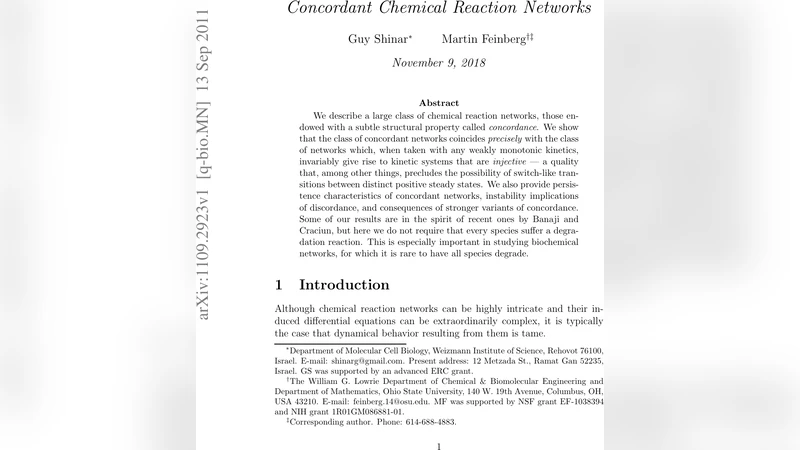
We describe a large class of chemical reaction networks, those endowed with a subtle structural property called concordance. We show that the class of concordant networks coincides precisely with the class of networks which, when taken with any weakly monotonic kinetics, invariably give rise to kinetic systems that are injective — a quality that, among other things, precludes the possibility of switch-like transitions between distinct positive steady states. We also provide persistence characteristics of concordant networks, instability implications of discordance, and consequences of stronger variants of concordance. Some of our results are in the spirit of recent ones by Banaji and Craciun, but here we do not require that every species suffer a degradation reaction. This is especially important in studying biochemical networks, for which it is rare to have all species degrade.
💡 Research Summary
The paper introduces and develops the concept of concordance—a structural property of chemical reaction networks (CRNs)—and demonstrates its profound implications for the dynamics of such networks under very general kinetic assumptions. A CRN is said to be concordant when its species‑reaction graph satisfies two combinatorial conditions: every even cycle is an s‑cycle (i.e., the product of the signs of its edges is positive) and no two even cycles share a species‑to‑reaction intersection. These graph‑theoretic constraints turn out to be equivalent to the stoichiometric matrix possessing the “sign‑nonsingular” (SSD) property, a condition previously known to guarantee injectivity of the species‑formation‑rate function for mass‑action kinetics in fully‑open reactors.
The authors prove that concordance alone, without any degradation reaction for each species, is sufficient to guarantee injectivity of the species‑formation‑rate function for any weakly monotonic kinetics. Weak monotonicity requires that increasing the concentration of any reactant (while keeping all other concentrations fixed) cannot decrease the rate of the reaction that uses that reactant. Injectivity means that the map from concentration vectors to reaction rates is one‑to‑one on the positive orthant, which in turn rules out the coexistence of two distinct stoichiometrically compatible equilibria, at least one of which is positive.
When a concordant network is additionally weakly reversible and conservative, the authors show that every stoichiometric compatibility class contains exactly one equilibrium, and that equilibrium is necessarily positive. Moreover, at any boundary composition (where at least one species concentration is zero) the production rate of each species is non‑negative, and at least one species has a strictly positive production rate. This “repelling boundary” property forces trajectories that start in the interior to stay away from the boundary and converge to the unique interior equilibrium.
The paper then extends the analysis to the fully‑open extension of a network, obtained by appending a degradation reaction (s \to 0) for every species. If the original network is concordant, its fully‑open extension is also concordant (in fact strongly concordant). Under any differentiably monotonic kinetics (including the non‑autocatalytic (NAC) class studied by Banaji and Craciun), the Jacobian of the species‑formation‑rate function is nonsingular everywhere, and all eigenvalues at the positive equilibrium have negative real parts. Hence the equilibrium is locally asymptotically stable, and no periodic orbits can arise in the fully‑open setting.
In contrast, the authors investigate discordant networks (those that fail the concordance conditions). They prove that for any discordant network there exists a differentially monotonic kinetic law that yields a positive unstable equilibrium. This establishes a direct link between the lack of concordance and the possibility of multistability, oscillations, or switch‑like behavior.
The work also clarifies the relationship with earlier theories. The deficiency theory (Feinberg) guarantees similar dynamical restrictions for zero‑deficiency networks but only under mass‑action kinetics. The fully‑open reactor theory (Schlosser, Craciun‑Feinberg) also yields injectivity but requires a degradation reaction for every species, a condition often violated in biochemical pathways. Concordance unifies and generalizes these results: it applies to arbitrary kinetics that are weakly monotonic, does not need degradation reactions, and can be checked algorithmically via the species‑reaction graph (software implementations are referenced).
Finally, the paper discusses strong concordance, a stricter version that remains sufficient for injectivity even when the kinetic law allows a reaction rate to depend on species that are neither reactants nor products (broadening the class of admissible kinetics). Strong concordance coincides with the SSD property of the stoichiometric matrix and thus inherits all the stability guarantees of the fully‑open case.
In summary, the authors provide a comprehensive theoretical framework that identifies a purely structural network property—concordance—that guarantees injectivity, uniqueness of positive equilibria, persistence, and (under mild additional assumptions) local stability for a wide class of kinetic laws. This advances our understanding of why many biochemical networks exhibit robust, “dull” dynamics despite their structural complexity, and it offers a practical tool for assessing the dynamical potential of newly proposed reaction networks.
Comments & Academic Discussion
Loading comments...
Leave a Comment