Weight structures and simple dg modules for positive dg algebras
Using techniques due to Dwyer-Greenlees-Iyengar we construct weight structures in triangulated categories generated by compact objects. We apply our result to show that, for a dg category whose homolo
Using techniques due to Dwyer-Greenlees-Iyengar we construct weight structures in triangulated categories generated by compact objects. We apply our result to show that, for a dg category whose homology vanishes in negative degrees and is semi-simple in degree 0, each simple module over the homology lifts to a dg module which is unique up to isomorphism in the derived category. This allows us, in certain situations, to deduce the existence of a canonical t-structure on the perfect derived category of a dg algebra. From this, we can obtain a bijection between hearts of t-structures and sets of so-called simple-minded objects for some dg algebras (including Ginzburg algebras associated to quivers with potentials). In three appendices, we elucidate the relation between Milnor colimits and homotopy colimits and clarify the construction of t-structures from sets of compact objects in triangulated categories as well as the construction of a canonical weight structure on the unbonded derived category of a non positive dg category.
💡 Research Summary
The paper develops a systematic method for constructing weight structures in triangulated categories that are generated by a set of compact objects, and then exploits these weight structures to obtain canonical t‑structures on perfect derived categories of certain differential graded (dg) algebras. The authors begin by adapting the Dwyer‑Greenlees‑Iyengar technique of normalized model structures and Koszul duality to the setting of a triangulated category 𝒯 with a chosen compact generating set 𝒞. By arranging the objects of 𝒞 into a “triangular” filtration they define two full subcategories 𝒯_{w≤0} and 𝒯_{w≥0} satisfying the axioms of a weight structure: each object of 𝒯 admits a distinguished triangle whose left term lies in 𝒯_{w≤0} and right term in 𝒯_{w≥0}, and the two subcategories are orthogonal. The intersection 𝒯_{w=0} (the weight heart) is not an abelian category in general but plays the role of a “pure” layer that records objects of exact weight zero.
With this machinery in place the authors turn to dg categories A whose homology H⁎(A) vanishes in negative degrees and whose degree‑zero homology H⁰(A) is a semisimple algebra. For each simple H⁰(A)‑module S_i they construct a dg module M_i in the perfect derived category Perf(A) that lifts S_i. The construction uses the weight structure: one first embeds S_i as an object of the weight heart, then applies the truncation functors associated to the weight structure to obtain a distinguished triangle whose middle term is the desired lift M_i. A crucial point is uniqueness: any two lifts of the same simple module become isomorphic in Perf(A) because the weight truncations kill all possible extensions in higher weights. Consequently, the set of simple‑minded objects in Perf(A) (objects that generate Perf(A) and have no non‑trivial extensions among themselves) is in bijection with the set of simple H⁰(A)‑modules.
Having identified a distinguished set of simple‑minded objects, the authors define a t‑structure on Perf(A) by taking the aisle to be the extension‑closed subcategory generated by the weight‑non‑negative part and the co‑aisle to be generated by the weight‑non‑positive part. The heart of this t‑structure is precisely the abelian category generated by the lifts M_i, and it is equivalent to the module category over H⁰(A). This yields a canonical t‑structure on Perf(A) whenever the hypotheses on A are satisfied. The result applies in particular to Ginzburg dg algebras associated with quivers with potentials, where the homology in degree zero is a Jacobian algebra that is often semisimple after suitable mutation.
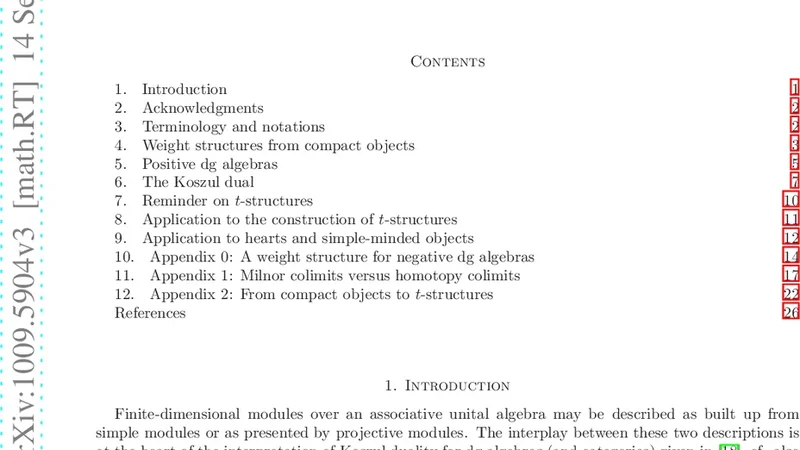
The paper concludes with three technical appendices. Appendix A establishes the equivalence between Milnor colimits and homotopy colimits in the relevant model categories, ensuring that the “direct limit” constructions used in the weight‑truncation process are homotopically sound. Appendix B revisits the classical construction of t‑structures from a set of compact generators, clarifying how the weight‑structure viewpoint streamlines the verification of the t‑structure axioms. Appendix C treats the case of non‑positive dg categories (those with homology only in non‑positive degrees) and shows how to endow the unbounded derived category D⁻(A) with a natural weight structure, which in turn can be used to produce t‑structures on suitable subcategories.
In summary, the authors provide a robust bridge between weight structures and t‑structures, demonstrate how simple modules over the degree‑zero homology of a dg algebra lift uniquely to dg modules, and use this to produce canonical t‑structures on perfect derived categories. Their methods broaden the toolkit for studying derived categories of dg algebras, especially those arising from quivers with potentials, and clarify the categorical underpinnings of simple‑minded objects and their hearts.
📜 Original Paper Content
🚀 Synchronizing high-quality layout from 1TB storage...