Numerical Comparison of Cusum and Shiryaev-Roberts Procedures for Detecting Changes in Distributions
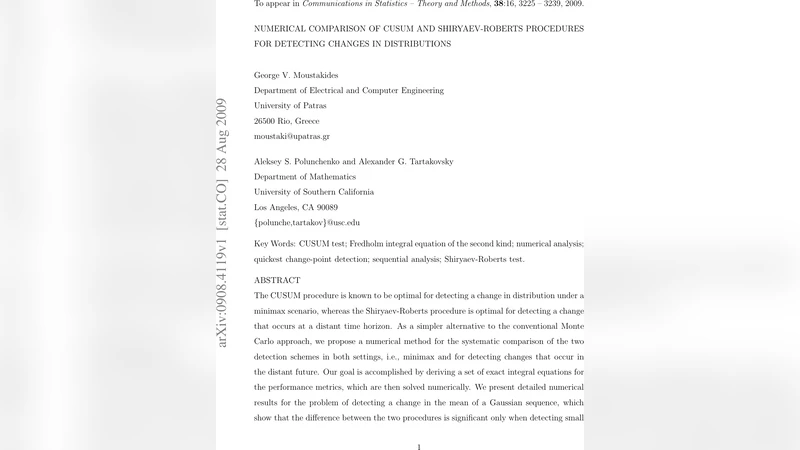
The CUSUM procedure is known to be optimal for detecting a change in distribution under a minimax scenario, whereas the Shiryaev-Roberts procedure is optimal for detecting a change that occurs at a distant time horizon. As a simpler alternative to the conventional Monte Carlo approach, we propose a numerical method for the systematic comparison of the two detection schemes in both settings, i.e., minimax and for detecting changes that occur in the distant future. Our goal is accomplished by deriving a set of exact integral equations for the performance metrics, which are then solved numerically. We present detailed numerical results for the problem of detecting a change in the mean of a Gaussian sequence, which show that the difference between the two procedures is significant only when detecting small changes.
💡 Research Summary
The paper tackles a long‑standing practical question in sequential change‑point detection: how do the classic CUSUM (Cumulative Sum) procedure and the Shiryaev‑Roberts (SR) procedure compare when evaluated under their respective optimality regimes? CUSUM is known to be minimax‑optimal (minimizing the worst‑case average detection delay subject to a fixed average run length, ARL) while SR is optimal in a Bayesian sense for changes that occur far in the future (minimizing the stationary average detection delay). Existing literature largely proves these properties analytically or via asymptotic approximations, but offers little quantitative guidance for finite‑sample settings, especially when the change magnitude and ARL constraints are specified.
To fill this gap, the authors derive exact integral equations for the two key performance metrics—ARL and average detection delay (ADD)—for both procedures. Starting from the likelihood‑ratio recursion that defines the detection statistics, they formulate Volterra‑type equations whose unknowns are the expected stopping times as functions of the current statistic value. For CUSUM the equation involves the transition kernel under the pre‑change distribution; for SR it involves a mixture of pre‑ and post‑change kernels reflecting the “head‑start” nature of the SR statistic. The resulting equations are:
ARL: V(s)=1+∫₀^h K₀(s,s′)V(s′)ds′, V(0)=0
ADD(τ): W(s)=∫₀^h K_τ(s,s′)W(s′)ds′+g_τ(s), W(0)=0
where h is the detection threshold, K₀ and K_τ are the transition densities before and after the change, and g_τ accounts for the immediate contribution at the change point. Because closed‑form solutions are unavailable, the authors propose a robust numerical scheme: discretize the interval
Comments & Academic Discussion
Loading comments...
Leave a Comment