I^K-convergence
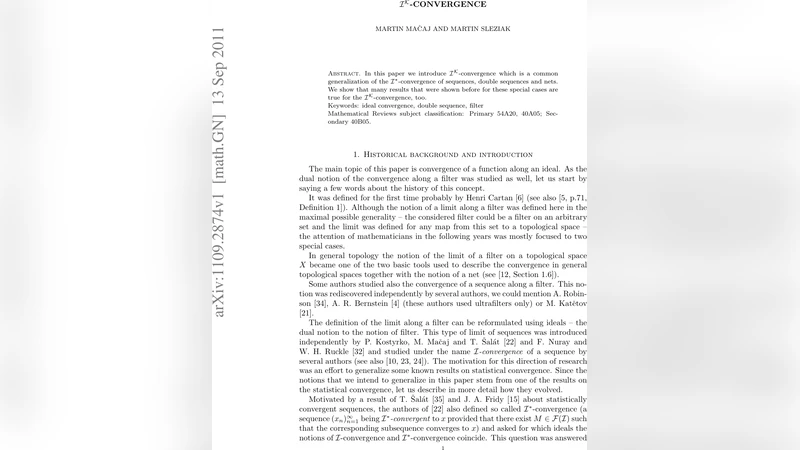
In this paper we introduce I^K-convergence which is a common generalization of the I^K-convergence of sequences, double sequences and nets. We show that many results that were shown before for these special cases are true for the I^K-convergence, too
💡 Research Summary
The paper introduces a new notion called I⁽ᴷ⁾‑convergence, which unifies and extends several previously studied concepts of convergence based on ideals and filters, namely I‑convergence, I*‑convergence, and their variants for sequences, double sequences, and nets.
Background and Motivation
The authors begin with a historical overview of convergence along filters and ideals, tracing its origins to Henri Cartan and subsequent developments by Robinson, Bernstein, Katětov, and others. The modern trend of using ideals to describe convergence (often called I‑convergence) emerged as a way to generalize statistical convergence. Earlier works defined I*‑convergence as the existence of a set M belonging to the filter generated by an ideal I such that the restriction of the sequence (or function) to M converges in the ordinary sense (i.e., Fin‑convergence).
Preliminaries
Standard definitions of ideals, filters, admissibility, maximality, and the dual relationship between them are recalled. I‑convergence of a function f : S → X is defined by the condition that for every neighbourhood U of the limit point x, the pre‑image f⁻¹(U) lies in the filter F(I). Basic properties (monotonicity, uniqueness in Hausdorff spaces, continuity preservation, compactness) are collected in Lemma 2.2.
Definition of I⁽ᴷ⁾‑convergence
The central definition (Definition 3.2) replaces the “Fin” ideal used in I*‑convergence with an arbitrary ideal K on the same index set S. A function f is I⁽ᴷ⁾‑convergent to x if there exists M ∈ F(I) such that the modified function
g(s) = f(s) for s ∈ M, g(s) = x for s ∉ M
is K‑convergent to x. This can be reformulated as a decomposition f = g + h where g is K‑convergent and h is non‑zero only on an I‑small set, mirroring earlier observations for statistical convergence. Lemma 3.5 shows that ordinary K‑convergence automatically yields I⁽ᴷ⁾‑convergence.
Relations Between I‑ and I⁽ᴷ⁾‑convergence
Two implications are investigated:
-
(3.1) I⁽ᴷ⁾‑convergence ⇒ I‑convergence
Proposition 3.7 proves that this direction holds precisely when K ⊆ I. If K is not contained in I, a counterexample is constructed using a set A ∈ K \ I, showing that a function can be I⁽ᴷ⁾‑convergent without being I‑convergent. -
(3.2) I‑convergence ⇒ I⁽ᴷ⁾‑convergence
The authors introduce the additive property AP(I, K), a collection of equivalent conditions (Lemma 3.9) describing a σ‑directedness of the ideal I in the Boolean algebra P(S)/K. When AP(I, K) holds, Theorem 3.11 demonstrates that any I‑convergent function on a first‑countable space is automatically I⁽ᴷ⁾‑convergent. The proof uses the filter F(I) to extract a set A that is K‑smallly away from each neighbourhood pre‑image, thereby constructing the required K‑convergent modification.
Conversely, Theorem 3.12 shows that if implication (3.2) holds for all functions into a first‑countable, non‑finitely‑generated space, then AP(I, K) must be satisfied. The argument builds a function whose values on a countable family of disjoint I‑small sets encode a decreasing neighbourhood basis at an accumulation point; the assumed I⁽ᴷ⁾‑convergence forces the existence of a K‑pseudointersection, which is precisely condition (iv) of Lemma 3.9.
Examples and Limitations
Example 3.14 examines pointwise I‑convergence of sequences of continuous real functions (i.e., convergence in Cₚ(X) with the pointwise topology). This space is not first‑countable, and the example shows that Theorem 3.11’s hypothesis fails: an I‑convergent sequence need not be I⁽ᴷ⁾‑convergent, illustrating the necessity of the countability assumption.
Conclusions and Outlook
The paper establishes I⁽ᴷ⁾‑convergence as a robust unifying framework that encompasses earlier notions for sequences, double sequences, and nets. The additive property AP(I, K) emerges as the key algebraic condition governing the interplay between I‑ and I⁽ᴷ⁾‑convergence. By allowing K to be any ideal, the theory can be tailored to diverse contexts, ranging from statistical convergence (K = Fin) to more exotic convergence modes dictated by specific ideals. The authors suggest further research directions, including extensions to non‑first‑countable spaces, interactions with measure‑theoretic concepts, and potential applications in functional analysis and topology.
Comments & Academic Discussion
Loading comments...
Leave a Comment