MDA-based ATL transformation to generate MVC 2 web models
Development and maintenance of Web application is still a complex and error-prone process. We need integrated techniques and tool support for automated generation of Web systems and a ready prescription for easy maintenance. The MDA approach proposes an architecture taking into account the development and maintenance of large and complex software. In this paper, we apply MDA approach for generating PSM from UML design to MVC 2Web implementation. That is why we have developed two meta-models handling UML class diagrams and MVC 2 Web applications, then we have to set up transformation rules. These last are expressed in ATL language. To specify the transformation rules (especially CRUD methods) we used a UML profiles. To clearly illustrate the result generated by this transformation, we converted the XMI file generated in an EMF (Eclipse Modeling Framework) model.
💡 Research Summary
The paper presents a model‑driven approach for automatically generating MVC 2 web application models from UML class diagrams using the ATL (Atlas Transformation Language) transformation engine. The authors first motivate the need for integrated, automated techniques in web development, noting that current processes remain complex and error‑prone. They then outline the Model‑Driven Architecture (MDA) paradigm, describing its four layers (CIM, PIM, PSM, and implementation frameworks) and the role of meta‑modeling standards such as MOF and ECORE, as well as model‑to‑model transformation languages, focusing on ATL.
Two meta‑models are defined: a source meta‑model that captures the essential elements of a UML class diagram (UMLPackage, Classifier, Property, Operation) and a target meta‑model that mirrors the Struts‑based MVC 2 architecture (Action, ActionForm, ActionMapping, ActionForward, JSP pages). Both meta‑models are implemented as ECORE models within the Eclipse Modeling Framework (EMF).
To express business operations that are not directly representable in plain UML, the authors create a UML profile containing four stereotypes: «Create», «Retrieve», «Update», and «Delete». These stereotypes annotate classes and operations in the source diagram, specifying the required input parameters, constraints, and expected navigation flow for each CRUD operation. The profile thus bridges the gap between high‑level design and the concrete MVC 2 components that will be generated.
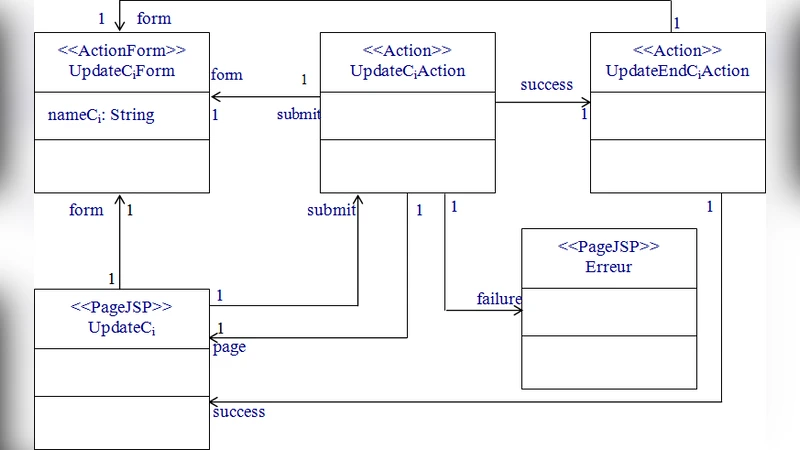
The core contribution lies in the ATL transformation rules. The rules traverse the source model, detect classes annotated with the CRUD stereotypes, and instantiate corresponding elements in the target model. For example, a «Create» stereotype triggers the creation of an ActionForm class to hold input fields, an Action class to process the creation logic, and the necessary ActionMapping and JSP page entries. The «Retrieve» stereotype generates list‑display JSP pages and forward configurations but deliberately omits an ActionForm for the root class, reflecting typical read‑only behavior. Similar mappings are defined for «Update» and «Delete». The ATL code combines declarative mappings with helper functions and conditional statements to handle association navigation and attribute propagation.
Executing the transformation yields an XMI file that encodes the complete MVC 2 model, which can be imported back into EMF for visual inspection. The authors demonstrate the process with a sample diagram containing three classes (Ci, Cj, Ck). The resulting model includes all required Actions, ActionForms, JSP pages, and forward definitions for each CRUD operation, confirming that the transformation faithfully reproduces the intended web architecture.
In the related‑work section, the paper surveys existing model transformation languages (ATL, QVT) and code generation tools (AndroMDA, UWE, WebML), noting that most prior efforts focus on generating code from use‑case or requirement models, or target different platforms such as Ajax or .NET. The authors argue that their approach is distinct because it explicitly models CRUD behavior via UML profiles and produces a full MVC 2 PSM using ATL, thereby offering a more complete pipeline from class diagram to deployable web model.
The conclusion reiterates that the proposed MDA‑based method automates the creation of essential web‑application artifacts from a UML class diagram, supporting creation, retrieval, update, and deletion of linked objects. Future work includes extending the transformation to generate actual Java/Struts source code, integrating additional MVC frameworks (e.g., Spring MVC), and enhancing the profile to cover more complex business rules and security constraints.
Comments & Academic Discussion
Loading comments...
Leave a Comment