Statistical Physics for Humanities: A Tutorial
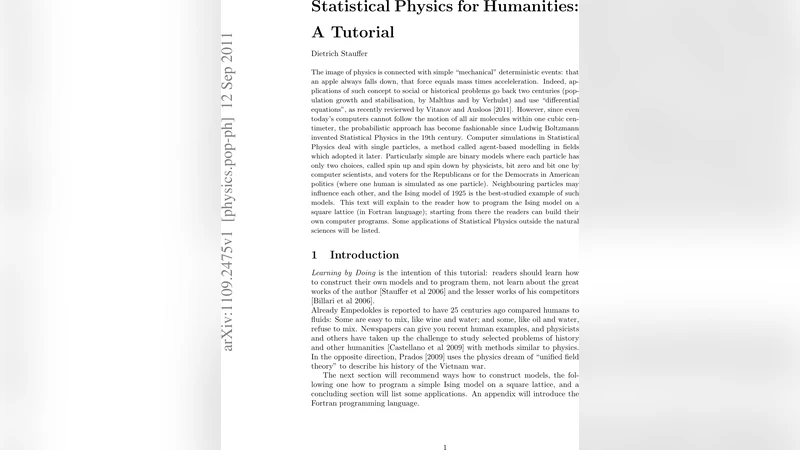
The image of physics is connected with simple “mechanical” deterministic events: that an apple always falls down, that force equals mass times acceleleration. Indeed, applications of such concept to social or historical problems go back two centuries (population growth and stabilisation, by Malthus and by Verhulst) and use “differential equations”, as recently revierwed by Vitanov and Ausloos [2011]. However, since even today’s computers cannot follow the motion of all air molecules within one cubic centimeter, the probabilistic approach has become fashionable since Ludwig Boltzmann invented Statistical Physics in the 19th century. Computer simulations in Statistical Physics deal with single particles, a method called agent-based modelling in fields which adopted it later. Particularly simple are binary models where each particle has only two choices, called spin up and spin down by physicists, bit zero and bit one by computer scientists, and voters for the Republicans or for the Democrats in American politics (where one human is simulated as one particle). Neighbouring particles may influence each other, and the Ising model of 1925 is the best-studied example of such models. This text will explain to the reader how to program the Ising model on a square lattice (in Fortran language); starting from there the readers can build their own computer programs. Some applications of Statistical Physics outside the natural sciences will be listed.
💡 Research Summary
The paper “Statistical Physics for Humanities: A Tutorial” presents a practical guide for applying the methods of statistical physics to problems in the humanities and social sciences. It begins by contrasting the traditional deterministic view of physics—exemplified by Newton’s law F = ma—with the modern probabilistic approach pioneered by Ludwig Boltzmann, emphasizing that the sheer number of microscopic degrees of freedom makes a full deterministic description impossible. The author then introduces agent‑based modeling, equating each agent with a binary variable (spin = ±1, bit = 0/1, or a voter for one of two parties). This binary abstraction is argued to be the simplest yet sufficiently rich representation for many social phenomena.
The tutorial proceeds to discuss model building. It defines a “model” as a mathematical description of individual elements and their interactions, citing classic demographic models (Malthus, Verhulst) as early examples of differential‑equation based approaches. The author stresses the “as simple as possible, but not simpler” principle, encouraging researchers to start with binary variables before moving to more complex multi‑state or continuous representations. Human mortality, voting patterns, and other aggregate statistics are shown to be well‑approximated by large‑sample averages, even though individual behavior is far more intricate.
A key conceptual shift is presented in the “Deterministic vs Statistical” section. Historical deterministic models of war preparation (e.g., Richardson’s 1935 equations) are contrasted with modern stochastic simulations that rely on random numbers to emulate the inherent uncertainty of large populations. The paper then introduces the Boltzmann distribution, p ∝ exp(–E/T), and the partition function Z, explaining that temperature T can be interpreted as a measure of social randomness or uncertainty rather than a physical temperature measured in Kelvin.
The core of the tutorial is the exposition of the Ising model. Each lattice site i carries a spin S_i = ±1, interacting with its four nearest neighbours on a square lattice via an energy term –J S_i S_j (J>0 favors alignment) and an external field term –H S_i (H represents a governmental or media bias). The total energy is E = –J∑⟨ij⟩S_iS_j – H∑_iS_i. The model’s statistical mechanics are described: at T = 0 the system is fully ordered (complete conformity), at T → ∞ it is completely random, and at intermediate temperatures the probability of a configuration follows the Boltzmann weight. The author notes that in two dimensions the critical temperature is exactly T_c/J ≈ 2.27, leading to spontaneous magnetization (M ≠ 0) for T < T_c, while in one dimension T_c = 0, illustrating the importance of dimensionality.
Mean‑field theory is presented as an analytical shortcut: replacing each neighbour’s spin by the average magnetization m yields an effective field H_eff = H + q m (q is the coordination number) and the self‑consistency equation m = tanh
Comments & Academic Discussion
Loading comments...
Leave a Comment