Query processing in distributed, taxonomy-based information sources
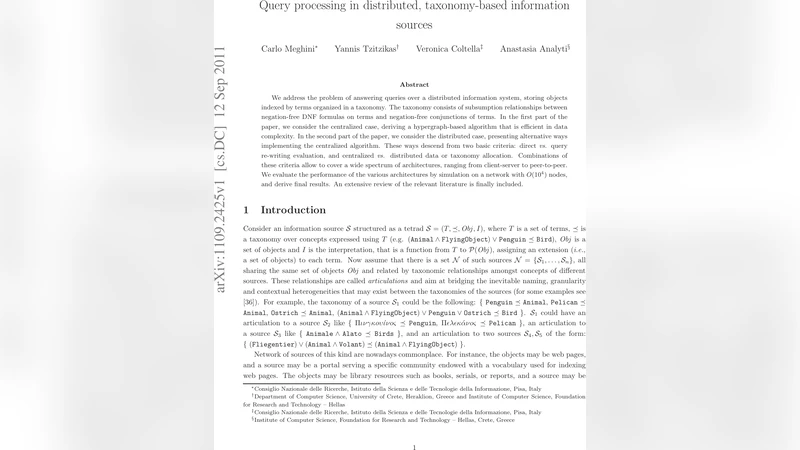
We address the problem of answering queries over a distributed information system, storing objects indexed by terms organized in a taxonomy. The taxonomy consists of subsumption relationships between negation-free DNF formulas on terms and negation-free conjunctions of terms. In the first part of the paper, we consider the centralized case, deriving a hypergraph-based algorithm that is efficient in data complexity. In the second part of the paper, we consider the distributed case, presenting alternative ways implementing the centralized algorithm. These ways descend from two basic criteria: direct vs. query re-writing evaluation, and centralized vs. distributed data or taxonomy allocation. Combinations of these criteria allow to cover a wide spectrum of architectures, ranging from client-server to peer-to-peer. We evaluate the performance of the various architectures by simulation on a network with O(10^4) nodes, and derive final results. An extensive review of the relevant literature is finally included.
💡 Research Summary
The paper tackles the problem of answering Boolean queries over a distributed information system in which objects are indexed by terms organized in a taxonomy. A taxonomy consists of subsumption relationships between negation‑free disjunctive normal form (DNF) formulas and conjunctions of terms. The authors first consider a centralized setting and derive a hypergraph‑based algorithm that evaluates queries with polynomial data complexity, which matches the theoretical lower bound for this problem.
The core of the approach is a formal model: an information source S is a quadruple (T, Γ, Obj, I) where T is a set of terms, Γ a set of subsumption pairs (q → d), Obj a finite set of objects, and I a mapping from terms to subsets of Obj. Queries are built from terms using ∧ and ∨ without negation. By converting each subsumption (q → d) into Horn clauses and then into a directed B‑hypergraph (hyperedges have a single head and possibly many tails), the authors show that an object o belongs to the answer of a term t iff t is B‑connected to the distinguished vertex “true” in the object‑specific hypergraph Hₒ. This equivalence reduces query answering to a reachability test in a hypergraph.
In the centralized case the algorithm constructs Hₒ for each object, performs a depth‑first (or breadth‑first) search from true to the target term, and caches intermediate results. Because each object can be processed independently, the overall data complexity is O(|Obj|). The algorithm is simple, sound, complete, and optimal with respect to data size.
To move to a distributed environment the paper introduces two orthogonal design dimensions:
- Evaluation mode – direct evaluation (the query is sent as‑is to the nodes that hold the data) versus query rewriting (a central component first rewrites the query into a set of simpler, single‑term queries).
- Data/taxonomy allocation – either the taxonomy, the object interpretations, or both are stored centrally, or they are distributed across the peers.
Combining these dimensions yields five distinct architectures:
- Client‑Server Direct – both taxonomy and interpretations reside on a central server; clients forward full queries.
- Client‑Server Rewriting – the taxonomy is central, but a rewriting component simplifies queries before they reach the interpretation server.
- Hybrid (Central Taxonomy, Distributed Interpretations) with Rewriting – a central taxonomy server rewrites queries, which are then evaluated in parallel on distributed peers holding the object mappings.
- Pure Peer‑to‑Peer Direct – each peer stores its own taxonomy and interpretations; queries are routed peer‑to‑peer and evaluated locally without rewriting.
- Pure Peer‑to‑Peer Rewriting – a lightweight central rewriting service exists, but both taxonomy and interpretations are fully distributed; peers receive only rewritten single‑term queries.
The authors evaluate these architectures through extensive simulations on a synthetic network of 10 000 nodes, calibrated with parameters observed in the Gnutella network. Metrics include average response time, network traffic, and cache hit ratio. The results show:
- The classic client‑server direct evaluation yields the lowest response time, as expected, because all processing is centralized and network hops are minimized.
- Among the distributed designs, the hybrid architecture (central taxonomy, distributed interpretations, with query rewriting) performs best, achieving response times close to the client‑server baseline while dramatically reducing redundant accesses to the same peer.
- Pure P2P designs incur the highest latency due to routing overhead and repeated hypergraph traversals across many peers.
- Caching of intermediate results provides a 20‑35 % reduction in response time across all architectures.
The paper concludes that a mixed approach—centralizing the taxonomy to enable efficient rewriting while keeping object interpretations distributed—offers the most favorable trade‑off for large‑scale, heterogeneous environments. The hypergraph‑based formulation provides a clean theoretical foundation, and the empirical study validates its practical relevance.
Future work suggested includes handling dynamic articulations (cross‑source mappings), extending the model to support negation and more expressive logical operators, and designing more sophisticated distributed hypergraph traversal algorithms to further improve pure P2P performance.
Comments & Academic Discussion
Loading comments...
Leave a Comment