Weighted reciprocity in human communication networks
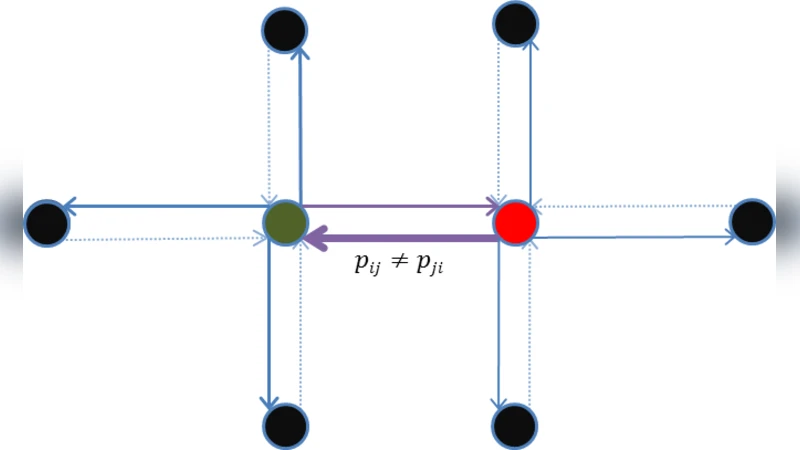
In this paper we define a metric for reciprocity—the degree of balance in a social relationship—appropriate for weighted social networks in order to investigate the distribution of this dyadic feature in a large-scale system built from trace-logs of over a billion cell-phone communication events across millions of actors. We find that dyadic relations in this network are characterized by much larger degrees of imbalance than we would expect if persons kept only those relationships that exhibited close to full reciprocity. We point to two structural features of human communication behavior and relationship formation—the division of contacts into strong and weak ties and the tendency to form relationships with similar others—that either help or hinder the ability of persons to obtain communicative balance in their relationships. We examine the extent to which deviations from reciprocity in the observed network are partially traceable to these characteristics.
💡 Research Summary
The paper tackles a fundamental methodological gap in the study of social reciprocity: traditional definitions rely on binary ties—whether a person names another as a friend or not—while real-world human interactions are inherently weighted, reflecting repeated exchanges such as phone calls, messages, or face‑to‑face encounters. To address this, the authors introduce a weighted reciprocity metric, Rᵢⱼ = |ln(pᵢⱼ) – ln(pⱼᵢ)|, where pᵢⱼ = wᵢⱼ / wᵢ⁺ is the probability that individual i initiates a communication toward j, wᵢⱼ being the raw count of directed interactions and wᵢ⁺ the total outgoing communication volume of i. This formulation satisfies four desiderata: (1) it reaches zero when the two directed weights are equal, (2) it grows monotonically with the absolute difference between the two weights, (3) it normalizes for individual differences in overall activity (communicative propensity), and (4) it is symmetric (Rᵢⱼ = Rⱼᵢ).
The authors first explore several idealized scenarios to build intuition. Under an “equidispersion” assumption—each person distributes their total communication evenly across all contacts—the expected directed weight is wᵢⱼ = wᵢ⁺ / k_outᵢ, leading to a simplified reciprocity expression Rᵢⱼ = |ln(k_outⱼ) – ln(k_outᵢ)|. In this case, reciprocity depends solely on the difference in out‑degree; if two nodes have the same number of contacts, reciprocity is perfect regardless of their absolute activity levels. This scenario highlights the role of degree assortativity: networks where high‑degree nodes tend to connect with other high‑degree nodes (positive assortativity) should, all else equal, exhibit lower average R values (more balanced dyads). Conversely, disassortative mixing pushes dyads toward higher imbalance.
When the equidispersion condition fails—i.e., individuals allocate more communication to a subset of contacts—the metric reduces to the log‑ratio of the raw directed weights, Rᵢⱼ = |ln(wᵢⱼ) – ln(wⱼᵢ)|, revealing that any deviation from equal allocation (core‑periphery behavior) directly inflates reciprocity. A further case arises when the directed weights are equal but the total outgoing strengths differ; then Rᵢⱼ = |ln(wⱼ⁺) – ln(wᵢ⁺)|, again indicating imbalance due to differing overall activity rather than dyadic asymmetry.
Empirically, the authors apply this framework to a massive mobile‑phone dataset: over one billion voice calls exchanged among eight million subscribers of a single European carrier during a two‑month period in 2008, yielding a directed weighted graph with roughly 300 million edges. After filtering out non‑human traffic (e.g., automated services), they compute R for every dyad. The distribution is heavily skewed toward positive values; the majority of dyads exhibit substantial imbalance, with many having R values corresponding to one partner making five times as many calls as the other.
Two structural mechanisms are identified as primary drivers of this imbalance. First, the classic “strong‑tie/weak‑tie” dichotomy: individuals tend to concentrate communication on a small core of strong ties while maintaining many peripheral weak ties. When one partner treats the relationship as strong (high weight) and the other treats it as weak (low weight), reciprocity deteriorates. Second, degree assortativity is present in the network (high‑degree nodes preferentially link to other high‑degree nodes), but because real communication is far from equidispersed, the assortative mixing does not compensate for the strong core‑periphery allocation, and the overall reciprocity remains low.
The findings have several implications. They challenge the adequacy of binary reciprocity measures, which would label many of these dyads as “mutual” despite clear behavioral asymmetry. They also suggest that relationship stability may be more closely tied to the balance of interaction frequencies than to nominal declarations of friendship. High asymmetry could signal potential relationship decay or unequal investment, aligning with sociological theories of balance and exchange.
Finally, the authors propose that the weighted reciprocity metric can be a valuable tool across disciplines—sociology, organizational studies, network science—where quantifying the degree of mutual investment matters. Future work could extend the analysis to multimodal communication (texts, social‑media messages), explore temporal dynamics of reciprocity (how R evolves over time), and integrate the metric into predictive models of tie formation, dissolution, and diffusion processes.
Comments & Academic Discussion
Loading comments...
Leave a Comment