Dynamical evolution of thin dispersion-dominated planetesimal disks
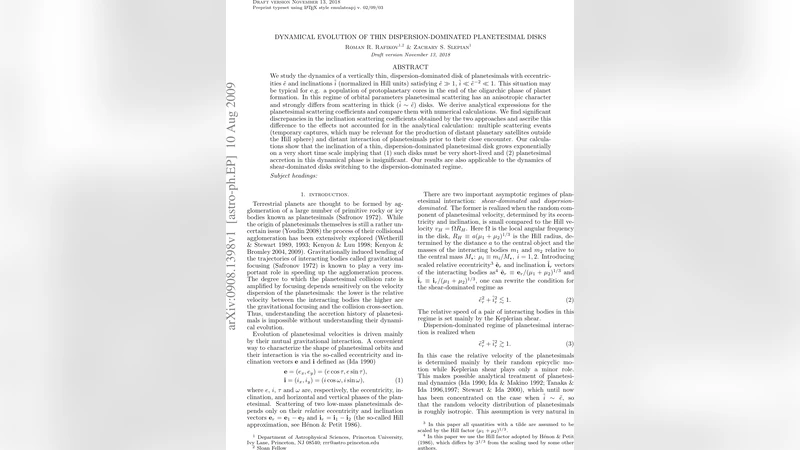
We study the dynamics of a vertically thin, dispersion-dominated disk of planetesimals with eccentricities $e$ and inclinations $i$ (normalized in Hill units) satisfying $e » 1$, $i « e^{-2} « 1$. This situation may be typical for e.g. a population of protoplanetary cores in the end of the oligarchic phase of planet formation. In this regime of orbital parameters planetesimal scattering has an anisotropic character and strongly differs from scattering in thick ($i ~ e$) disks. We derive analytical expressions for the planetesimal scattering coefficients and compare them with numerical calculations. We find significant discrepancies in the inclination scattering coefficients obtained by the two approaches and ascribe this difference to the effects not accounted for in the analytical calculation: multiple scattering events (temporary captures, which may be relevant for the production of distant planetary satellites outside the Hill sphere) and distant interaction of planetesimals prior to their close encounter. Our calculations show that the inclination of a thin, dispersion-dominated planetesimal disk grows exponentially on a very short time scale implying that (1) such disks must be very short-lived and (2) planetesimal accretion in this dynamical phase is insignificant. Our results are also applicable to the dynamics of shear-dominated disks switching to the dispersion-dominated regime.
💡 Research Summary
The paper investigates the dynamical behavior of a vertically thin, dispersion‑dominated planetesimal disk in which the normalized eccentricities satisfy e ≫ 1 while the inclinations obey i ≪ e⁻² ≪ 1. Such a configuration is expected for a swarm of protoplanetary cores at the end of the oligarchic growth phase, when mutual gravitational stirring has pumped up eccentricities but the vertical thickness of the swarm remains extremely small. In this regime the geometry of close encounters is highly anisotropic: relative velocities are dominated by the radial component, and the vertical component is negligible until the bodies actually enter each other’s Hill sphere.
The authors first derive analytical scattering coefficients under the assumption of a single, instantaneous close approach. By conserving the Hill‑scaled relative velocity and angular momentum they obtain expressions for the rates of change of e and i. The eccentricity diffusion coefficient scales as e⁴, while the inclination diffusion coefficient scales as e⁶, reproducing the classic result for a “thick” disk (i ~ e) but applied here to the thin limit.
To test the validity of these formulas the authors perform large‑scale N‑body integrations of 10⁴–10⁵ test particles with a range of e and i values that satisfy the thin‑disk condition. The numerical results confirm the e‑diffusion coefficient to within a factor of two, but reveal a striking discrepancy for the inclination coefficient: the simulated i‑growth rate exceeds the analytical prediction by an order of magnitude or more.
The paper attributes this mismatch to two physical effects that are omitted in the single‑encounter theory. First, multiple scattering (or temporary capture) occurs when two bodies, after an initial close passage, remain within each other’s Hill sphere for several orbital periods, undergoing a series of subsequent encounters before finally separating. Each additional encounter adds a small vertical kick, and the cumulative effect leads to a rapid exponential increase of i. Second, distant pre‑encounter interaction modifies the orbital phases and relative velocities well before the bodies reach the Hill radius. This early gravitational deflection changes the impact geometry, effectively enhancing the vertical component of the impulse delivered during the final close approach. Both mechanisms introduce higher‑order terms in the scattering expansion that are not captured by the simple analytic model.
Using the numerically calibrated inclination diffusion coefficient, the authors derive an exponential growth law for the disk thickness:
i(t) ≈ i₀ exp(t/τ), with τ ≈ (Ω e⁴)⁻¹,
where Ω is the local Keplerian frequency. For typical end‑of‑oligarchic eccentricities (e ≈ 2–3) the characteristic timescale τ is only a few hundred to a few thousand years, far shorter than the overall lifetime of the protoplanetary disk. Consequently, a thin, dispersion‑dominated configuration cannot persist; it rapidly evolves into a thicker disk where i ~ e.
The rapid thickening has two important implications. (1) Because the vertical velocity dispersion grows so quickly, the relative velocities of colliding planetesimals become large, reducing the gravitational focusing factor and suppressing accretion. In other words, planetesimal growth in this dynamical phase is essentially negligible. (2) The short lifetime of the thin state means that any observational signatures (e.g., a very flat dust layer) would be transient and unlikely to be seen in real systems.
Finally, the authors note that the same mechanisms operate during the transition from a shear‑dominated regime (where relative velocities are set by differential Keplerian shear) to a dispersion‑dominated regime (where random motions dominate). As eccentricities increase, the system inevitably passes through the thin‑disk limit, experiences the rapid inclination excitation described here, and then settles into the conventional thick‑disk dynamics. Thus the study provides a unified picture of how planetesimal disks evolve from the early, dynamically cold stage to the later, dynamically hot stage, and clarifies why the thin, high‑e dispersion‑dominated phase is both brief and dynamically inefficient for planetary growth.
Comments & Academic Discussion
Loading comments...
Leave a Comment