Kuratowskis Theorem for Two Closure Operators
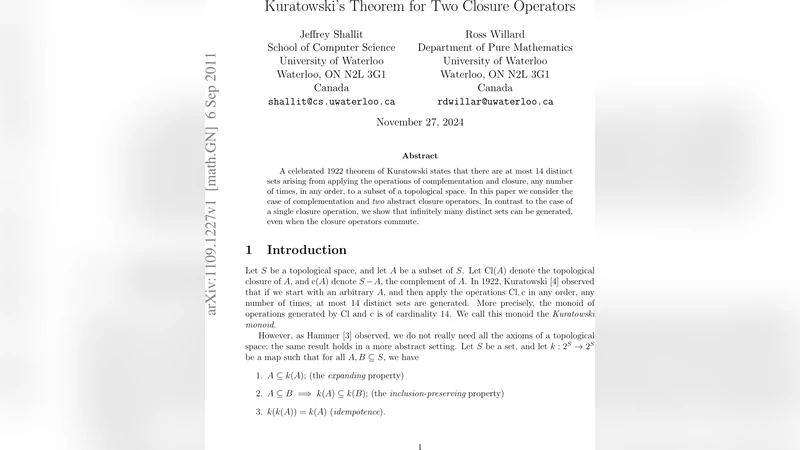
A celebrated 1922 theorem of Kuratowski states that there are at most 14 distinct sets arising from applying the operations of complementation and closure, any number of times, in any order, to a subset of a topological space. In this paper we consider the case of complementation and two abstract closure operators. In contrast to the case of a single closure operation, we show that infinitely many distinct sets can be generated, even when the closure operators commute.
💡 Research Summary
The paper investigates a natural generalisation of Kuratowski’s classic 1922 theorem, which states that at most fourteen distinct sets can be obtained by repeatedly applying closure and complement operations to a subset of a topological space. While the original result holds for a single closure operator, the authors consider the situation where two abstract closure operators, denoted p and q, are available together with the complement operator c.
The authors begin by recalling the standard definition of a closure operator as a map k : 2^S → 2^S satisfying extensivity (A ⊆ k(A)), monotonicity (A ⊆ B ⇒ k(A) ⊆ k(B)), and idempotence (k(k(A)) = k(A)). They note that for a single operator k the monoid generated by {k, c} has exactly fourteen elements, a fact originally proved by Kuratowski and later abstracted by Hammer.
Moving to two operators, they first prove a basic identity (Theorem 1): for any closure operators p and q, the composite pcq cpcq is equivalent to pcq. This mirrors the single‑operator identity k c k c k = k c k, but it does not by itself guarantee finiteness of the monoid generated by {p, q, c}. Indeed, they exhibit a simple example on the natural numbers where p adds the next odd integer and q adds the next even integer; iterating pq yields (pq)^n({0}) = {0,…,2^n}, showing that the monoid can be infinite even without complement.
The paper then focuses on the case where p and q commute (pq = qp). Under this additional hypothesis a wealth of new identities emerges. The authors list several concrete equalities (e.g., pq c p c q c q c p c p q ≡ pq c p q) and prove a general theorem (Theorem 4) stating that for any even‑length word a₁…a₂ₙ with each aᵢ ∈ {p, q, pq}, the expression
pq c a₁ c a₂ … c a₂ₙ c pq
is always equivalent to pq c pq. The proof relies on the observation that for each a the operator c a c is an interior operator (idempotent, monotone, and contracting), and on systematic insertion of complementary pairs to “balance” the word.
To formalise these observations the authors introduce a first‑order theory T₂com. Its language contains constants 1, p, q, a binary composition “·”, a unary complement “c”, and a binary order ≤. The axioms encode that (M, ·, 1) is a monoid, ≤ is a partial order compatible with composition, 1 ≤ p = p p, 1 ≤ q = q q, and the commutation pq = qp. Models of T₂com are precisely inclusion‑preserving maps on power sets together with the complement operation (which itself is not a closure operator). Within this framework the authors show that any two c‑balanced words that are equivalent for all commuting closure operators must be provably equal in T₂com, linking semantic equivalence to syntactic provability.
The central contribution is an explicit construction of commuting closure operators that generate an infinite monoid even when the complement is present. The authors define four pairs (pᵢⱼ, qᵢⱼ) on ℤ, each handling different parity or trivial cases, and then extend them to a larger set S = ℤ ∪ {⊤, ⊥}. The final operators p and q act as follows: they apply the appropriate pᵢⱼ or qᵢⱼ on the integer part of a set and preserve the special points ⊤, ⊥. These p and q are shown to be closure operators, to commute, and to leave the special points untouched.
With these operators, the authors consider the word wₙ = (c p c p c q c q)ⁿ. Starting from A = {0, ⊤}, a straightforward calculation yields wₙ(A) = {2ⁿ, ⊤} for every n ≥ 1. Since the sets {2ⁿ, ⊤} are all distinct, the collection {wₙ(A) : n ∈ ℕ} is infinite, proving that the monoid generated by {c, p, q} is infinite (Theorem 8).
In the concluding section the authors pose two open problems. First, whether the set Σ of all formal equations w₁ = w₂ (with w₁, w₂ ∈ {c, p, q}* and semantic equivalence for all commuting closure operators) is decidable. Second, whether Σ admits a finite basis, i.e., whether the monoid with generators c, p, q and relations Σ can be presented with finitely many defining equations. These questions highlight the deeper algebraic complexity introduced by multiple interacting closure operators and suggest directions for future research.
Overall, the paper demonstrates that the elegant finiteness of the classic Kuratowski monoid does not survive the addition of a second closure operator, even under the strong commutation assumption, and it opens a rich line of inquiry into the algebraic structures generated by closure and complement operations.
Comments & Academic Discussion
Loading comments...
Leave a Comment