Mach Number Dependence of Turbulent Magnetic Field Amplification: Solenoidal versus Compressive Flows
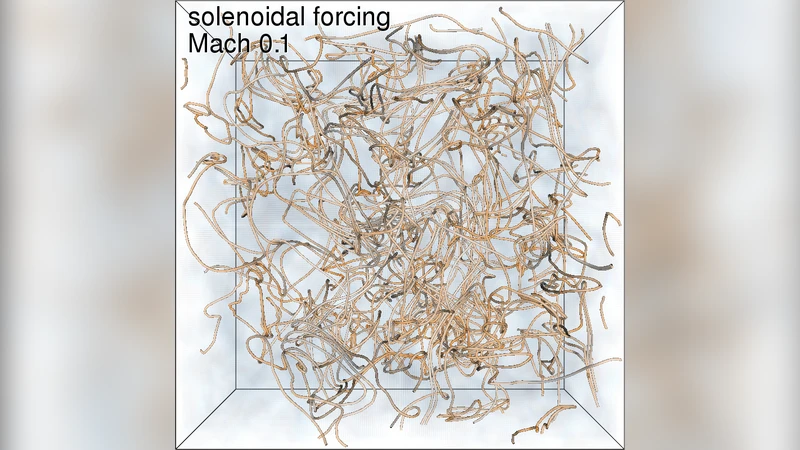
We study the growth rate and saturation level of the turbulent dynamo in magnetohydrodynamical simulations of turbulence, driven with solenoidal (divergence-free) or compressive (curl-free) forcing. For models with Mach numbers ranging from 0.02 to 20, we find significantly different magnetic field geometries, amplification rates, and saturation levels, decreasing strongly at the transition from subsonic to supersonic flows, due to the development of shocks. Both extreme types of turbulent forcing drive the dynamo, but solenoidal forcing is more efficient, because it produces more vorticity.
💡 Research Summary
This paper presents a systematic numerical investigation of the turbulent dynamo – the process by which a weak seed magnetic field is exponentially amplified by turbulent motions – focusing on how the growth rate and saturation level depend on the flow Mach number and on the nature of the turbulent forcing. The authors perform three‑dimensional magnetohydrodynamic (MHD) simulations using the FLASH code, covering a wide range of rms Mach numbers from 0.02 up to 20, which is considerably broader than in previous studies. For each Mach number they run two families of simulations: one with solenoidal (divergence‑free) forcing, which injects vorticity directly, and one with compressive (curl‑free) forcing, which injects only compressive motions. The forcing is generated by a stochastic Ornstein‑Uhlenbeck process and projected in Fourier space to obtain pure solenoidal or pure compressive components (ζ = 1 or ζ = 0, respectively).
The initial conditions are isothermal (constant sound speed), uniform density, zero bulk velocity, and an extremely weak magnetic field (plasma β ≈ 10²⁰). The simulations are carried out on uniform grids of 128³, 256³, and 512³ cells to demonstrate convergence. Most runs solve the ideal MHD equations (ν = η = 0) so that dissipation arises only from numerical truncation; a subset of four representative models is also repeated with explicit viscosity and resistivity (non‑ideal MHD) to verify that the results are not artefacts of the numerical scheme.
The magnetic energy grows exponentially, Eₘ = Eₘ₀ exp(Γ t), until it reaches a saturation level that is a fraction of the kinetic energy, (Eₘ/Eₖ)ₛₐₜ. Both the exponential growth rate Γ and the saturation fraction depend strongly on the Mach number and on the forcing type. Solenoidal forcing consistently yields larger Γ and higher saturation fractions than compressive forcing. In the subsonic regime (M < 1) solenoidal runs achieve saturation levels of 40–60 % of the kinetic energy, while compressive runs barely amplify the field (saturation < 1 %). This difference is traced to the amount of vorticity present: solenoidal forcing directly injects rotational motions, enabling the classic “stretch‑twist‑fold” dynamo mechanism to operate efficiently. In contrast, compressive forcing does not inject vorticity; any vortical motions arise only from viscous terms acting on density gradients, which are weak at low Mach numbers, leading to negligible dynamo action.
A striking feature appears at the transition from subsonic to supersonic flow (M ≈ 1). At this Mach number shocks become prevalent, as shown by the density renderings. Shocks disrupt coherent vortical structures, thereby suppressing the dynamo. Consequently, both forcing types exhibit a pronounced dip in Γ and in (Eₘ/Eₖ)ₛₐₜ around M ≈ 1. When the Mach number is increased further (M ≈ 2–20), the situation changes: oblique, colliding shocks generate vorticity anew, partially restoring the dynamo efficiency. In this high‑Mach regime the growth rate scales roughly as Γ ∝ M¹ᐟ³ for both forcings, a behaviour that differs from analytic predictions for purely acoustic turbulence (Γ ∝ M³) and from incompressible Kolmogorov‑based theories (which predict no Mach‑number dependence).
The authors quantify the solenoidal fraction of the kinetic energy, χ = E_sol/E_tot, and find that χ drops sharply for compressive forcing at low Mach numbers, confirming the lack of rotational energy. For solenoidal forcing χ remains high (≈ 0.7–0.9) across the whole Mach range, indicating a persistent reservoir of vorticity. The magnetic field morphology also reflects the forcing: compressive runs display relatively straight, volume‑filling field lines, whereas solenoidal runs produce tangled, space‑filling magnetic structures, consistent with more efficient field line stretching.
Resolution tests demonstrate that the measured growth rates and saturation levels converge with increasing grid resolution, and that the inclusion of explicit viscosity and resistivity (Pm ≈ 2, Re ≈ 1500) does not alter the main conclusions. This establishes that the observed dynamo behaviour is physical rather than a numerical artefact.
The paper places its results in the context of existing dynamo theory. Classical models based on Kolmogorov turbulence (e.g., Subramanian 1997) predict Γ ∝ Re¹ᐟ² and no explicit Mach‑number dependence, which is inconsistent with the present findings, especially in the supersonic, shock‑dominated regime. The authors argue that extending dynamo theory to include Burgers‑type turbulence (characterised by shocks) and to account for finite magnetic Prandtl numbers (Pm ≈ 1) is essential for a comprehensive description.
In astrophysical terms, the study shows that even purely compressive driving – a plausible model for turbulence generated by supernova blast waves or large‑scale galactic shocks – can sustain a turbulent dynamo, albeit less efficiently than solenoidal driving. This has implications for magnetic field amplification in molecular clouds, star‑forming regions, and early galaxies, where supersonic, highly compressible turbulence is common. The identified dip in dynamo efficiency at M ≈ 1 suggests that environments transitioning from subsonic to supersonic turbulence may experience a temporary slowdown in magnetic field growth, followed by a resurgence as shock‑induced vorticity becomes dominant at higher Mach numbers.
Overall, the paper provides a comprehensive, high‑resolution numerical dataset that maps out the dependence of turbulent dynamo growth on both compressibility (Mach number) and the nature of turbulent forcing, highlighting the central role of vorticity generation and shock physics in determining magnetic field amplification efficiency.
Comments & Academic Discussion
Loading comments...
Leave a Comment