Use of floating surface detector stations for the calibration of a deep-sea neutrino telescope
We propose the operation of floating Extensive Air Shower (EAS) detector stations in coincidence with the KM3NeT Mediterranean deep-sea neutrino telescope to determine the absolute position and orientation of the underwater detector and to investigate possible systematic angular errors. We evaluate the accuracy of the proposed calibration strategies using a detailed simulation of the EAS and KM3NeT detectors.
💡 Research Summary
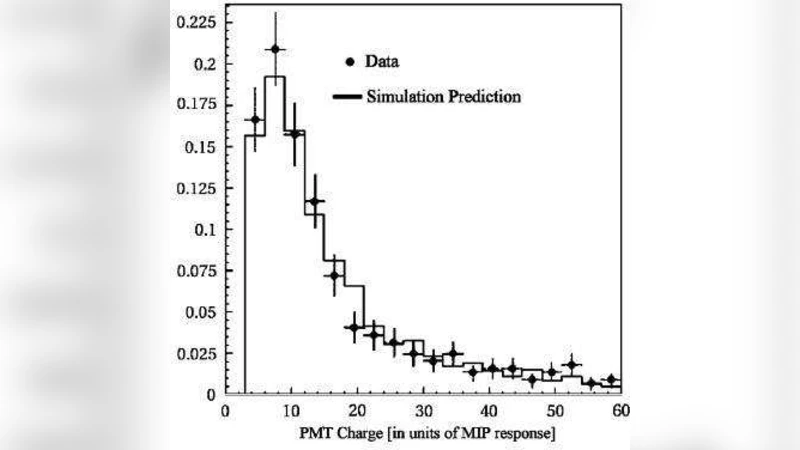
The paper proposes a novel calibration system for the forthcoming KM3NeT deep‑sea neutrino telescope by deploying floating Extensive Air Shower (EAS) detector stations, specifically the HELYCON array, on the sea surface directly above the underwater instrument. Each HELYCON station consists of six 1 m² plastic scintillator tiles coupled to wavelength‑shifting fibers and fast photomultiplier tubes, read out by a CERN HPTDC chip with a timing precision better than 100 ps. The stations are synchronized via GPS and transmit data over the internet to a central server.
A comprehensive Monte‑Carlo chain is employed: CORSIKA generates atmospheric showers in the energy range 10¹⁴–5×10¹⁵ eV; a dedicated HELYCON simulation models the response of the surface detectors; and KM3Sim (a GEANT4‑based package) propagates muons through 4000 m of seawater, simulates Cherenkov photon production, and models the response of KM3NeT’s optical modules (OMs). The studies show that about 35 % of showers in the considered energy band contain muons with energies above 2 TeV capable of reaching the deep‑sea detector. Of these muons, roughly two‑thirds can be reconstructed by KM3NeT with an angular precision of 0.1°.
The calibration strategy has two complementary parts. First, for each coincident event, the shower axis direction reconstructed from the HELYCON array is compared with the muon track direction reconstructed by KM3NeT. The distribution of the zenith‑angle differences should be centered at zero; any statistically significant shift would reveal a systematic angular bias in the neutrino telescope’s reconstruction. By requiring at least three active HELYCON detectors (signal > 4 MIP) per event, the single‑shower angular resolution is about 0.1°. Simulations indicate that operating three independent floating arrays, each spaced 150 m apart and covering ≈360 m², for a ten‑day period yields a combined systematic‑offset measurement precision of 0.05°.
Second, the absolute position of the underwater detector is obtained by measuring, on an event‑by‑event basis, the distance between the impact point of the reconstructed muon track on the sea surface and the shower axis footpoint. The positional resolution per shower ranges from 20 m to 35 m depending on the number of active surface detectors. Averaging over the same ten‑day data set reduces the uncertainty to about 0.6 m, assuming the floating platform positions are known with much higher precision (GPS plus high‑precision tiltmeters can deliver sub‑0.05° inclination measurements).
The authors acknowledge several practical limitations. Platform motion due to waves and wind can introduce inclination and positional jitter; however, they argue that commercial tiltmeters provide sufficient accuracy to correct for this effect. Potential degradation of GPS signals, data latency, and power supply issues in a marine environment are not explicitly modeled and would need to be addressed in a real‑world deployment. Moreover, the study assumes that the relative positions of KM3NeT’s optical modules are already known from acoustic positioning, focusing solely on the global offset and absolute location.
In conclusion, the floating HELYCON arrays constitute an independent, surface‑based calibration infrastructure capable of measuring a possible angular offset in KM3NeT’s track reconstruction with a precision of 0.05° and determining the detector’s absolute position to within roughly 0.6 m after ten days of operation. This approach complements existing acoustic and optical calibration methods and could become a key component in ensuring the scientific accuracy of the KM3NeT neutrino observatory.
Comments & Academic Discussion
Loading comments...
Leave a Comment