Algebraic theories, span diagrams and commutative monoids in homotopy theory
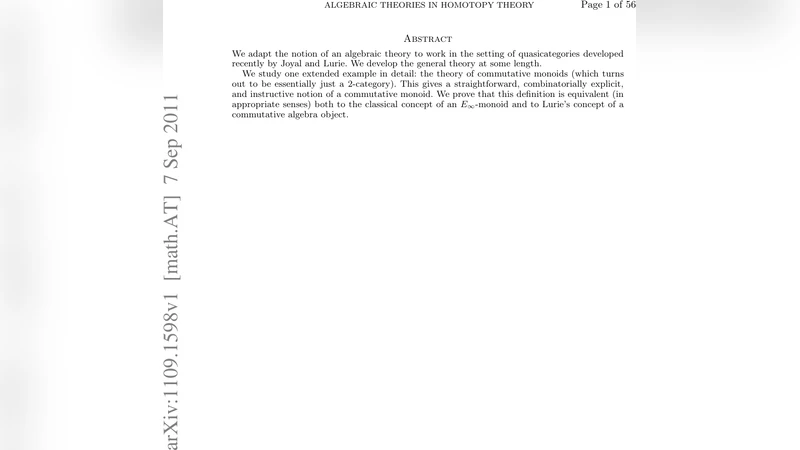
We adapt the notion of an algebraic theory to work in the setting of quasicategories developed recently by Joyal and Lurie. We develop the general theory at some length. We study one extended example in detail: the theory of commutative monoids (which turns out to be essentially just a 2-category). This gives a straightforward, combinatorially explicit, and instructive notion of a commutative monoid. We prove that this definition is equivalent (in appropriate senses) both to the classical concept of an E-infinity monoid and to Lurie’s concept of a commutative algebra object.
💡 Research Summary
The paper develops a framework for algebraic theories inside the modern setting of quasicategories, a model for (∞,1)-categories introduced by Joyal and Lurie. After a brief motivation, the author revisits the classical Lawvere theory—an ordinary category generated under finite products by a single object—and lifts this notion to the ∞‑categorical world. In this higher‑categorical context an algebraic theory is a quasicategory T equipped with a distinguished object such that the full sub‑quasicategory generated by that object under finite ∞‑products is equivalent to T itself. Models of such a theory are product‑preserving functors T → 𝒮, where 𝒮 denotes the ∞‑category of spaces.
The central example is the theory of commutative monoids. The author observes that any natural operation on a commutative monoid M can be described by a span of finite sets X ← U → Y: the left leg copies elements of X according to a map f, and the right leg adds together the copies according to a map g. This yields an operation Σ_g ∘ Δ_f : M^X → M^Y. If one passes to the ordinary category Th Mon whose morphisms are isomorphism classes of spans, one loses the higher‑dimensional homotopical information that is crucial for homotopy‑coherent commutativity.
To retain this information the author constructs a quasicategory Span whose objects are finite sets, 1‑morphisms are spans, and higher‑simplices encode compatible families of spans together with pullback squares. He shows that Span is in fact a (2,1)‑category: all 2‑cells are invertible and any cell of dimension three or higher is uniquely determined by its lower‑dimensional faces. Consequently Span can be regarded as a strict 2‑category enriched in groupoids, and the usual nerve construction identifies it with a quasicategory satisfying the inner‑horn filling conditions for dimensions ≥ 3.
Having built Span, the paper proves two key equivalences. First, product‑preserving functors Span → 𝒮 are exactly the E_∞‑monoids (commutative monoids up to coherent homotopy) in the sense of May and Boardman–Vogt; this recovers Badzioch’s result that models of Th Mon in spaces are generalized Eilenberg–Mac Lane spaces, now upgraded to the ∞‑categorical setting. Second, the same functors are equivalent to Lurie’s commutative algebra objects CommAlg(𝒮) in the symmetric monoidal ∞‑category of spaces. The proof proceeds by comparing the monoidal structures: the coproduct in Span corresponds to the Day convolution product, which matches the tensor product used in Lurie’s definition of commutative algebras.
Beyond the main theorem, the author discusses why the span‑based approach is more flexible than operadic methods. Operads cannot directly express equations that reuse a variable (e.g., the distributive law a·(b + c) = a·b + a·c) because each variable appears only once in an operadic tree. In contrast, spans separate copying (Δ) from addition (Σ), allowing such equations to be encoded without extra indirection. This suggests that more sophisticated algebraic structures, such as E_∞‑rings or semirings, could be modeled by appropriate families of span‑like diagrams, a direction the author plans to pursue in future work.
The paper also includes a thorough technical development of quasicategorical preliminaries: a comparison of strict and weak 2‑categories, the nerve construction for (2,1)‑categories, and lifting properties for inner and outer horns in (n,1)‑categories. These results are used to verify that Span satisfies the required horn‑filling conditions and that functors between such quasicategories behave as expected with respect to fibrations.
In summary, the work provides a clean, combinatorial description of commutative monoids in homotopy theory via span diagrams, embeds this description into the language of quasicategories, and establishes precise equivalences with both classical E_∞‑monoids and Lurie’s commutative algebra objects. This bridges the gap between traditional algebraic theories and modern higher‑category theory, and opens the door to a span‑based treatment of more elaborate homotopical algebraic structures.
Comments & Academic Discussion
Loading comments...
Leave a Comment