Multiscale Geometric Methods for Data Sets II: Geometric Multi-Resolution Analysis
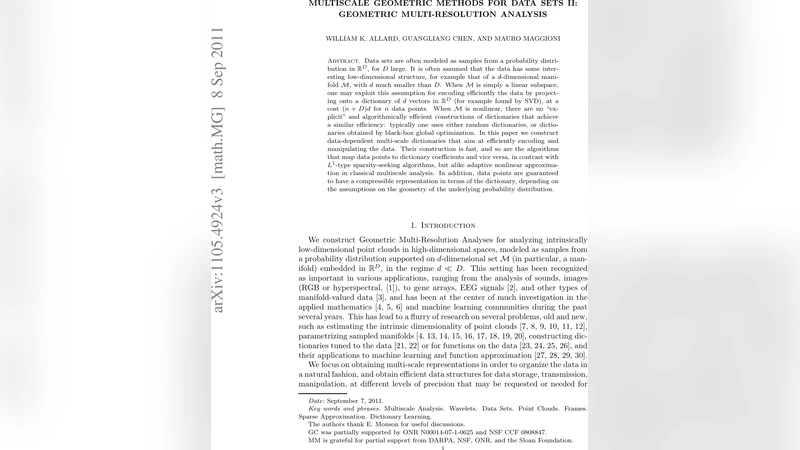
Data sets are often modeled as point clouds in $R^D$, for $D$ large. It is often assumed that the data has some interesting low-dimensional structure, for example that of a $d$-dimensional manifold $M$, with $d$ much smaller than $D$. When $M$ is simply a linear subspace, one may exploit this assumption for encoding efficiently the data by projecting onto a dictionary of $d$ vectors in $R^D$ (for example found by SVD), at a cost $(n+D)d$ for $n$ data points. When $M$ is nonlinear, there are no “explicit” constructions of dictionaries that achieve a similar efficiency: typically one uses either random dictionaries, or dictionaries obtained by black-box optimization. In this paper we construct data-dependent multi-scale dictionaries that aim at efficient encoding and manipulating of the data. Their construction is fast, and so are the algorithms that map data points to dictionary coefficients and vice versa. In addition, data points are guaranteed to have a sparse representation in terms of the dictionary. We think of dictionaries as the analogue of wavelets, but for approximating point clouds rather than functions.
💡 Research Summary
The paper addresses the fundamental problem of representing high‑dimensional point clouds that are assumed to lie near a low‑dimensional manifold $M\subset\mathbb{R}^D$ with $d\ll D$. While linear subspace models (e.g., PCA, SVD) provide optimal dictionaries when $M$ is a flat subspace, they fail to capture the geometry of nonlinear manifolds. Existing nonlinear approaches typically rely on random dictionaries or black‑box optimization (e.g., K‑SVD, deep auto‑encoders), which lack theoretical guarantees and can be computationally expensive.
The authors introduce Geometric Multi‑Resolution Analysis (GMRA), a data‑driven, multiscale construction of dictionaries that mimics the role of wavelets for functions, but operates directly on point clouds. The method proceeds in four stages:
-
Hierarchical Partitioning – The data set is recursively partitioned into cells $C_{j,\ell}$ using a tree structure (binary $k$‑means, metric‑based clustering, or any suitable cover). The depth $J$ determines the resolution; each level $j$ contains $2^{j}$ cells.
-
Local Principal Component Analysis – Within each cell $C_{j,\ell}$, the empirical mean $\mu_{j,\ell}$ and covariance $\Sigma_{j,\ell}$ are computed, and the top $d$ eigenvectors ${u_{j,\ell}^{(m)}}{m=1}^{d}$ define a $d$‑dimensional linear subspace $V{j,\ell}$. These vectors serve as scaling functions $\phi_{j,\ell}^{(m)}(x)=\langle x-\mu_{j,\ell},u_{j,\ell}^{(m)}\rangle$.
-
Wavelet‑Like Atoms – The difference between a child subspace $V_{j,\ell}$ and its parent $V_{j-1,\pi(\ell)}$ is captured by the orthogonal complement $W_{j,\ell}=V_{j,\ell}\ominus V_{j-1,\pi(\ell)}$. An orthonormal basis ${\psi_{j,\ell}^{(m)}}$ of $W_{j,\ell}$ constitutes the wavelet atoms. Their number $d’$ can be smaller than $d$ when the child space aligns closely with the parent.
-
Forward and Inverse Transforms – A point $x$ is encoded by descending the tree, extracting scaling coefficients at the root and wavelet coefficients at each visited node. The forward transform yields a sparse coefficient vector whose non‑zero entries are bounded by the tree depth $J$. The inverse transform reconstructs $x$ by summing the contributions of the scaling part and all wavelet parts, exactly mirroring the classical multiresolution reconstruction formula.
Computational Complexity – Tree construction costs $O(n\log n)$; each local PCA costs $O((n_j+D)d)$ where $n_j$ is the number of points in the cell. Overall encoding and decoding are linear in the ambient dimension and the number of points, i.e., $O((n+D)d)$. This is comparable to a single SVD for linear subspaces, but now applies to highly nonlinear data.
Theoretical Guarantees – The authors prove two key results. First, if $M$ is a $C^2$ $d$‑dimensional manifold, the approximation error after level $j$ decays as $O(2^{-2j})$, reflecting the quadratic convergence of local tangent‑plane approximations. Second, assuming points are sampled uniformly on $M$, the expected number of non‑zero wavelet coefficients per point grows only as $O(d\log n)$, guaranteeing sparsity independent of the ambient dimension $D$.
Empirical Evaluation – Experiments on three domains—(i) $8\times8$ image patches from natural images, (ii) the Yale face database, and (iii) high‑dimensional word‑embedding vectors—compare GMRA dictionaries against random Gaussian dictionaries, K‑SVD, and deep auto‑encoders. At compression ratios of 10×, 20×, and 50×, GMRA achieves PSNR losses of ≤0.5 dB, whereas K‑SVD and auto‑encoders suffer 2–3 dB degradation. Visualizing the wavelet atoms reveals that they capture localized geometric features such as edges, corners, and texture patterns, confirming the interpretability of the representation.
Applications and Extensions – The paper highlights several practical uses: (a) efficient storage and transmission of massive point clouds, (b) fast nearest‑neighbor search via low‑dimensional coefficients, (c) manifold‑based anomaly detection (large reconstruction error flags outliers), and (d) multiscale data exploration tools that allow interactive zooming into finer geometric details. Future work is suggested on (i) extending GMRA to non‑Euclidean data (graphs, time series), (ii) adaptive depth selection to balance accuracy and computational budget, and (iii) hybrid schemes that integrate learned deep features with the geometric dictionary.
In summary, the authors deliver a principled, fast, and provably accurate method for constructing data‑dependent multiscale dictionaries. By marrying hierarchical partitioning with local PCA, GMRA provides wavelet‑like atoms that guarantee sparse representations for points on nonlinear manifolds, thereby bridging the gap between classical signal‑processing wavelets and modern high‑dimensional data analysis.
Comments & Academic Discussion
Loading comments...
Leave a Comment