Homology and K-theory of the Bianchi groups
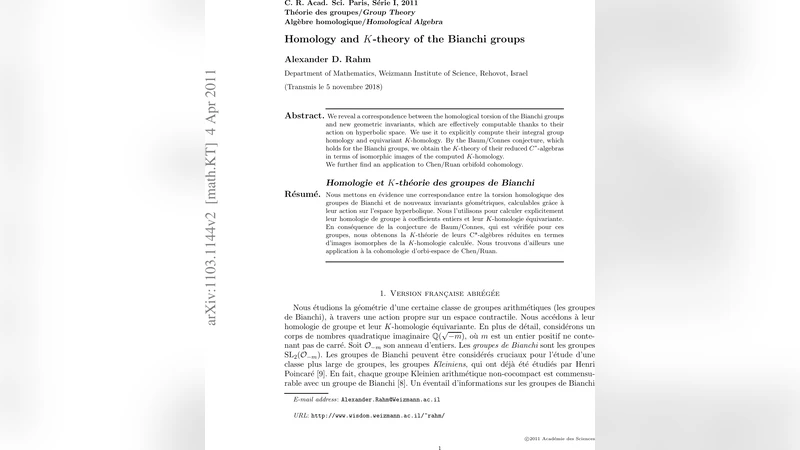
We reveal a correspondence between the homological torsion of the Bianchi groups and new geometric invariants, which are effectively computable thanks to their action on hyperbolic space. We use it to explicitly compute their integral group homology and equivariant $K$-homology. By the Baum/Connes conjecture, which holds for the Bianchi groups, we obtain the $K$-theory of their reduced $C^*$-algebras in terms of isomorphic images of the computed $K$-homology. We further find an application to Chen/Ruan orbifold cohomology. % {\it To cite this article: Alexander D. Rahm, C. R. Acad. Sci. Paris, Ser. I +++ (2011).}
💡 Research Summary
The paper by Alexander D. Rahm presents a comprehensive study of the homology and K‑theory of the Bianchi groups, i.e. the groups SL₂(𝒪₋ₘ) and their quotients PSL₂(𝒪₋ₘ) where 𝒪₋ₘ is the ring of integers in an imaginary quadratic field ℚ(√−m). The author exploits the natural action of these groups on three‑dimensional hyperbolic space ℍ³, which is isomorphic to the symmetric space SL₂(ℂ)/SU₂. By using the classical Bianchi fundamental polyhedron (computed for all m by computer) and refining the induced cell structure until each cell is pointwise fixed by its stabiliser, a detailed equivariant cell complex is obtained.
With this refined complex the equivariant Leray–Serre spectral sequence (originating from the action on the cell complex) is applied. A crucial observation is that the only finite orders occurring in PSL₂(𝒪₋ₘ) are 2 and 3, so the author isolates the ℓ‑torsion subcomplexes (ℓ = 2, 3). Theorem 2.2 shows that the ℓ‑primary part of the E₂‑page depends solely on the homeomorphism type of the ℓ‑torsion subcomplex; consequently, when the 2‑ and 3‑torsion subcomplexes are homeomorphic (as happens for the non‑Euclidean principal ideal domains m = 19, 43, 67, 163) the resulting homology groups have identical torsion patterns.
Proposition 2.1 gives the explicit integral homology of PSL₂(𝒪₋ₘ) for the four non‑Euclidean cases. In degree 1 the group is free of rank β₁ (the first Betti number), while in degree 2 there is a free part of rank β₁ − 1 together with a direct sum of ℤ/4ℤ, ℤ/2ℤ and ℤ/3ℤ. Higher degrees consist only of copies of ℤ/2ℤ and ℤ/3ℤ, the numbers of which are encoded in the Poincaré series P₂ₘ(t) and P₃ₘ(t).
Having determined the equivariant cell structure, the author computes the Bredon homology of the Bianchi groups, which yields the equivariant K‑homology K₀^{Γ}(EΓ) and K₁^{Γ}(EΓ) for Γ = PSL₂(𝒪₋ₘ). Theorem 2.5 lists these groups explicitly in terms of β₁, ℤ/2ℤ and ℤ/3ℤ, with Bott periodicity supplying the remaining degrees.
Since the Baum–Connes conjecture is known to hold for the Bianchi groups (Julg–Kasparov), the computed equivariant K‑homology is isomorphic to the K‑theory of the reduced C*‑algebra C*_r(Γ). Thus the paper provides a concrete description of K₀(C*_r(Γ)) and K₁(C*_r(Γ)) for all Bianchi groups, linking group homology, geometric topology, and operator algebras.
Finally, the geometric data obtained from the hyperbolic action are complexified to produce explicit orbifold structures. Using Chen–Ruan orbifold cohomology, the author determines the orbifold cohomology rings for all Bianchi groups and supplies an algorithm to compute the underlying vector space structure. This furnishes a rich class of three‑dimensional complex orbifolds that serve as test cases for Ruan’s crepant resolution conjecture and have potential applications in cosmology.
In summary, Rahm’s work combines hyperbolic geometry, spectral sequence techniques, and operator‑algebraic methods to give a full computation of the integral homology, equivariant K‑homology, and reduced C*‑algebra K‑theory of the Bianchi groups, and further connects these results to modern topics such as Chen–Ruan orbifold cohomology.
Comments & Academic Discussion
Loading comments...
Leave a Comment