Variable elimination in chemical reaction networks with mass action kinetics
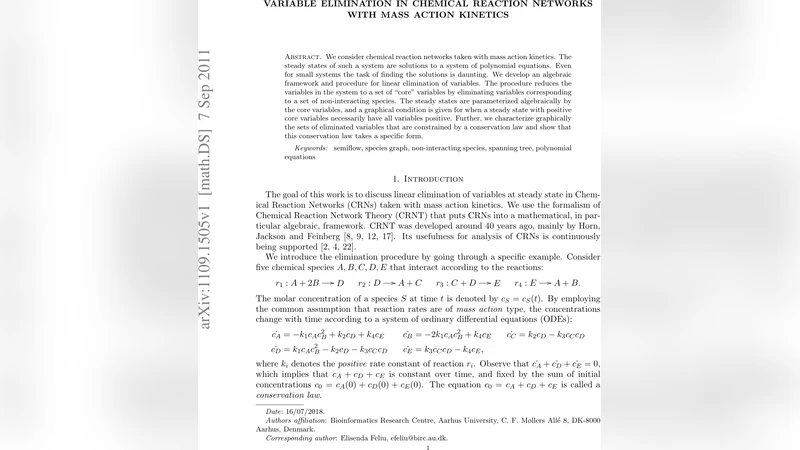
We consider chemical reaction networks taken with mass action kinetics. The steady states of such a system are solutions to a system of polynomial equations. Even for small systems the task of finding the solutions is daunting. We develop an algebraic framework and procedure for linear elimination of variables. The procedure reduces the variables in the system to a set of “core” variables by eliminating variables corresponding to a set of non-interacting species. The steady states are parameterized algebraically by the core variables, and a graphical condition is given for when a steady state with positive core variables necessarily have all variables positive. Further, we characterize graphically the sets of eliminated variables that are constrained by a conservation law and show that this conservation law takes a specific form.
💡 Research Summary
The paper addresses the challenging problem of determining steady‑state solutions of chemical reaction networks (CRNs) governed by mass‑action kinetics. At steady state the concentrations satisfy a system of polynomial equations, which quickly becomes intractable even for modestly sized networks. The authors develop a systematic algebraic framework that reduces the dimensionality of this problem by linearly eliminating a large subset of variables.
The key notion introduced is that of non‑interacting species: a set of species that never appear together on the same side of any reaction. Such a set can be of two types. If the sum of their concentrations is conserved (i.e., there exists a linear conservation law involving only those species), the set is called a cut; otherwise it is a non‑cut. The authors show that each non‑interacting set corresponds to a particular subgraph of the species graph (a directed graph whose vertices are species and whose edges encode the direction of influence in reactions). “Full subgraphs” encode the presence of a conservation law, while “non‑interacting subgraphs” encode its absence.
The elimination procedure relies heavily on graph theory. The Laplacian matrix L(G) of the species graph is constructed, and the classical Matrix‑Tree theorem is invoked: the cofactor L(G)(i j) equals the sum over all spanning trees rooted at vertex j of the product of edge labels. This relationship allows the authors to express each eliminated concentration as a rational function of the remaining “core” concentrations. Two distinct linear situations arise. In the homogeneous case (cuts) the coefficient matrix has column sums zero, rank = |core| − 1, and a single free parameter remains; the conservation law supplies the missing equation. In the inhomogeneous case (non‑cuts) the matrix has full rank, yielding a unique solution for the eliminated variables.
A detailed example with five species (A–E) and four reactions illustrates both cases. Species B and C form a non‑interacting non‑cut set; solving the linear subsystem gives C = k₂/k₃ and E = (k₂/k₄) D, showing that B, C can be treated as core variables while A, D, E are eliminated. Conversely, A, D, E constitute a cut; their concentrations are expressed in terms of B, C and the conserved total c₀ = c_A + c_D + c_E. The authors prove that positivity of the core variables guarantees positivity of all concentrations, provided the underlying subgraph satisfies a connectivity condition (no directed cycles that would force a zero concentration).
Beyond the example, the paper formalizes the connection between non‑interacting sets and semi‑flows (vectors in the kernel of the stoichiometric matrix). Minimal semi‑flows correspond to full subgraphs, and each such semi‑flow gives rise to a linear conservation law of a specific form. The authors also discuss how the procedure extends to arbitrary CRNs, not only the previously studied post‑translational modification (PTM) systems.
Practical implications are highlighted. By reducing a CRN to a polynomial system in a small number of core variables, one can (i) infer steady‑state behavior from experimentally measurable concentrations of those core species, (ii) discriminate between competing kinetic models that share the same species but differ in reaction structure, (iii) design experiments that target subgraphs maximizing information gain, and (iv) dramatically lower the computational burden when searching for multistationarity, since the eliminated variables no longer need to be sampled.
In summary, the authors provide a rigorous, graph‑theoretic method for linear variable elimination in mass‑action CRNs, linking non‑interacting species, conservation laws, and the Matrix‑Tree theorem. The resulting reduction yields algebraic varieties in core variables whose positive points correspond exactly to positive steady states of the original network, offering both theoretical insight and practical tools for the analysis of complex biochemical systems.
Comments & Academic Discussion
Loading comments...
Leave a Comment