A Study of the PDGF Signaling Pathway with PRISM
In this paper, we apply the probabilistic model checker PRISM to the analysis of a biological system – the Platelet-Derived Growth Factor (PDGF) signaling pathway, demonstrating in detail how this pathway can be analyzed in PRISM. We show that quantitative verification can yield a better understanding of the PDGF signaling pathway.
💡 Research Summary
This paper demonstrates how the probabilistic model checker PRISM can be applied to the quantitative verification of the Platelet‑Derived Growth Factor (PDGF) signaling pathway. After a brief introduction that positions systems biology within the broader context of formal verification, the authors review related work where PRISM has been used to study other signaling cascades such as FGF and MAPK, and they note alternative formal methods (bio‑PEPA, Petri nets, Kappa).
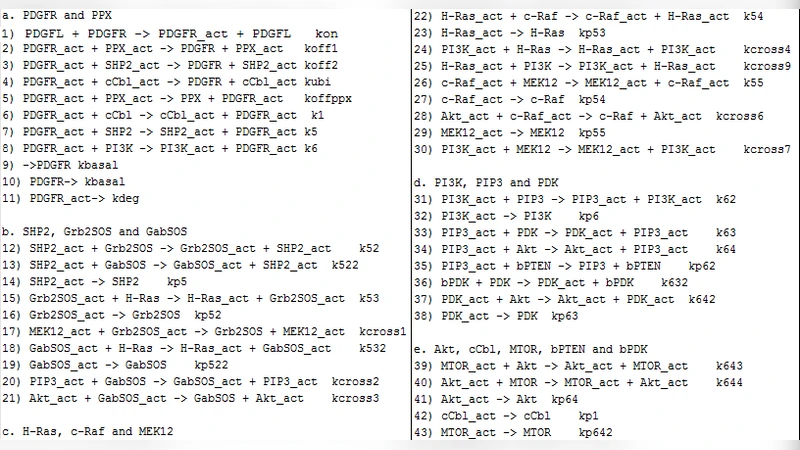
The biological model originates from an extensive literature‑based ordinary differential equation (ODE) description containing 35 molecular species. For tractability, the authors extract a core sub‑network of 17 species that captures the essential features: ligand‑receptor binding (PDGF‑PDGFR), negative feedback on the receptor, and the two major downstream cascades—MAPK and PI3K/Akt. Three external inputs are defined: PDGF ligand (PDGFL), a phosphatase inhibitor (bPTEN), and a basal activator of PDK (bPDK). Interactions are classified as activating (blue arrows), positive crosstalk (green), and negative regulation (red).
Each molecular species is represented as a Boolean variable (active/inactive) within PRISM modules. Reaction rates derived from the ODE model become transition rates in a continuous‑time Markov chain (CTMC). Guarded commands of the form “
Comments & Academic Discussion
Loading comments...
Leave a Comment