A semi-quantitative equivalence for abstracting from fast reactions
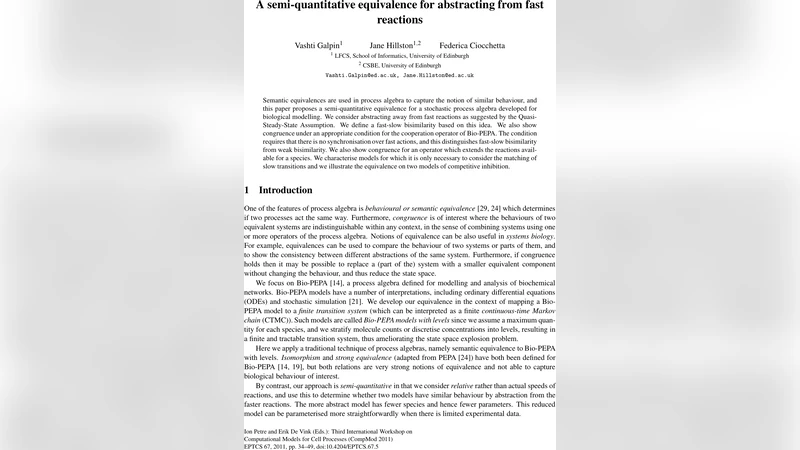
Semantic equivalences are used in process algebra to capture the notion of similar behaviour, and this paper proposes a semi-quantitative equivalence for a stochastic process algebra developed for biological modelling. We consider abstracting away from fast reactions as suggested by the Quasi-Steady-State Assumption. We define a fast-slow bisimilarity based on this idea. We also show congruence under an appropriate condition for the cooperation operator of Bio-PEPA. The condition requires that there is no synchronisation over fast actions, and this distinguishes fast-slow bisimilarity from weak bisimilarity. We also show congruence for an operator which extends the reactions available for a species. We characterise models for which it is only necessary to consider the matching of slow transitions and we illustrate the equivalence on two models of competitive inhibition.
💡 Research Summary
The paper introduces a novel semi‑quantitative behavioural equivalence, called fast‑slow bisimilarity, for the stochastic process algebra Bio‑PEPA, which is widely used for modelling biochemical reaction networks. Bio‑PEPA models are first transformed into finite‑state continuous‑time Markov chains (CTMCs) by discretising species concentrations into “levels”. This discretisation bounds the state space and makes formal analysis tractable.
The authors draw inspiration from the Quasi‑Steady‑State Assumption (QSSA), a classical technique in enzymology that separates reactions into fast and slow time‑scales. In QSSA, intermediate species that participate only in fast reactions are assumed to be at (quasi) steady state, allowing them to be eliminated from the ODE system. Analogously, the paper partitions the set of reaction names A into fast reactions A_f and slow reactions A_s. Each transition in the labelled transition system carries a label (α, w) where α is the reaction name and w is a multiset describing the participating species, their roles (reactant, product, modifier, etc.), stoichiometric coefficients and current levels.
A transformation w↦w_Δ removes all intermediate species ϒ from w, retaining only a selected subset Δ of non‑intermediate species that are relevant for the comparison. Fast‑slow bisimilarity is then defined as follows: (i) any transition labelled by a fast reaction is ignored (treated like a τ‑action); (ii) for a slow reaction, the transformed capability w_Δ must be preserved, i.e., the two processes must be able to perform the same slow reaction with the same observable participants. The definition also includes the usual reflexive‑transitive closure over fast transitions, allowing sequences of fast steps to be collapsed before a slow step is matched.
The paper proves that fast‑slow bisimilarity is a congruence with respect to the cooperation operator ⊲⊳ of Bio‑PEPA, provided that no fast actions are synchronised between cooperating components. This restriction distinguishes the new equivalence from ordinary weak bisimilarity, where such a condition is unnecessary. The authors also show congruence for an “extension” operator that adds new reactions to a species. Moreover, they define a stricter relation called slow bisimulation, which only considers slow transitions at all. They prove that for a class of models where fast reactions never appear in synchronisations (i.e., they are internal to a component), fast‑slow bisimilarity coincides with slow bisimulation, simplifying verification.
To illustrate the theory, the authors analyse two competitive inhibition models. The first is a detailed Bio‑PEPA specification containing substrate S, enzyme E, inhibitor I, and intermediate complexes SE and IE, together with reversible binding and catalytic steps. The second model is obtained by applying QSSA: the intermediate complexes are eliminated, yielding a reduced set of slow reactions that capture the overall conversion of substrate to product in the presence of inhibitor. By constructing the labelled transition systems and applying the fast‑slow bisimilarity definition, the authors demonstrate that the two models are equivalent: every slow transition of the detailed model has a matching transition in the reduced model with identical w_Δ, and all fast transitions are internal and therefore ignored. This equivalence shows that the reduced model preserves all observable dynamics while drastically reducing the number of parameters and the size of the state space.
In the discussion, the authors compare their approach with existing notions of equivalence for Bio‑PEPA (isomorphism, strong bisimulation, weak bisimulation). They argue that those relations are either too strict (requiring exact matching of rates) or too coarse (ignoring the distinction between fast and slow reactions). Fast‑slow bisimilarity occupies a middle ground: it respects the relative magnitude of reaction rates (fast vs. slow) without needing exact numerical values, making it suitable for biological modelling where absolute rates are often uncertain. The congruence results guarantee that components can be replaced by their fast‑slow equivalent counterparts in larger networks without altering the overall behaviour, enabling modular verification and state‑space reduction.
Finally, the paper outlines future work, including extending the framework to models with multiple nested time‑scale separations, dynamic re‑classification of reactions during simulation, and applying the technique to other stochastic process algebras such as the stochastic π‑calculus. The contribution is a rigorous, semantically grounded method for abstracting away fast biochemical reactions while preserving observable system dynamics, offering a valuable tool for both theoretical analysis and practical model reduction in systems biology.
Comments & Academic Discussion
Loading comments...
Leave a Comment