Lectures on algebraic categorification
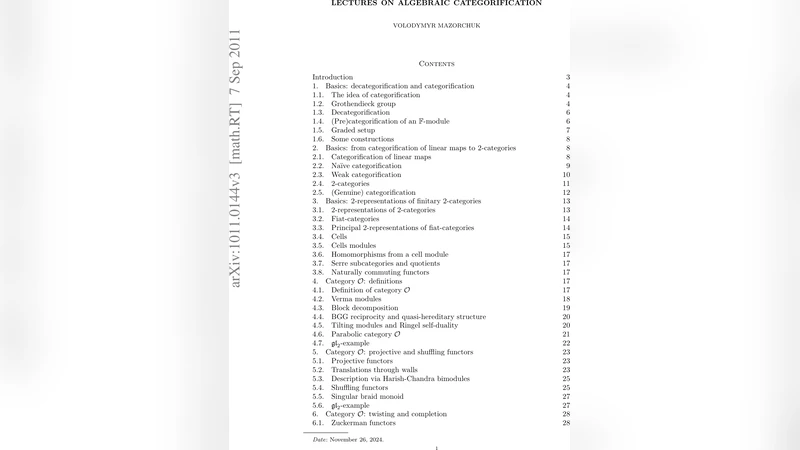
This is a write-up of the lectures given by the author during the Master Class “Categorification” at {\AA}rhus University, Denmark in October 2010.
💡 Research Summary
The manuscript “Lectures on Algebraic Categorification” is a comprehensive write‑up of the master‑class delivered at Aarhus University in October 2010. Its purpose is to give a self‑contained, yet advanced, introduction to the modern program of algebraic categorification, where classical algebraic structures such as groups, rings, Lie algebras, and quantum groups are lifted to higher‑categorical objects. The paper is organized into five logical parts: (1) motivation and historical background, (2) categorical preliminaries, (3) categorification of quantum groups via Khovanov‑Lauda‑Rouquier (KLR) algebras, (4) categorified link invariants and Khovanov homology, and (5) outlook and open problems.
In the opening section the author explains why categorification matters. By replacing set‑theoretic constructions with functorial and natural‑transformational analogues, one obtains richer invariants that retain more refined information. Simple examples—such as interpreting addition of integers as composition of endofunctors, or viewing a group action as a functor from the group’s one‑object category—serve to illustrate the guiding principle.
The second section develops the necessary categorical language. It reviews ordinary categories, functors, natural transformations, and then moves to 2‑categories, 2‑functors, and modifications. The author emphasizes the two kinds of composition (horizontal and vertical) and introduces grading conventions that will later be used to keep track of the quantum parameter (q). The discussion of Grothendieck groups provides the bridge between categorical data and the decategorified algebraic objects.
Section three is the technical heart of the manuscript. After recalling the Drinfeld‑Jimbo definition of a quantum group (U_q(\mathfrak g)) and its representation theory, the author introduces crystal bases as a combinatorial shadow of the quantum group. The main construction is the KLR (Khovanov‑Lauda‑Rouquier) algebra, presented diagrammatically via oriented strands with crossings and dots. Generators correspond to elementary diagrams, and relations are encoded by local moves reminiscent of Reidemeister moves. The paper proves that the category of finitely generated graded modules over a KLR algebra categorifies the integrable highest‑weight representations of the corresponding quantum group. In particular, standard modules correspond to canonical basis elements, and the graded dimension of a module matches the (q)‑character of the associated quantum group element. Detailed examples for (\mathfrak{sl}_2) and (\mathfrak{sl}_3) illustrate the construction.
The fourth section turns to link homology. Khovanov’s original categorification of the Jones polynomial is revisited, now interpreted as a 2‑categorical complex built from the KLR diagrammatics. The author shows how the differential in Khovanov homology arises from a smooth functor between certain 2‑categories, and how the resulting homology groups inherit a natural grading that coincides with the quantum grading of the underlying quantum group representation. The discussion extends to Khovanov‑Rozansky homology for (\mathfrak{sl}_n), where the higher‑rank KLR algebras provide the algebraic backbone. The paper emphasizes that the categorified link invariants are not merely decategorifications of quantum group invariants but rather new homological objects that detect subtle topological information.
The final section surveys current research directions. It highlights the move from 2‑categorical to 3‑categorical and ∞‑categorical frameworks, the development of categorical quantum field theories, and the interplay with geometric representation theory (e.g., perverse sheaves on quiver varieties). Open problems include constructing explicit categorifications for quantum groups of non‑simply‑laced type, understanding the full structure of the 2‑representation theory of KLR algebras, and extending the link homology constructions to 4‑manifolds via higher‑categorical cobordism categories.
Overall, the manuscript succeeds in presenting a coherent narrative that connects abstract categorical ideas with concrete algebraic and topological applications. By blending diagrammatic calculus, graded module theory, and homological constructions, it demonstrates that algebraic categorification is a powerful unifying language for modern mathematics, offering both conceptual insight and computational tools.
Comments & Academic Discussion
Loading comments...
Leave a Comment