High-resolution measurements of face-to-face contact patterns in a primary school
Little quantitative information is available on the mixing patterns of children in school environments. Describing and understanding contacts between children at school would help quantify the transmission opportunities of respiratory infections and identify situations within schools where the risk of transmission is higher. We report on measurements carried out in a French school (6-12 years children), where we collected data on the time-resolved face-to-face proximity of children and teachers using a proximity-sensing infrastructure based on radio frequency identification devices. Data on face-to-face interactions were collected on October 1st and 2nd, 2009. We recorded 77,602 contact events between 242 individuals. Each child has on average 323 contacts per day with 47 other children, leading to an average daily interaction time of 176 minutes. Most contacts are brief, but long contacts are also observed. Contacts occur mostly within each class, and each child spends on average three times more time in contact with classmates than with children of other classes. We describe the temporal evolution of the contact network and the trajectories followed by the children in the school, which constrain the contact patterns. We determine an exposure matrix aimed at informing mathematical models. This matrix exhibits a class and age structure which is very different from the homogeneous mixing hypothesis. The observed properties of the contact patterns between school children are relevant for modeling the propagation of diseases and for evaluating control measures. We discuss public health implications related to the management of schools in case of epidemics and pandemics. Our results can help define a prioritization of control measures based on preventive measures, case isolation, classes and school closures, that could reduce the disruption to education during epidemics.
💡 Research Summary
This study provides a detailed quantitative characterization of face‑to‑face contacts among primary‑school children and teachers using a high‑resolution RFID‑based proximity‑sensing system. Conducted over two consecutive days (October 1‑2, 2009) in a French primary school in Lyon, the experiment involved 232 children (ages 6‑12) and 10 teachers across ten classes. Each participant wore an unobtrusive badge that recorded a contact whenever two badges exchanged at least one radio packet within a 20‑second interval, corresponding to a face‑to‑face distance of roughly 1–1.5 m – a range relevant for respiratory pathogen transmission.
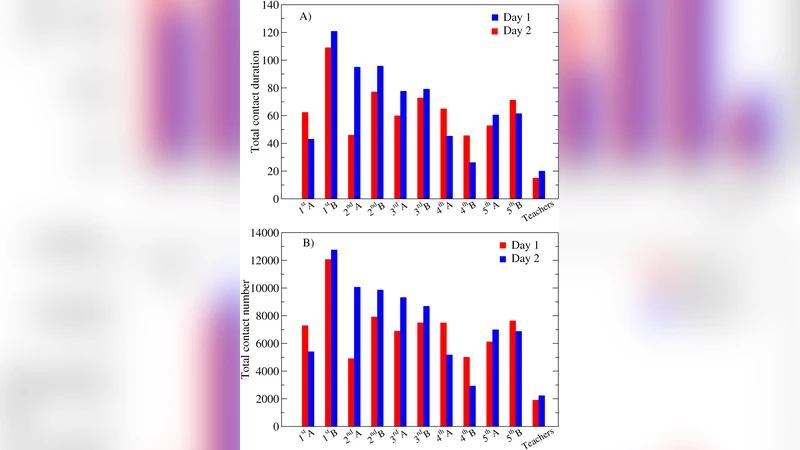
A total of 77,602 contact events were captured (≈37 k on day 1, ≈40 k on day 2). On average, each child experienced 323 contacts per day with 47 distinct peers, accumulating about 176 minutes of proximity time. The distribution of contacts is highly heterogeneous: the coefficient of variation squared (CV²) for the number of contacts per individual is ≈0.25, while the CV² for contact durations is ≈1.1, indicating a broad spread with many brief encounters and a small fraction of long‑lasting interactions (≈0.2 % exceed five minutes). The mean contact duration is 33 seconds, and 88 % of contacts last less than one minute.
Spatial analysis shows that contacts are strongly assortative by class. A child spends roughly three times more time in contact with classmates than with pupils from other classes. The class‑level contact matrices reveal a pronounced diagonal dominance, reflecting that most transmission opportunities are confined within a single classroom. Nevertheless, inter‑class mixing does occur, especially during shared activities such as lunch in the common canteen and recess on the playground, where multiple classes converge. Approximate localization using RFID reader signals allowed reconstruction of individual trajectories, confirming that the timing of these shared periods drives the observed inter‑class contacts.
Temporal dynamics were examined using sliding 20‑minute windows (updated every 5 minutes). The average degree of the network spikes during breaks and lunch, while it drops during classroom instruction, illustrating how the school schedule modulates contact opportunities. Comparing the two days, Pearson correlations of individual‑level metrics (total contacts, cumulative time) exceed 0.8, indicating a high degree of reproducibility, yet each day also introduces about 10 % new distinct contacts, underscoring the dynamic nature of the network.
The authors translate these empirical findings into an “exposure matrix” that quantifies the average contact time between each pair of classes. This matrix deviates substantially from the homogeneous mixing assumption commonly used in compartmental epidemic models. Incorporating the measured heterogeneity—both in contact frequency and duration—into transmission models is expected to improve predictions of outbreak size, speed, and the impact of interventions.
From a public‑health perspective, the results suggest that class‑based interventions (e.g., temporary class closure, staggered lunch times) could be more efficient than whole‑school closures, because the majority of contacts—and thus transmission risk—are confined within classes. Moreover, the identification of high‑contact periods (recess, lunch) offers concrete targets for mitigation measures such as staggered breaks, reduced crowding in the canteen, or enhanced ventilation.
Limitations include the short observation window (only two days), the exclusion of contacts outside school premises (e.g., after‑school activities, households), and the lack of direct infection data to validate transmission risk. Future work should aim at longer, multi‑site deployments, integration with virological surveillance, and exploration of how different school architectures or schedules affect contact patterns.
In summary, this paper demonstrates that RFID‑based sensing can reliably capture the fine‑grained structure of school contact networks, revealing strong class‑level clustering, pronounced temporal fluctuations, and a mixture of brief and occasional long contacts. These insights provide a robust empirical foundation for refined epidemiological models and more nuanced, less disruptive mitigation strategies in school settings during respiratory disease outbreaks.
Comments & Academic Discussion
Loading comments...
Leave a Comment