The Igusa-Todorov function for comodules
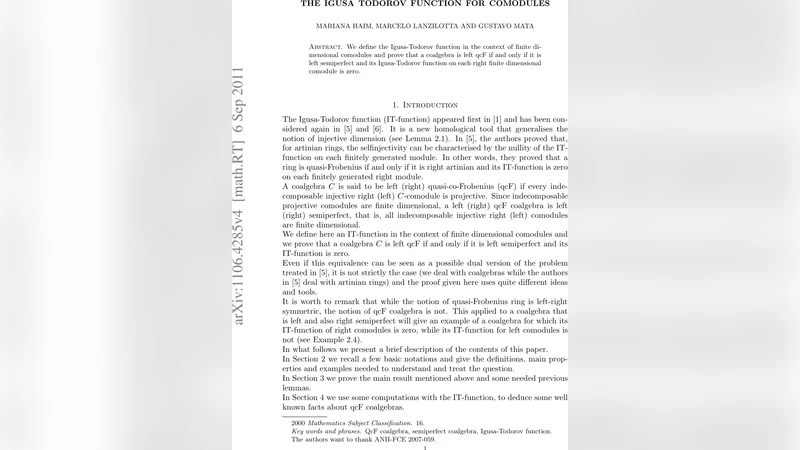
We define the Igusa-Todorov function in the context of finite dimensional comodules and prove that a coalgebra is left qcF if and only if it is left semiperfect and its Igusa-Todorov function on each right finite dimensional comodule is zero.
💡 Research Summary
The paper introduces the Igusa‑Todorov (IG) function into the setting of finite‑dimensional comodules over a coalgebra and uses it to characterize left quasi‑co‑Frobenius (qcF) coalgebras. After recalling the classical IG function for modules, the authors define a comodule version by taking a minimal free resolution of a finite‑dimensional right comodule M. For each step Fi of the resolution they consider the C‑dimension of Fi (where C is the underlying coalgebra) and set
IG(M)=sup {dim Fi − dim Fi‑1 | i≥1}.
This definition is well‑posed precisely when the coalgebra C is left semiperfect, because then every finite‑dimensional comodule admits a projective cover (i.e., a free cover). The IG function is shown to be invariant under comodule isomorphisms and to vanish exactly when the minimal free resolution collapses to length zero.
The central result consists of two equivalences. Theorem 3.1 proves that if C is left qcF then (i) C is left semiperfect, and (ii) IG(N)=0 for every right finite‑dimensional comodule N. The proof exploits the defining property of a left qcF coalgebra: there exists a coalgebra morphism φ:C→C* (the linear dual) that is a left C‑module isomorphism. This φ induces a bijection between free comodules and their duals, guaranteeing that every finite‑dimensional comodule is a direct summand of a free comodule. Consequently the minimal free resolution of any N has length zero, so IG(N)=0.
The converse, Theorem 3.5, assumes that C is left semiperfect and that IG(N)=0 for all right finite‑dimensional comodules N. From IG(N)=0 the authors deduce that each N is already a direct summand of a free comodule; equivalently, every N possesses a projective cover. This property forces the canonical map φ:C→C* to be an isomorphism of left C‑modules, which is precisely the definition of a left qcF coalgebra. Hence the two conditions are equivalent.
To illustrate the theory, the paper examines several families of coalgebras. Finite‑dimensional coalgebras automatically satisfy IG(N)=0 for all N, and therefore are qcF and semiperfect. For co‑semisimple coalgebras the same holds, while for certain infinite‑dimensional examples the IG function can be positive, showing that those coalgebras fail to be left qcF. These examples demonstrate that the vanishing of the IG function provides a practical, computable criterion for qcF‑ness.
The authors conclude by emphasizing that the comodule IG function furnishes a concise homological invariant that simultaneously detects semiperfectness and the qcF property. They suggest further directions: extending the IG function to infinite‑dimensional comodules, relating it to other homological dimensions such as Gorenstein or dominant dimensions, and exploring its behavior under coalgebra extensions or Morita‑type equivalences. The work thus opens a new avenue for applying homological tools from representation theory to the study of coalgebras and their comodules.
Comments & Academic Discussion
Loading comments...
Leave a Comment