The Information Flow Framework: New architecture
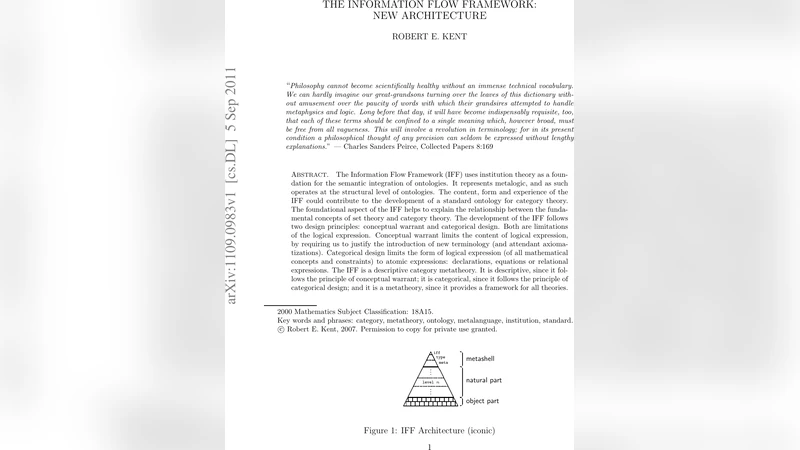
This presentation discusses a new, modular, more mature architecture for the Information Flow Framework (IFF). The IFF uses institution theory as a foundation for the semantic integration of ontologies. It represents metalogic, and as such operates at the structural level of ontologies. The content, form and experience of the IFF could contribute to the development of a standard ontology for category theory. The foundational aspect of the IFF helps to explain the relationship between the fundamental concepts of set theory and category theory. The development of the IFF follows two design principles: conceptual warrant and categorical design. Both are limitations of the logical expression. Conceptual warrant limits the content of logical expression, by requiring us to justify the introduction of new terminology (and attendant axiomatizations). Categorical design limits the form of logical expression (of all mathematical concepts and constraints) to atomic expressions: declarations, equations or relational expressions. The IFF is a descriptive category metatheory. It is descriptive, since it follows the principle of conceptual warrant; it is categorical, since it follows the principle of categorical design; and it is a metatheory, since it provides a framework for all theories.
💡 Research Summary
**
The paper presents a new, modular architecture for the Information Flow Framework (IFF), positioning it as a descriptive category metatheory that operates at the structural level of ontologies. Built on institution theory, the IFF aims to provide a principled foundation for the semantic integration of heterogeneous ontologies. The authors introduce two guiding design principles: conceptual warrant and categorical design. Conceptual warrant requires that any new terminology or axiom be justified by reference to lower‑level concepts already present in the metalevel, ensuring that terms are not introduced arbitrarily and that their meanings remain consistent across the hierarchy. Categorical design restricts all logical expressions to atomic forms—declarations, equations, or relational expressions—eschewing traditional logical connectives (∧, ∨, ∀, ∃) in favor of commutative diagrams and composition, thereby aligning the formalism directly with categorical intuition.
The architecture is organized along two orthogonal dimensions. Vertically, it consists of three layers: the objective part (level 0), the natural part (levels 1 to ∞), and the metalevel (the metashell and metastack). The objective part contains the terminology needed for object‑level ontologies expressed atomically. The natural part houses namespaces that encode basic mathematical and logical concepts using only atomic expressions, while the metashell provides a first‑order axiomatization of five primitive notions—thing, set, function, source, target. The metastack, inspired by Cantor’s diagonal argument, forms an infinite chain of toposes (Set₁ ⊂ Set₂ ⊂ …) that serves as the set‑theoretic backbone of the framework.
Horizontally, the framework is partitioned into namespaces and meta‑ontologies. Each namespace corresponds to a specific domain (e.g., set theory, category theory, logic, or application areas such as gene ontology or road‑map ontology). Meta‑ontologies are coherent composites of namespaces that enforce a uniform formal structure across the entire system.
Within the vertical hierarchy, the core component (IFF‑SET) implements the set‑theoretic side of the metastack. It defines a hierarchy of abstract, feature‑less sets and provides primitive operations such as membership, power‑set, and function composition, all expressed atomically. The structure component comprises a family of category‑theoretic meta‑ontologies (e.g., IFF‑CAT, IFF‑2CAT, IFF‑DCAT) that formalize objects, morphisms, functorial composition, adjunctions, limits, and other categorical constructs using the same atomic syntax. This duality ensures that set theory and category theory constrain each other: categories are defined as sets of objects and morphisms with appropriate source/target functions, while collections of sets and functions at any metalevel form a category.
The paper also situates the IFF within the broader context of the IEEE Standard Upper Ontology (SUO) project, noting that the IFF supplies the structural layer of SUO. Development proceeds along three concurrent tracks: (1) axiomatic expression, moving from natural‑language descriptions to first‑order and finally atomic axioms; (2) category completeness, progressing from finitely complete categories to cartesian‑closed categories and ultimately to full toposes; (3) element generalization, extending the notion of elements from ordinary global elements to generalized morphisms, with some generalized elements already used as parameters.
Historical background on the term “ontology” is provided, tracing its philosophical roots to Aristotle and its modern AI/KE definition as a formal, explicit specification of a shared conceptualization. Examples such as the Gene Ontology and a road‑map ontology illustrate how the IFF can model concrete domains.
Roles of category theory—pure, applied, philosophical, and support—are discussed, emphasizing that the IFF itself traverses all four: it began as an applied tool for knowledge engineering, now also supports category theory by providing a meta‑framework, and implicitly engages in philosophical justification of categorical foundations.
In summary, the IFF proposes a rigorously modular, two‑dimensional architecture that unifies set‑theoretic and categorical foundations under strict design constraints. By enforcing conceptual warrant and atomic categorical design, it seeks to eliminate ambiguity in ontology integration and to lay the groundwork for a standard ontology of category theory. Ongoing work aims to complete the metastack of toposes, fully axiomatize the natural part, and realize the generalized element framework, thereby delivering a robust metatheoretical infrastructure for semantic integration, knowledge maintenance, and the broader goals of the IEEE SUO initiative.
Comments & Academic Discussion
Loading comments...
Leave a Comment