Anisotropic MHD Turbulence
The solar wind and the interstellar medium are permeated by large-scale magnetic fields that render magnetohydrodynamic (MHD) turbulence anisotropic. In the weak-turbulence limit in which three-wave interactions dominate, analytical and high-resolution numerical results based on random scattering of shear-Alfv'en waves propagating parallel to a large-scale magnetic field, as well as direct simulations demonstrate rigorously an anisotropic energy spectrum that scales as $k^{-2}_\perp$, instead of the famous Iroshnikov-Kraichnan (IK) spectrum of $k^{-3/2}$ for the isotropic case. Even in the absence of a background magnetic field, anisotropy is found to develop with respect to the local magnetic field, although the energy spectrum is globally isotropic and is found to be consistent with a $k^{-3/2}$ scaling. It is also found in direct numerical simulations that the energy cascade rate is much closer to IK scaling than a Kolmogorov scaling. Recent observations in the solar wind on cascade rates (as functions of the proton temperature and solar wind speed at 1 AU) seem to support this result [Vasquez et al. 2007].
💡 Research Summary
The paper investigates how large‑scale magnetic fields imprint anisotropy on magnetohydrodynamic (MHD) turbulence in the solar wind and the interstellar medium (ISM). Starting from the classic Kolmogorov (K41) and Iroshnikov‑Kraichnan (IK) phenomenologies, the authors emphasize that while Kolmogorov assumes isotropy and local eddy interactions, IK introduces Alfvén wave packets propagating along a magnetic field and retains isotropy as an additional assumption. In the presence of a strong background field, however, isotropy is broken, and the turbulence can be either “strong” (critical balance) or “weak” (dominance of three‑wave interactions).
Under the weak‑turbulence hypothesis, three‑wave resonant interactions dominate. A wave packet moving parallel to the uniform field B₀ collides only with oppositely directed packets; the collision time is τₖ∥≈1/(k∥V_A). Because the nonlinear change per collision is small, many collisions (∼χ⁻², with χ≈k⊥v_k/(k∥V_A)≪1) are required for a cascade. Treating k∥ as a parameter and applying dimensional analysis yields an energy spectrum E(k⊥)∝k⊥⁻² in the perpendicular direction. This result matches the exact stationary solution of the kinetic equation derived by Galtier et al. (2000) for incompressible MHD with a strong uniform field.
The authors test these predictions with two sets of direct numerical simulations (DNS). The first set solves the 2‑D incompressible MHD equations with a strong uniform B₀ lying in the simulation plane. They compute both the one‑dimensional (1D) spectrum E₁D(k) (integrated over all directions) and the two‑dimensional (2D) spectrum E₂D(k∥=0,k⊥=k). The 1D spectrum follows a k⁻³⁄₂ scaling, reminiscent of the isotropic IK law, because the integration over k∥ masks the separate perpendicular scaling. In contrast, the 2D spectrum measured strictly at k∥=0 displays a clear k⊥⁻² power law, confirming the weak‑turbulence prediction.
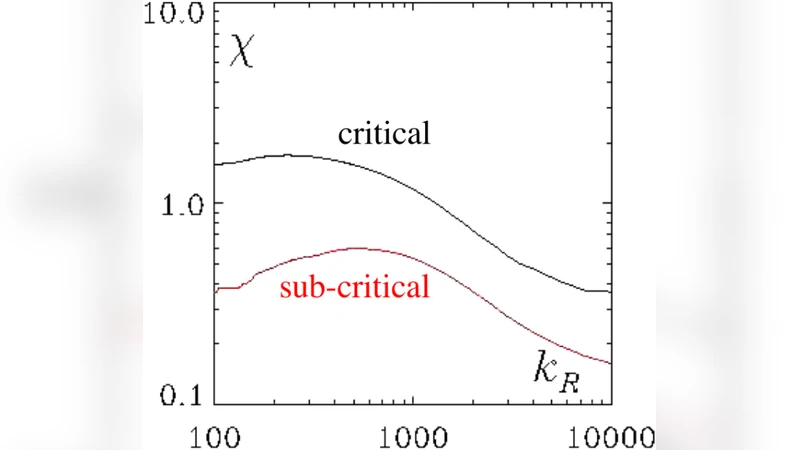
The second set of DNS removes the uniform background field. Even without B₀, the flow develops local anisotropy relative to the instantaneous magnetic field direction. Using second‑order structure functions, the authors find a scale‑dependent relation k∥∝k⊥^{2/3}, consistent with the critical‑balance hypothesis (k∥V_A≈k⊥v_k). However, the measured nonlinearity parameter χ lies between 0.5 and 1, indicating that the turbulence is marginally weak rather than fully strong. The total energy spectrum is close to k⁻³⁄₂, but the difference from a Kolmogorov k⁻⁵⁄³ law is only about ten percent, making a decisive discrimination difficult on spectral slopes alone.
A more robust discriminator is the energy cascade rate ε. IK theory predicts ε_IK∼k³E(k)²/V_A, whereas Kolmogorov predicts ε_K∼k^{5/2}E(k)^{3/2}. The authors compute ε directly from the time derivative of the spectral energy and compare it with both scalings. The DNS data align far better with the IK form: fitting ε∝k³E²/V_A yields a nearly constant coefficient C_IK≈1.8 across resolutions, while fitting ε∝k^{5/2}E^{3/2} requires a coefficient C_K that grows with increasing resolution (C_K≈4.0–4.6). This systematic behavior strongly supports the weak‑turbulence, IK‑type cascade in the simulated flows.
The paper also connects these findings to solar‑wind observations. Vasquez et al. (2007) reported cascade rates at 1 AU that are consistent with the IK prediction and an order of magnitude lower than the Kolmogorov estimate, providing empirical validation of the simulation results.
In summary, the study demonstrates that:
- In the presence of a uniform magnetic field, weak‑turbulence theory predicts an anisotropic perpendicular spectrum E(k⊥)∝k⊥⁻², which is confirmed by high‑resolution DNS.
- Even without a global field, local anisotropy develops relative to the instantaneous magnetic direction, and the global spectrum remains close to the IK k⁻³⁄₂ law.
- Energy cascade rates measured in DNS follow the IK scaling far more faithfully than the Kolmogorov scaling, indicating that the cascade proceeds via many weak wave‑packet collisions rather than a single eddy turnover.
- Observational evidence from the solar wind corroborates the IK‑type cascade rates.
The authors conclude that anisotropy is a fundamental feature of MHD turbulence, that weak‑turbulence theory provides a robust framework for interpreting perpendicular spectra, and that future work should address the more complex 3‑D case where both shear and pseudo Alfvén waves coexist.
Comments & Academic Discussion
Loading comments...
Leave a Comment