On quantum interactive proofs with short messages
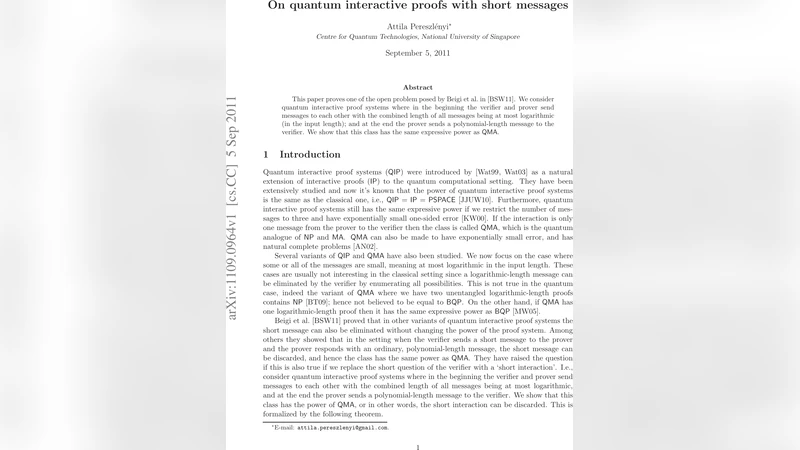
This paper proves one of the open problem posed by Beigi et al. in arXiv:1004.0411v2. We consider quantum interactive proof systems where in the beginning the verifier and prover send messages to each other with the combined length of all messages being at most logarithmic (in the input length); and at the end the prover sends a polynomial-length message to the verifier. We show that this class has the same expressive power as QMA.
💡 Research Summary
The paper addresses an open problem raised by Beigi, Shor, and Watrous (2011) concerning quantum interactive proof systems with short messages. The authors define a model, denoted QIPshort, in which the verifier and prover exchange a sequence of messages at the beginning of the protocol such that the total length of all these messages is bounded by O(log n), where n is the input size. Each of these early messages consists of a single qubit (the verifier’s question and the prover’s answer), and there are at most O(log n) rounds. After this short interaction, the prover sends a final message of polynomial length (poly(n) qubits) to the verifier. The completeness and soundness parameters c(n) and s(n) are polynomial‑time computable functions with a gap c(n)−s(n) ≥ 1/poly(n).
The main theorem states that QIPshort(log n, c, s) = QMA. The inclusion QMA ⊆ QIPshort is trivial because a QMA protocol can be viewed as a one‑round interactive proof with a polynomial‑length prover message and no verifier message. The non‑trivial direction, QIPshort ⊆ QMA, is proved through a two‑stage construction.
Stage 1: Bounding the prover’s private space.
Lemma 3.1 shows that, without loss of generality, the prover’s private register after the i‑th round can be assumed to contain at most 2i qubits that differ from the all‑zero state. The proof proceeds by induction, repeatedly applying suitable unitaries on the verifier’s side to “compress” the prover’s state and keep the acceptance probability unchanged. Consequently, after m = O(log n) rounds the prover’s private space can be limited to O(log n) qubits (Corollary 3.2). This compression is crucial because it makes the prover’s actions describable by a polynomial‑size classical transcript.
Stage 2: Classical description of the prover’s unitaries.
Using the Solovay–Kitaev theorem (Theorem 2.5) and its corollary (Corollary 2.6), each prover unitary U_i acting on at most 2m qubits can be approximated to error 1/(3n) by a quantum circuit C_{U_i,1/3n} composed of O(5·2^m·log³(5·2^m·n)) gates from the universal set {H, T, CNOT}. The total description length of all m circuits is polynomial in n. The QMA verifier receives these classical descriptions as part of the quantum witness.
With these circuit descriptions, the QMA verifier can simulate the first m rounds of the interactive protocol on a quantum computer, thereby preparing an approximation |φ⟩ of the joint state of the prover’s private register, the verifier’s private register, and the last verifier question. The accumulated approximation error is bounded by m·(1/3n) ≤ 1/(2n) for sufficiently large n.
Final round simulation.
In the last round the prover’s behavior is modeled as a quantum channel Φ that maps the joint system (prover’s private register P_m together with the verifier’s last question Q_{m+1}) to the final answer A_{m+1}. The Choi–Jamiołkowski state ρ_Φ of this channel lives on O(log n) input qubits and poly(n) output qubits. The QMA verifier expects to receive N + k copies of ρ_Φ (for suitable polynomial N, k). It randomly permutes these copies, discards all but the first N + 1, performs quantum state tomography on the N copies of the input side to check that they are close to the maximally mixed state (ensuring the copies are indeed independent and correctly prepared), and then simulates Φ on the remaining copy using post‑selection. If any step fails, the verifier rejects.
Because the tomography step guarantees that the copies are close to the ideal Choi state with high probability, and because the simulated channel reproduces the exact behavior of the original prover in the last round, the overall acceptance probability of the QMA verifier matches that of the original QIPshort protocol up to the prescribed completeness‑soundness gap. Hence any language in QIPshort(log n, c, s) has a QMA proof system, establishing the equality of the two classes.
The paper thus shows that even when the verifier and prover engage in a logarithmic‑size quantum dialogue before the final polynomial‑length message, the expressive power does not exceed that of QMA. This result extends the earlier work of Beigi et al., which eliminated a short verifier question but left open the case of a short two‑way interaction. The techniques—compressing the prover’s private space and replacing quantum operations by classical circuit descriptions—provide a useful toolkit for further investigations into the power of limited‑communication quantum interactive proofs.
Comments & Academic Discussion
Loading comments...
Leave a Comment