Systematic effects in the estimate of the local gamma-ray emissivity
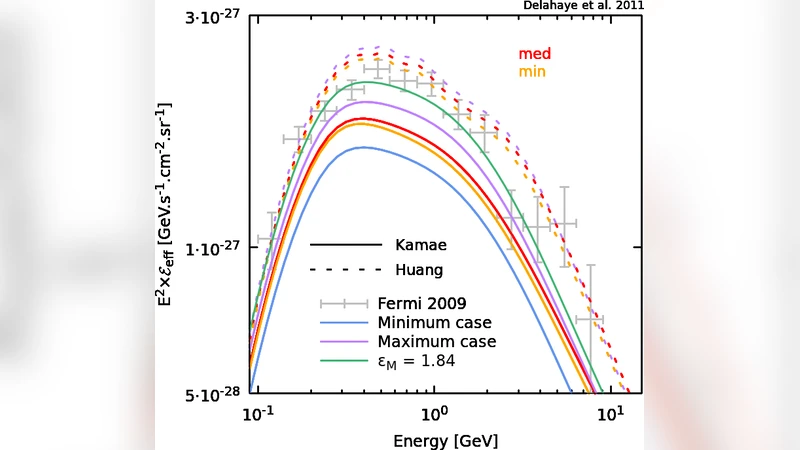
We show in this letter that estimates of the local emissivity of {\gamma}-rays in the GeV-TeV range suffer uncertainties which are of the same order of magnitude as the current Fermi results. Primary cosmic-ray fluxes, cosmic-ray propagation, interstellar helium abundance and {\gamma}-ray production crosssections all affect the estimate of this quantity. We also show that the so-called nuclear enhancement factor – though widely used so far to model the {\gamma}-ray emissivity – is no longer a relevant quantity given the latest measurements of the primary cosmic ray proton and helium spectra.
💡 Research Summary
This paper investigates the systematic uncertainties that affect the determination of the local γ‑ray emissivity in the GeV–TeV range, focusing on the component produced by neutral‑pion (π⁰) decay. The authors start by noting that the Fermi‑LAT measurements of the local emissivity (derived from atomic hydrogen regions at intermediate Galactic latitudes) have been interpreted using a constant nuclear enhancement factor (𝜖_M ≈ 1.84) and the γ‑ray production cross‑sections of Kamae et al. However, newer cross‑section calculations (e.g., Huang et al.) and recent cosmic‑ray (CR) data suggest that this approach may be insufficient.
The study proceeds by defining the effective emissivity per hydrogen atom, E_eff, as a convolution of the CR fluxes (protons and α‑particles) with the γ‑ray production cross‑sections for each target nucleus in the interstellar medium (ISM). Four main sources of systematic error are examined:
-
Primary CR spectra – The authors adopt several recent measurements (BESS, CREAM, ATIC, PAMELA) and provide a new fit to the PAMELA data, including a force‑field solar modulation with a Fisk potential of 500 MV. Because the α‑to‑proton ratio rises with rigidity above ~100 GV, the nuclear enhancement factor becomes energy‑dependent, varying by more than 30 % between 1 GeV and 1 TeV.
-
CR propagation – Using the propagation parameter sets (min, med, max) identified in earlier work (Donato et al.), they compute the CR density gradient within ~1 kpc of the Sun, the region that dominates the Fermi‑LAT emissivity measurement. Depending on the propagation model and the assumed source distribution (Lorimer vs. Paczynski), the local emissivity can differ by up to 10 % at energies above 10 GeV.
-
ISM metallicity (He/H ratio) – Observations and Galactic chemical‑evolution models indicate that the helium‑to‑hydrogen number ratio varies from ≈0.111 at the Galactic centre to ≈0.087 in the outer disc, with a local value near 0.097. Since p+He and α+He collisions contribute roughly 20 % and 5 % of the total γ‑ray signal, a 20 % change in He/H translates into about a 5 % variation of the emissivity.
-
γ‑ray production cross‑sections – The authors compare two widely used Monte‑Carlo based models: Kamae et al. (based on PYTHIA 6) and Huang et al. (based on DPMJET‑3). The latter includes resonant structures and yields emissivities up to 50 % higher than the Kamae model, especially at higher energies. The choice of nuclear weighting (Norbury & Townsend vs. other prescriptions) also introduces non‑negligible differences.
By varying each ingredient independently, the authors quantify the resulting spread in the predicted emissivity. The primary CR spectrum contributes ≈45 % uncertainty, propagation ≈10 %, He/H ratio ≈5 %, and cross‑section/model choice between 10 % and 50 % depending on energy. When combined, the total theoretical uncertainty reaches 45 %–50 %, comparable to or larger than the statistical errors reported by Fermi‑LAT (4 %–30 %). Moreover, the Fermi data stop at 10 GeV, whereas the model divergences become most pronounced at higher energies, underscoring the need for extended observations (e.g., CTA, DAMPE).
A key conclusion concerns the nuclear enhancement factor. Traditionally treated as a constant scaling factor to account for heavier nuclei in both CRs and the ISM, the authors demonstrate that 𝜖_M is intrinsically energy‑dependent because the α/ p ratio is not constant. Figure 2 shows variations exceeding 30 % across the relevant energy range, rendering the constant‑𝜖_M approximation obsolete for precise modeling.
In summary, the paper argues that achieving the full potential of high‑precision γ‑ray measurements requires parallel improvements in CR spectral measurements, propagation modeling, ISM composition knowledge, and up‑to‑date γ‑ray production cross‑sections. The authors call for the community to abandon the simplistic constant nuclear enhancement factor and to incorporate the full energy dependence of all relevant inputs in future diffuse‑emission models.
Comments & Academic Discussion
Loading comments...
Leave a Comment