Rooted-tree Decompositions with Matroid Constraints and the Infinitesimal Rigidity of Frameworks with Boundaries
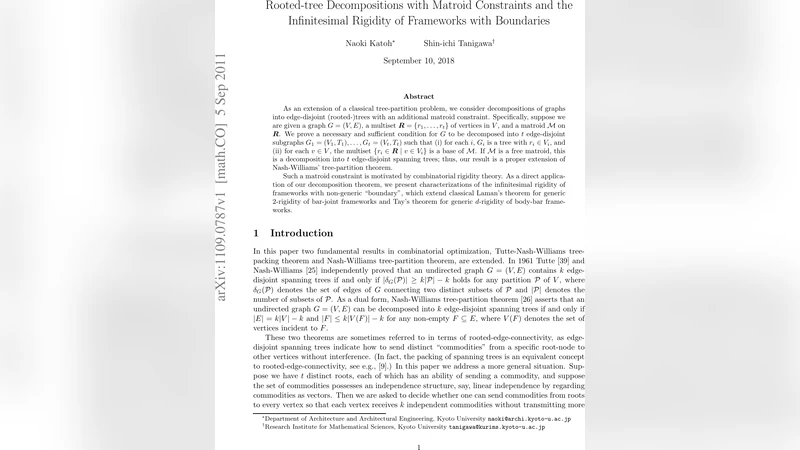
As an extension of a classical tree-partition problem, we consider decompositions of graphs into edge-disjoint (rooted-)trees with an additional matroid constraint. Specifically, suppose we are given a graph $G=(V,E)$, a multiset $R={r1,…, r_t}$ of vertices in $V$, and a matroid ${\cal M}$ on $R$. We prove a necessary and sufficient condition for $G$ to be decomposed into $t$ edge-disjoint subgraphs $G_1=(V_1,T_1),…, G_t=(V_t,T_t)$ such that (i) for each $i$, $G_i$ is a tree with $r_i\in V_i$, and (ii) for each $v\in V$, the multiset ${r_i\in R\mid v\in V_i}$ is a base of ${\cal M}$. If ${\cal M}$ is a free matroid, this is a decomposition into $t$ edge-disjoint spanning trees; thus, our result is a proper extension of Nash-Williams’ tree-partition theorem. Such a matroid constraint is motivated by combinatorial rigidity theory. As a direct application of our decomposition theorem, we present characterizations of the infinitesimal rigidity of frameworks with non-generic “boundary”, which extend classical Laman’s theorem for generic 2-rigidity of bar-joint frameworks and Tay’s theorem for generic $d$-rigidity of body-bar frameworks.
💡 Research Summary
The paper studies a natural generalization of the classical tree‑partition and tree‑packing theorems by introducing a matroid constraint on the set of roots. Given an undirected graph G = (V,E), a multiset R = {r₁,…,r_t} ⊆ V of designated root vertices, and a matroid M on R with rank k, the authors ask when G can be decomposed into t edge‑disjoint rooted trees (T_i, r_i) such that for every vertex v ∈ V the multiset {r_i | v ∈ V(T_i,r_i)} forms a basis of M. This notion is called a basic rooted‑tree decomposition.
The main result (Theorem 1.2) gives a clean necessary and sufficient condition consisting of three parts:
- (C1) For each vertex v, the set of roots that are exactly v (i.e., R_v) must be independent in M.
- (C2) For every non‑empty edge set F ⊆ E, the inequality
|F| + |R_F| ≤ k·|V(F)| − k + r_M(R_F)
must hold, where R_F is the multiset of roots incident to F and r_M is the rank function of M. - (C3) The global count must satisfy |E| + |R| = k·|V|.
When M is the free matroid (every subset of R is independent and has rank |R|), k = t and (C1)–(C3) reduce exactly to Nash‑Williams’ tree‑partition theorem, showing that the new theorem truly extends the classical result.
The proof proceeds in two directions. The necessity is straightforward: a basic decomposition yields a directed arborescence for each rooted tree; counting incoming arcs together with the roots incident to each vertex gives (C3), while a cut‑set argument on any edge subset F produces (C2). The sufficiency is more involved. The authors first observe that condition (C2) can be expressed as a submodular function inequality, allowing it to be checked in polynomial time via submodular function minimisation. Then they construct a matroid intersection instance whose independent sets correspond to partial rooted‑tree packings respecting the matroid bases at each vertex. Using the polynomial‑time matroid‑intersection algorithm they obtain a maximal packing; the equality in (C3) guarantees that this packing is in fact a full basic decomposition.
A dual formulation (Theorem 5.1) is also provided, showing that the theorem can be viewed as a matroid‑union type statement, analogous to Tutte‑Nash‑Williams tree‑packing.
The combinatorial framework is applied to rigidity theory. Classical Laman’s theorem characterises generic infinitesimal rigidity of 2‑dimensional bar‑joint frameworks via the same counting condition as Nash‑Williams (k = 2). Tay’s theorem gives a similar characterisation for generic d‑dimensional body‑bar frameworks (k = d + 1). However, both results assume the underlying placement is generic, which is unrealistic when some joints or bodies are fixed to the ground (pins, sliders, or bars with prescribed directions). By interpreting the fixed elements as “boundary” vertices whose incident roots are pre‑specified, the authors show that the same counting conditions (C1)–(C3) become necessary for infinitesimal rigidity even without genericity of the boundary. Moreover, the existence of a basic rooted‑tree decomposition guarantees sufficiency. Consequently, they obtain extensions of Laman’s and Tay’s theorems to:
- Bar‑joint frameworks with bar‑boundary in ℝ² (fixed bar directions);
- Bar‑joint frameworks with pin‑boundary in ℝ² (fixed joint positions);
- Bar‑joint frameworks with slider‑boundary in ℝ² (fixed slider directions);
- Body‑bar frameworks with bar‑boundary in ℝᵈ;
- Body‑bar frameworks with pin‑boundary in ℝᵈ.
These results subsume recent work by Servatius, Shai and Whiteley on pinned bar‑joint frameworks and generalise earlier observations by Streinu and Theran on slider‑boundary frameworks.
The paper also discusses algorithmic aspects: checking (C2) reduces to submodular function minimisation, and constructing the decomposition can be done via matroid intersection in polynomial time. The authors note that while (C2) alone can be handled by matroid intersection, the full theorem does not follow directly from the matroid‑union theorem because the matroid M may not decompose into a direct sum of rank‑1 matroids.
In summary, the work provides a powerful combinatorial tool—basic rooted‑tree decomposition with matroid constraints—that unifies and extends classical tree‑packing results and rigidity characterisations, and offers efficient algorithms for both verification and construction. It opens avenues for further extensions to other types of constraints (e.g., hypergraphs, dynamic networks) and for practical applications in engineering where non‑generic boundary conditions are the norm.
Comments & Academic Discussion
Loading comments...
Leave a Comment