Une lettre dHenri Lebesgue `a Elie Cartan
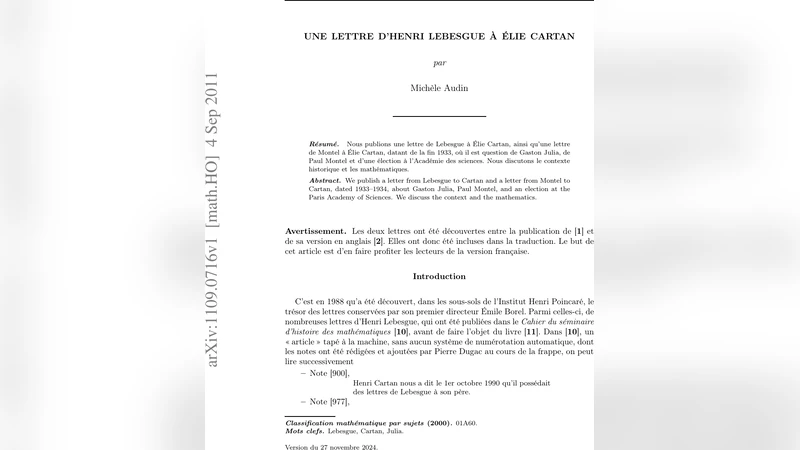
We publish a letter from Lebesgue to Cartan and a letter from Montel to Cartan, dated 1933–1934, about Gaston Julia, Paul Montel, and an election at the Paris Academy of Sciences. We discuss the context and the mathematics. The two letters have been discovered between the publication of the book “Fatou, Julia, Montel, le Grand prix des sciences math'ematiques de 1918 et apr`es” (Springer 2009) and the publication of the English translation (Springer 2011). They have been included in the translation. This paper is dedicated to the readers of the French version.
💡 Research Summary
The paper presents two previously unpublished letters—one from Henri Lebesgue and one from Paul Montel—addressed to Élie Cartan and dated around the 1933‑34 election of Gaston Julia to the Paris Academy of Sciences. The letters were discovered after the 2009 French monograph on Fatou, Julia, and Montel and were included in the 2011 English translation; the authors make them available to French‑language readers.
The first letter, unsigned with a precise date, can be placed between early November 1933 and January 1934 based on internal references. Lebesgue writes from a feverish bed, explains his inability to meet Julia, and launches a detailed critique of Montel’s claim to have “generalised Lindelöf.” Lebesgue insists that the results Montel attributes to himself are essentially those of Poincaré, and that the “Lindelöf‑type” theorem used by Julia in his 1932 Zurich plenary talk does not rely on Montel’s work. He also points out that Julia, a severely wounded World‑I veteran, enjoys a sympathetic bias that may distort a fair scientific assessment. Lebesgue’s tone is personal, moralistic, and infused with the bitterness he felt after withdrawing from Academy sessions in protest against what he perceived as political manipulation of elections.
The second letter, dated 24 December 1933, is Montel’s reply. Montel defends his theory of normal families, arguing that it is indispensable for the iteration theory developed by Julia and Fatou. He rebuts Lebesgue’s accusation that his results are merely a “Scandinavian method” and stresses that his own contributions are original, not a simple re‑phrasing of Lindelöf. Montel also references his long‑standing conflict with Borel and the broader power struggle within the Academy, especially with Émile Picard, to illustrate how personal rivalries can influence scientific decisions. He stresses that the Academy’s election should be based on pure scientific merit, not on wartime sympathies or personal vendettas.
Beyond the polemics, the letters illuminate the mathematical landscape of the early 1930s. Lebesgue’s discussion of Betti numbers (B₁ = B₃ = 1, B₂ = 2?) and of the topology of complex varieties shows his continued interest in global analysis, while Montel’s emphasis on normal families reflects the central role of Montel’s theorem in the development of complex dynamics. The debate over priority—whether Julia’s iteration results depend fundamentally on Montel’s normal‑family theory or can be derived independently—mirrors later “priority disputes” that have shaped the historiography of mathematics.
Historically, the paper situates the letters within the broader context of the Academy’s 1934 election to replace the late Paul Painlevé. Julia was ultimately elected on 5 March 1934, a decision that Lebesgue found unjust, prompting his temporary boycott of Academy meetings. The correspondence also reveals how the aftermath of World I, personal health, and academic politics intertwined: Julia’s war injury, Lebesgue’s resentment toward Picard, Montel’s rivalry with Borel, and the shifting power dynamics among French mathematicians.
The authors conclude that these manuscripts are valuable primary sources for understanding the interplay of mathematics, personality, and institutional politics in interwar France. By publishing the full texts with explanatory notes, they provide scholars with material to reassess the scientific contributions of Julia, Montel, and Lebesgue, as well as the ethical standards and decision‑making processes of the Paris Academy of Sciences during a turbulent period.
Comments & Academic Discussion
Loading comments...
Leave a Comment