A KIF Formalization for the IFF Category Theory Ontology
This paper begins the discussion of how the Information Flow Framework can be used to provide a principled foundation for the metalevel (or structural level) of the Standard Upper Ontology (SUO). This SUO structural level can be used as a logical framework for manipulating collections of ontologies in the object level of the SUO or other middle level or domain ontologies. From the Information Flow perspective, the SUO structural level resolves into several metalevel ontologies. This paper discusses a KIF formalization for one of those metalevel categories, the Category Theory Ontology. In particular, it discusses its category and colimit sub-namespaces.
💡 Research Summary
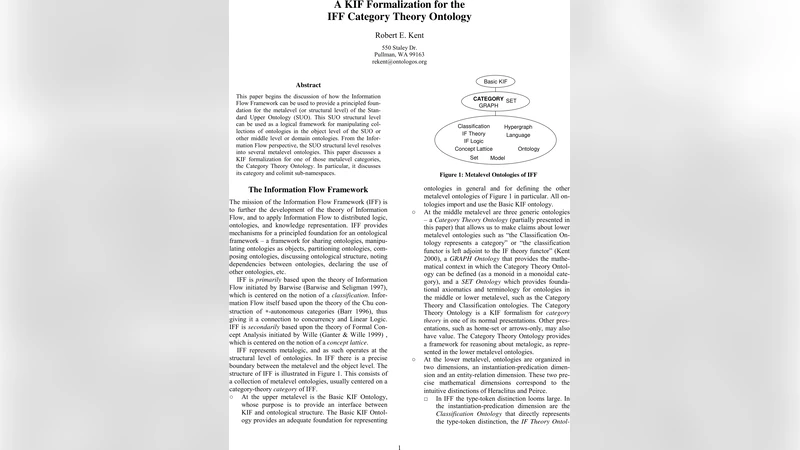
The paper presents a detailed formalization of a Category Theory Ontology using the Knowledge Interchange Format (KIF) within the Information Flow Framework (IFF), aiming to provide a principled metalevel foundation for the Standard Upper Ontology (SUO). The IFF is organized into three hierarchical layers: an upper metalevel containing the Basic KIF Ontology that bridges KIF syntax with ontological structure; a middle metalevel comprising three generic ontologies—Category Theory, GRAPH, and SET—that supply the mathematical scaffolding; and a lower metalevel that hosts concrete ontologies such as Classification, IF Theory, Hypergraph, and Language.
The Category Theory Ontology is positioned in the middle layer and imports terms from the Basic KIF, SET, and GRAPH ontologies (e.g., “function”, “class”, “graph”, “object”, “morphism”). It defines a category as a monoid in the 2‑dimensional quasi‑category of large graphs: a category C is a triple ⟨C, μ_C, η_C⟩ where μ_C is a graph‑morphism representing composition and η_C is a graph‑morphism representing identities. KIF functions “underlying”, “mu”, and “eta” expose the underlying graph, the composition morphism, and the identity morphism, respectively.
Subsequent KIF definitions introduce the usual categorical constituents: object, morphism, source, target, composable‑opspan, and composable. These are linked to SET classes and functions, ensuring that the categorical notions are grounded in the underlying SET ontology. The paper provides explicit KIF axioms for the preservation of source and target under composition and identity, and encodes the associative law and left/right unit laws both as commutative diagrams (in the graph‑morphism world) and as KIF equalities involving the functions “composition” and “identity”.
The opposite category construction is formalized via a KIF function “opposite”. It reverses source and target, swaps the order of composition (m₂ ◦_op m₁ = m₁ ◦ m₂), and retains the same objects. An involution theorem (opposite(opposite(C)) = C) is proved as a KIF axiom, demonstrating the symmetry of the construction.
Monomorphisms, epimorphisms, and isomorphisms are defined using right‑cancellability, left‑cancellability (via the opposite category), and the conjunction of both properties, respectively. The corresponding KIF functions and axioms capture these notions as subclasses of the morphism class, with universal quantification over parallel morphisms to express cancellability.
Although the paper’s space constraints limit the exposition of functors, natural transformations, adjunctions, and limits, it outlines a separate “colimit” namespace. The authors argue that colimits provide a “building‑blocks” approach to ontology construction, making merging, mapping, and alignment of ontological components explicit and analyzable. The colimit namespace is intended to draw on all basic categorical components (objects, morphisms, diagrams, cocones, etc.) to support compositional ontology engineering at the object level.
Overall, the contribution lies in demonstrating how a mature mathematical theory—category theory—can be encoded in a logic‑based interchange language (KIF) and integrated into a layered ontological framework (IFF). By grounding categories, functors, and related constructs in graph‑based primitives and by providing a suite of KIF axioms, the work offers a reusable, formally verified foundation for higher‑order ontology manipulation, reasoning about meta‑ontologies, and systematic construction of complex domain ontologies. This bridges the gap between abstract categorical semantics and practical ontology engineering, paving the way for automated reasoning services that operate across multiple ontological layers.
Comments & Academic Discussion
Loading comments...
Leave a Comment