DNA Lossless Differential Compression Algorithm based on Similarity of Genomic Sequence Database
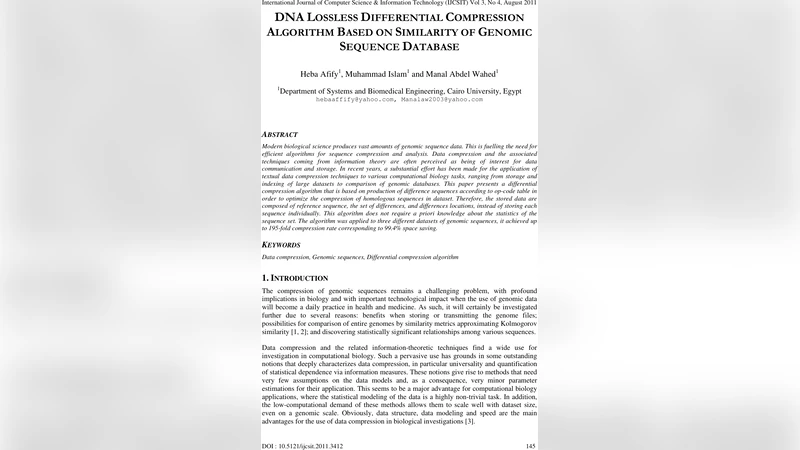
Modern biological science produces vast amounts of genomic sequence data. This is fuelling the need for efficient algorithms for sequence compression and analysis. Data compression and the associated techniques coming from information theory are often perceived as being of interest for data communication and storage. In recent years, a substantial effort has been made for the application of textual data compression techniques to various computational biology tasks, ranging from storage and indexing of large datasets to comparison of genomic databases. This paper presents a differential compression algorithm that is based on production of difference sequences according to op-code table in order to optimize the compression of homologous sequences in dataset. Therefore, the stored data are composed of reference sequence, the set of differences, and differences locations, instead of storing each sequence individually. This algorithm does not require a priori knowledge about the statistics of the sequence set. The algorithm was applied to three different datasets of genomic sequences, it achieved up to 195-fold compression rate corresponding to 99.4% space saving.
💡 Research Summary
The paper presents a loss‑less differential compression method tailored for genomic sequence databases that contain many homologous sequences. Instead of storing each full DNA string, the approach stores a single reference genome together with a compact representation of the differences (insertions, deletions, and substitutions) between each target sequence and the reference. The authors define an operation‑code (op‑code) table with nine symbols (0–8) to encode the type of variation at each position: “0” for identity, “1–3” for three possible substitution categories, “4” for deletion, and “5–8” for the four possible insertions (G, A, C, T).
The compression pipeline consists of three stages. First, each target sequence is locally aligned to the reference using a standard alignment algorithm (the exact algorithm is not specified). This alignment introduces gaps that correspond to insertions or deletions, allowing homologous positions to be placed in the same column. Second, the aligned sequences are scanned position by position; for every mismatch the appropriate op‑code is recorded, and the absolute position (relative to the unaligned reference) is stored in a location vector. Insertions do not advance the reference position, while all other operations do. Third, the op‑code stream and the location vector are compressed separately. The op‑code stream is encoded with Huffman coding and also with the ZLIB deflator; the location vector is transformed into a series of inter‑position distances and compressed with ZLIB. Compression ratio (compressed size / original size) and space saving (1 – ratio) are used as evaluation metrics.
Three publicly available datasets were used for evaluation: (1) 3,615 human mitochondrial genomes (≈56 MB), (2) 500 H1N1 influenza virus genomes (≈601 KB), and (3) 100 Mus musculus sequences (≈1 MB). The Cambridge reference sequence (NC_012920) served as the reference for the mitochondrial set, HM17663 for the virus set, and AJ843867 for the mouse set. Results show that the mitochondrial dataset, which exhibits >99 % identity among its members, can be reduced from 56 MB to 294.3 KB—a 195‑fold compression (99.4 % space saving). The virus dataset compresses to 212.9 KB (≈3‑fold) and the mouse dataset to 9.6 KB (≈11‑fold). In the mitochondrial case, ZLIB achieved a better compression ratio for the op‑code stream than Huffman; for the virus and mouse data Huffman performed slightly better. The location vectors were always compressed with ZLIB.
The study highlights the potential of differential compression when the sequences are highly similar, confirming that storing only the variations can dramatically reduce storage requirements. However, several limitations are evident. The reference‑selection process is manual; no algorithmic strategy for choosing an optimal reference is discussed. The alignment method is not described in detail, hindering reproducibility. No comparative benchmarks against existing DNA compressors (e.g., GenCompress, DNACompress, DNAzip, GRS) are provided, nor are runtime, memory consumption, or decompression speed measured. The nine‑symbol op‑code scheme may be insufficient for representing complex structural variants such as large inversions, translocations, or reverse‑complement matches.
Future work should address automatic reference selection, support for higher‑order variants, and a thorough performance comparison with state‑of‑the‑art DNA compressors. Additionally, profiling of compression/decompression time and resource usage would be essential for practical deployment in large‑scale genomic repositories. With these enhancements, the proposed differential compression framework could become a valuable tool for efficient storage, transmission, and downstream analysis of massive genomic databases.
Comments & Academic Discussion
Loading comments...
Leave a Comment