Robust Adaptive Geometric Tracking Controls on SO(3) with an Application to the Attitude Dynamics of a Quadrotor UAV
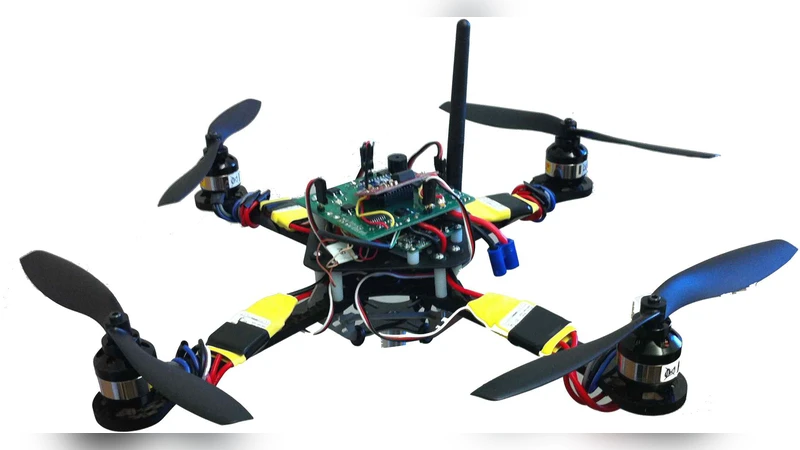
This paper provides new results for a robust adaptive tracking control of the attitude dynamics of a rigid body. Both of the attitude dynamics and the proposed control system are globally expressed on the special orthogonal group, to avoid complexities and ambiguities associated with other attitude representations such as Euler angles or quaternions. By designing an adaptive law for the inertia matrix of a rigid body, the proposed control system can asymptotically follow an attitude command without the knowledge of the inertia matrix, and it is extended to guarantee boundedness of tracking errors in the presence of unstructured disturbances. These are illustrated by numerical examples and experiments for the attitude dynamics of a quadrotor UAV.
💡 Research Summary
The paper presents a globally defined, robust adaptive tracking controller for the attitude dynamics of a rigid body, with a particular focus on quadrotor UAVs. Traditional attitude representations such as Euler angles suffer from singularities, while quaternions suffer from double‑covering and unwinding issues. To avoid these problems, the authors formulate both the dynamics and the control law directly on the special orthogonal group SO(3), which is the configuration manifold of a rotating body.
The rigid‑body dynamics are expressed as
J Ω̇ + Ω×JΩ = u + Δ, Ṙ = R Ω̂,
where R∈SO(3) is the rotation matrix, Ω∈ℝ³ the body‑fixed angular velocity, J the (unknown) symmetric positive‑definite inertia matrix, u the control torque, and Δ a bounded disturbance. The “hat” map converts vectors to skew‑symmetric matrices and its inverse “vee” recovers vectors.
A configuration error function Ψ(R,R_d)=½ tr
Comments & Academic Discussion
Loading comments...
Leave a Comment