Critical Aspects of Modern Open Source SoftwareTechnology to Support Emerging Demands
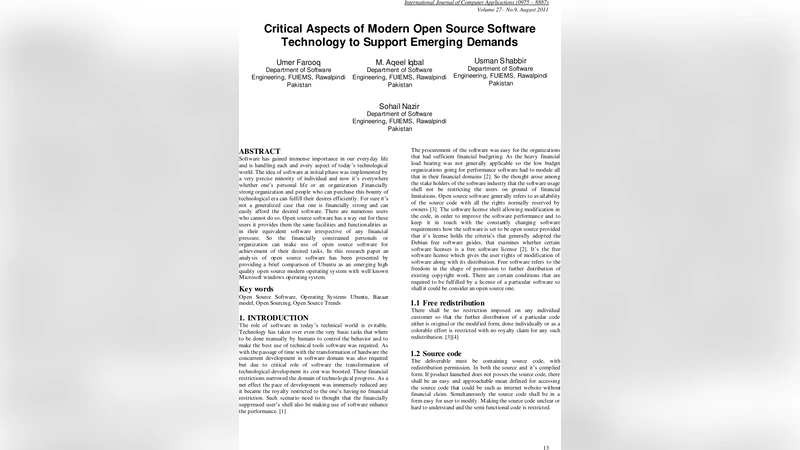
Software has gained immense importance in our everyday lifeand is handling each and every aspect of today’s technologicalworld. The idea of software at initial phase was implemented bya very precise minority of individual and now it’s everywherewhether one’s personal life or an organization .Financiallystrong organization and people who can purchase this bounty oftechnological era can fulfill their desires efficiently. For sure it’s not a generalized case that one is financially strong and caneasily afford the desired software. There are numerous userswho cannot do so. Open source software has a way out for theseusers it provides them the same facilities and functionalities asin their equivalent software irrespective of any financialpressure. So the financially constrained personals ororganization can make use of open source software forachievement of their desired tasks. In this research paper ananalysis of open source software has been presented byproviding a brief comparison of Ubuntu as an emerging highquality open source modern operating system with well knownMicrosoft windows operating system
💡 Research Summary
The paper titled “Critical Aspects of Modern Open Source Software Technology to Support Emerging Demands” attempts to argue that open‑source software (OSS) provides a cost‑effective alternative to proprietary solutions, especially for financially constrained individuals and organizations. It begins with a broad statement about the pervasive role of software in modern life and notes that while early software development was limited to a small elite, today software touches every aspect of personal and corporate activity. The authors claim that the high price of commercial software creates a barrier for many users, and OSS removes that barrier by offering comparable functionality without licensing fees.
The core of the paper is a discussion of OSS licensing. Ten “principles” are listed, covering free redistribution, source‑code availability, permission to create derivative works, non‑discrimination, and the prohibition of royalty claims. The authors compare several well‑known licenses—BSD, GPL, LGPL, MIT, and MPL—using a tabular format that indicates which rights each license grants. The emphasis is on the legal freedom to modify and redistribute code, which the authors argue encourages innovation and reduces dependency on vendors.
Next, the authors introduce the “Bazaar model” of software development, contrasting it with the traditional “Cathedral model.” In the Bazaar model, an early prototype is released publicly, and a distributed community of developers contributes code, reports bugs, and proposes new features in parallel. The paper claims that this model leads to rapid bug detection, a large pool of contributors, and many derivative products. However, the discussion lacks depth on the practical challenges of such a model—version‑control complexity, quality assurance, security auditing, and governance—issues that are well documented in the OSS literature.
The paper then attempts a comparison between Ubuntu (as a representative modern OSS operating system) and Microsoft Windows (the dominant proprietary OS). The authors assert that Ubuntu offers high quality, flexibility, and zero licensing cost, while Windows provides extensive commercial support and broader hardware compatibility. No empirical performance data, user‑experience studies, or cost‑benefit analyses are presented; the comparison remains at a superficial, descriptive level.
In the “Pros and Cons” section, the authors list several advantages of OSS: reliability (bugs are quickly found and fixed by a large community), stability (continuous peer review), availability (free download worldwide), auditability (source code transparency improves security), and financial savings (no license fees). They also note disadvantages: the need for technical expertise to effectively use and modify the software (“software kills”), process opacity due to many contributors, potential imbalance between developers and end‑users, higher maintenance effort for organizations that must manage updates and security patches, and difficulties in guaranteeing consistent quality across disparate contributions.
The conclusion reiterates that OSS can democratize access to technology for financially limited users, but successful adoption requires careful license selection, active community participation, and robust quality and security management practices. The authors suggest future work should include quantitative performance benchmarks between Ubuntu and Windows, detailed cost‑benefit analyses, and systematic security vulnerability assessments.
Overall, the paper provides a high‑level overview of OSS concepts, licensing, and development philosophy, but it suffers from numerous typographical and grammatical errors, a lack of methodological rigor, and an absence of empirical evidence. It reads more like an exploratory essay than a scholarly study. For readers seeking an introductory understanding of OSS principles, the paper offers some useful terminology, yet for policymakers or researchers needing solid data, further rigorous investigation is required.
Comments & Academic Discussion
Loading comments...
Leave a Comment