The Wecken property for random maps on surfaces with boundary
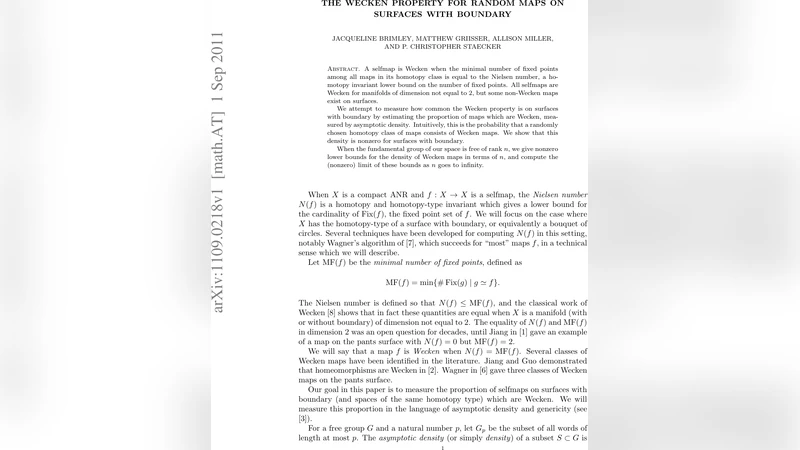
A selfmap is Wecken when the minimal number of fixed points among all maps in its homotopy class is equal to the Nielsen number, a homotopy invariant lower bound on the number of fixed points. All selfmaps are Wecken for manifolds of dimension not equal to 2, but some non-Wecken maps exist on surfaces. We attempt to measure how common the Wecken property is on surfaces with boundary by estimating the proportion of maps which are Wecken, measured by asymptotic density. Intuitively, this is the probability that a randomly chosen homotopy class of maps consists of Wecken maps. We show that this density is nonzero for surfaces with boundary. When the fundamental group of our space is free of rank n, we give nonzero lower bounds for the density of Wecken maps in terms of n, and compute the (nonzero) limit of these bounds as n goes to infinity.
💡 Research Summary
The paper investigates how frequently the Wecken property occurs for self‑maps of surfaces with boundary. A map is called Wecken when its Nielsen number N(f) – a homotopy invariant lower bound for the number of fixed points – coincides with the minimal possible number of fixed points MF(f) among all maps homotopic to f. While every self‑map on a manifold of dimension ≠2 is Wecken, there are known non‑Wecken examples on 2‑dimensional manifolds (surfaces). The authors ask: what is the “probability” that a randomly chosen homotopy class of maps on a surface with boundary consists of Wecken maps?
To make this precise they use the notion of asymptotic density (also called genericity) in free groups. The fundamental group of a surface with boundary is a free group F_n of rank n. A homotopy class of a self‑map corresponds uniquely to an endomorphism φ : F_n → F_n, so the problem reduces to estimating the density of Wecken endomorphisms among all endomorphisms of F_n.
The key technical tool is Wagner’s algorithm for computing Nielsen numbers on bouquets of circles. For an endomorphism φ with the “remnant” property (a generic condition proved by Brown to hold on a set of density 1), Wagner defines for each occurrence of a generator a_i in φ(a_i) a pair of “Wagner tails” w, w̄. Two fixed points are directly related when the corresponding tail‑pairs intersect; indirect relation is the transitive closure of direct relation. Wagner proved that the number of equivalence classes of fixed points with non‑zero index sum equals N(φ). Consequently, if all Wagner tails are distinct (except for the trivial tail at the wedge point), each fixed point lies in its own essential Nielsen class, giving N(φ)=MF(φ); i.e., φ is Wecken. This observation yields a simple sufficient condition: tail‑distinct endomorphisms are Wecken.
The authors define V_n as the set of tail‑distinct endomorphisms of F_n, W_n as the set of all Wecken endomorphisms, and R_n as the set of endomorphisms with remnant. Since R_n is generic, D(V_n∩R_n)=D(V_n) and V_n∩R_n⊂W_n, we have D(V_n)≤D(W_n). Thus any lower bound on D(V_n) immediately gives a lower bound on the density of Wecken maps.
The paper proceeds in two parts. First, for n=2 (the “pair‑of‑pants” surface) they analyze Wagner’s three Wecken classes T₂, T₄, T₅. T₅ has density zero because it lacks remnant. T₂ splits into two sub‑classes T_{2a} and T_{2b} (and a symmetric T_{2b}′). By counting admissible assignments of first/last letters and interior letters of the images φ(a), φ(b), they obtain explicit asymptotic densities:
- D(T_{2a}) ≥ 2/27,
- D(T_{2b}) ≥ 1/24,
- D(T_{2b}′) ≥ 1/24. Hence D(W₂) ≥ 2/27 + 1/24 ≈ 0.129, establishing that a positive proportion of endomorphisms of F₂ are Wecken.
Second, for general n≥3 they introduce the notion of a “simple” endomorphism. Let S_φ be the set consisting of each φ(a_i) and its inverse. S_φ is simple if there exists a word U such that for any distinct x, y∈S_φ either the maximal common initial subword M(x,y) is trivial or equals U. Simple endomorphisms automatically have distinct Wagner tails, so they lie in V_n. By combinatorial counting of words of length ≤p that satisfy the simplicity condition, they derive a lower bound c_n on D(V_n). The bound is expressed in terms of n and tends to e^{‑3}≈0.0497 as n→∞. More refined analysis (Theorem 11) improves the bound, and computer experiments suggest the true limit is at least e^{‑2}≈0.1353, possibly as high as e^{‑1}≈0.3679.
The authors supplement the theoretical work with extensive computer simulations. Random endomorphisms of F_n are generated for various n (2, 3, 4, 5, 10, 20, 50) and word lengths p up to 14. The proportion that belong to V_n is recorded (Table 3). The data show a clear trend: D(V_n) is non‑zero for all n, appears to increase with n, and seems to converge to a value well below 1. The experimental curves are plotted alongside the theoretical lower bounds, confirming that the bounds are indeed conservative.
In summary, the paper establishes several new facts about the prevalence of the Wecken property on surfaces with boundary:
- For every rank n≥2, the asymptotic density of Wecken endomorphisms of F_n is strictly positive; thus a randomly chosen homotopy class of self‑maps on a surface with boundary is Wecken with non‑zero probability.
- The density does not vanish as n grows; in fact it approaches a positive constant (at least e^{‑3}) and empirical evidence points to a larger limit.
- The tail‑distinct condition provides a practical, algorithmic criterion for verifying the Wecken property, and the simplicity condition gives a tractable subclass whose density can be estimated combinatorially.
- The work bridges fixed‑point theory, combinatorial group theory, and probabilistic methods, opening avenues for further study of generic properties of maps on low‑dimensional manifolds.
Comments & Academic Discussion
Loading comments...
Leave a Comment